I usually explain it to patients this way: grading an embryo by eye under the microscope is like judging a person by their outward appearance, you can tell someone looks fit and healthy, but you have no way of knowing what’s happening on the inside. PGT-A is how we open up the genetic blueprint hidden deep inside the cells. Even a beautiful, top-grade embryo can fail to implant or implant and later miscarry, if its chromosome count is off. I’ve put together this in-depth guide so parents can understand exactly what this process involves.
Quick Answer
| Question | Answer |
|---|---|
| What is PGT-A? | Preimplantation Genetic Testing for Aneuploidies, a technology that screens embryos for chromosome number abnormalities before transfer, previously known as PGS. |
| Why does it matter for ICSI/IVF? | A visually perfect embryo can still carry the wrong number of chromosomes, which can prevent implantation or lead to later miscarriage, PGT-A catches this before transfer. |
| Is the biopsy safe for the embryo? | Yes. Only 5-8 cells are removed from the trophectoderm (the layer that becomes the placenta), not from the inner cell mass that becomes the baby. |
| How long do results take? | Typically 14-21 days after biopsy. |
| What does PGT-A cost? | ฿39,900 for the first embryo and ฿15,900 for each additional embryo, you can choose to test only your best-graded embryos rather than all of them. |
| Who is it recommended for? | Most strongly for mothers 35+, couples with recurrent miscarriage, repeated implantation failure, or a family history of genetic conditions. |
What Is PGT-A, and Why Is It Key to ICSI Success?
PGT-A (Preimplantation Genetic Testing for Aneuploidies), known in the past as PGS, is a technology that screens for chromosome number abnormalities in a human embryo before it’s transferred into the uterus.
Naturally, humans have 23 pairs of chromosomes (46 total): 22 pairs of autosomes and one pair of sex chromosomes (XX for female, XY for male). If an error occurs during egg or sperm cell division, the resulting embryo can end up with too many or too few chromosomes, a condition called aneuploidy, which has a direct and serious impact on IVF/ICSI success:
- Extra chromosomes: The most well-known example is an extra copy of chromosome 21 (Trisomy 21), which causes Down syndrome. An extra chromosome 13 (Patau syndrome) or 18 (Edwards syndrome) typically causes severe abnormalities, often resulting in loss of the pregnancy before or shortly after birth.
- Missing chromosomes: For example, a missing X chromosome (Turner syndrome, 45 chromosomes total) results in short stature, underdeveloped ovaries, and infertility later in life.
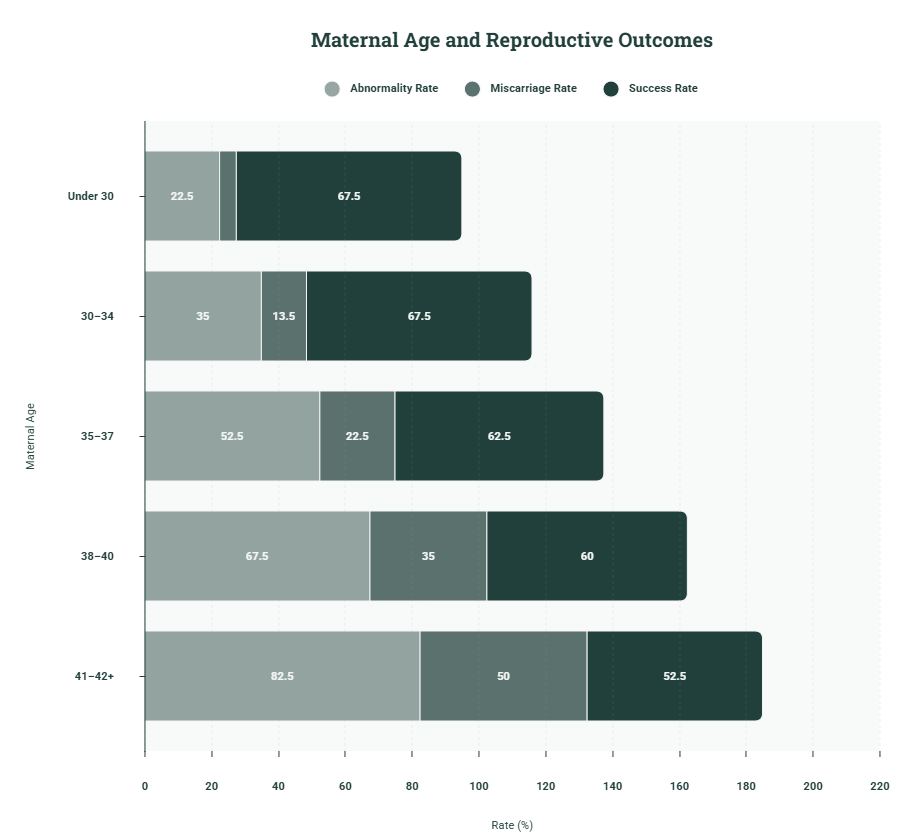
Chromosome Abnormality Rates by Maternal Age
The single biggest factor affecting embryo chromosome abnormality is maternal age, as a woman gets older, egg cell division becomes more prone to error. The general pattern reported in reproductive medicine literature looks like this:
| Maternal Age | Embryo Chromosome Abnormality Rate | Natural Miscarriage Rate | Success Rate When Transferring a PGT-A-Normal Embryo |
|---|---|---|---|
| Under 30 | ~20–25% | Under 10% | Up to 65–70% |
| 30–34 | ~30–40% | ~12–15% | Up to 65–70% |
| 35–37 | ~50–55% | ~20–25% | Up to 60–65% |
| 38–40 | Up to 65–70% | ~30–40% | Up to 60% |
| 41–42+ | Up to 80–85% | 50%+ | ~50–55% |
These figures reflect general patterns reported in reproductive medicine literature rather than a single cited study or GFC’s own outcome data specifically; ask your specialist for figures relevant to your individual case.
What this table shows is stark: for mothers over 35, roughly half of all eggs carry a chromosome abnormality, and past 40, as many as 8 in 10 embryos may have a genetic error. This is exactly why transferring an embryo without chromosome screening becomes increasingly risky as maternal age rises, both in terms of lower implantation rates and higher miscarriage risk.
How the PGT-A Lab Process Works – Is It Safe for the Embryo?
Many parents worry that removing cells for testing could harm the baby, cause developmental problems, or damage the embryo. Here’s exactly how our lab at GFC handles this process, at every careful step:
- Culture the embryo to blastocyst stage (Day 5–6) – We culture the embryo until it reaches a stage with roughly 100–150 cells. At this point, the embryo has clearly separated into two distinct cell layers: the inner cell mass, which develops into the baby, and the trophectoderm, the outer layer that develops into the placenta.
- Careful cell removal (embryo biopsy) – A highly experienced embryologist uses a precision laser to gently open the outer shell and remove just 5–8 cells from the trophectoderm layer only. The inner cell mass, the part that becomes the baby, is never touched or disturbed, which is why this process does not cause birth defects.
- Vitrification (embryo freezing) – Immediately after the biopsy, the embryo itself is vitrified in liquid nitrogen at -196°C, preserving it in its best possible condition while results are pending. It will later be thawed for a Frozen Embryo Transfer (FET) once you and your specialist are ready to proceed.
- Genetic analysis via NGS – The 5–8 biopsied cells are sent for DNA extraction and analyzed using Next-Generation Sequencing (NGS), the most accurate technology currently available, capable of reading all 23 chromosome pairs. Results are typically ready in 14–21 days.
The Key Benefits of PGT-A
Once we have a clear PGT-A result, it meaningfully changes the odds for fertility treatment:
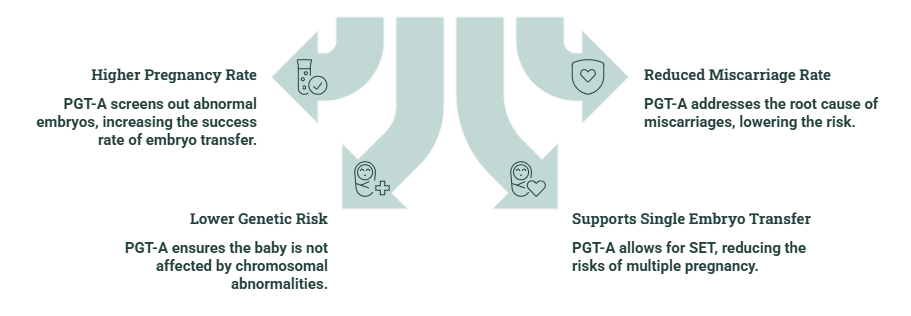
- Higher pregnancy rate per transfer, up to 70% – Because we screen out chromosomally abnormal embryos before transfer (which would not have implanted anyway), you avoid spending time and money on a transfer cycle that was unlikely to succeed.
- Miscarriage rate reduced to under 10% – More than 80% of first-trimester miscarriages are caused by embryo chromosome abnormalities. PGT-A addresses this at the root cause, meaningfully reducing this source of heartbreak for parents.
- Lower risk of passing on a genetic condition – Provides confidence that the baby is not affected by Down syndrome or other birth defects caused by chromosome number abnormalities.
- Supports single embryo transfer (SET) – Gives your doctor confidence to transfer just one, carefully confirmed embryo rather than two, reducing the risk of multiple pregnancy, which carries real dangers for both mother and babies, including preeclampsia and preterm birth.
PGT-A at Genesis Fertility Center
At GFC, we combine an experienced medical team and embryology scientists with a clean, internationally standard closed-system laboratory. You can review baseline treatment costs on our ICSI packages and pricing 2026 page, or see our full breakdown of first-time ICSI costs, which shows exactly where PGT-A fits into a typical treatment budget, or come in to speak with our team directly.
PGT-A is priced at ฿39,900 for the first embryo and ฿15,900 for each additional embryo, you can choose to test only your best-graded embryos rather than sending every embryo for testing.
Who Is Suitable for PGT-A?
While PGT-A is optional, I recommend it especially for couples with any of the following:
- Mothers aged 35 or older
- Couples with a history of two or more consecutive unexplained miscarriages
- Couples who have had two or more good-grade embryos fail to implant after IVF/ICSI (repeated implantation failure)
- Couples with a personal or family history of a chromosomal condition or genetic disease
Frequently Asked Questions
What is a “mosaic” embryo result, and can a mosaic embryo still be transferred?
A mosaic embryo contains a mixture of two cell populations, some with a normal chromosome count and some with an abnormality, within the same embryo (found in roughly 10–20% of tested embryos). Current evidence suggests some mosaic embryos have the capacity for “self-correction,” where normal cells outgrow and effectively crowd out abnormal ones during development. If a patient has no fully chromosomally normal embryos available, your doctor can assess the specific risk profile and, in some cases, recommend transferring a suitable mosaic embryo, which can still result in a healthy pregnancy. If you do proceed with a transfer, progesterone support after embryo transfer plays an important role in helping sustain the pregnancy through the earliest weeks.
Can a PGT-A result be inaccurate or misread?
This is uncommon. Current NGS technology is 98–99% accurate. The roughly 1% margin of error can come from mosaicism (where the biopsied placental cells don’t perfectly reflect the cells inside the embryo itself) or from background noise during DNA amplification. Because of this, we still recommend that mothers who conceive via a PGT-A-tested embryo undergo standard Down syndrome screening again at 11–14 weeks of pregnancy, for maximum safety.
What embryo stage is best for the PGT-A biopsy?
The blastocyst stage (Day 5–6) is the safest and most suitable stage. In the early years of this technology, cells were sometimes biopsied from Day 3 embryos, which have only about 8 cells total removing, one cell meant losing 12.5% of the embryo, which could bruise it and slow its growth. At Day 5, the embryo has over 100 cells, so removing 5–8 cells from the placental layer represents a very small proportion, with a much lower risk of harming development.
How is the PGT-A cost calculated, and is it worth it?
The standard fee is ฿39,900 for the first embryo and ฿15,900 for each additional embryo, you can choose to test only your best-graded embryos rather than every one. In my view, this is especially worthwhile for women over 35: a single transfer cycle already carries costs for uterine-lining preparation medication, physician fees, and procedure costs. If an untested, abnormal embryo is transferred, you not only lose that cycle’s cost but, if miscarriage follows, also lose months of physical and emotional recovery time. PGT-A helps save both time and heartbreak in the long run.
What happens if PGT-A shows that every embryo is chromosomally abnormal?
I understand this is one of the most difficult situations for parents to face, but knowing in advance is still better than transferring and later miscarrying. If this happens, we schedule a consultation to investigate the underlying cause together, assessing whether the issue traces back to egg or sperm quality (for example, high sperm DNA fragmentation in the male partner). From there, we can build a more intensive 3-month preparation plan, adjust the stimulation medication protocol, or bring in advanced sperm selection technology such as Microfluidic Sperm Sorting (MSS) for the next cycle to improve the chances of a normal embryo.
Why Choose Genesis Fertility Center (GFC)?

Every fertility journey is unique, and choosing the right fertility clinic is an important step toward building your family. At Genesis Fertility Center (GFC), our experienced team of reproductive specialists provides personalized treatment plans using advanced Assisted Reproductive Technology (ART), including IVF, ICSI, Egg Freezing, Embryo Freezing, and PGT-A. We combine advanced laboratory technology with evidence-based treatment protocols to deliver care tailored to your individual fertility needs.
Our multidisciplinary team of obstetricians, gynecologists, fertility specialists, and embryologists is committed to providing compassionate care, clear communication, and transparent pricing throughout every stage of your fertility journey.
To learn more or schedule a consultation, please contact Genesis Fertility Center (GFC).
Call Center: 097-484-5335
Clinic Hours
- Monday – Friday: 9:00 AM – 8:00 PM
- Saturday – Sunday: 8:00 AM – 8:00 PM