Receiving a mosaic embryo result after PGT-A (preimplantation genetic testing for aneuploidy) can be confusing and stressful. Learn more about PGT-A genetic testing by NGS, including how embryos are biopsied, how results are reported, and what different PGT-A findings mean for embryo selection. Learn more about frozen embryo transfer at GFC here.
A mosaic PGT-A result means that the cells tested from the embryo biopsy showed an intermediate chromosome copy-number result, suggesting possible mosaicism. It does not necessarily mean that every cell in the embryo is abnormal.
This distinction matters because PGT-A analyzes a small number of cells taken from the trophectoderm, the outer layer of the blastocyst that primarily contributes to the placenta. The biopsy therefore does not provide a complete genetic assessment of every cell that may eventually form the fetus.
Can a mosaic embryo be transferred?
Yes, in selected circumstances. Mosaic embryo transfer may be considered when no euploid embryo is available. However, the decision should be individualized based on the specific PGT-A result, chromosome involved, type of mosaic finding, laboratory reporting method, embryo characteristics, and the patient’s reproductive circumstances.
Genetic counseling is strongly recommended before transferring a mosaic embryo.
What Is a Mosaic Embryo?
A mosaic embryo is an embryo with a PGT-A result showing an intermediate chromosome copy number in the biopsied sample.
In simple terms, the test suggests that the sampled cells may not all have the same chromosome complement.
A typical human cell contains 46 chromosomes. An abnormal number of chromosomes is called aneuploidy. When different cell populations with different chromosome complements are present, the term mosaicism may be used.
However, a mosaic PGT-A result should not be interpreted as direct evidence that normal and abnormal cells are distributed throughout the entire embryo.
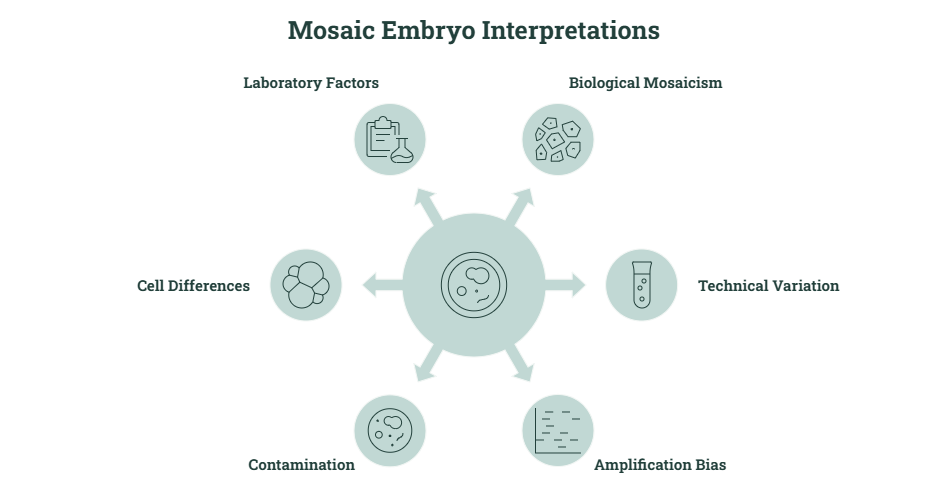
With commonly used NGS-based PGT-A, DNA from a group of trophectoderm cells is analyzed. PGT-A is performed as part of an IVF and ICSI treatment cycle, where embryos are cultured to the blastocyst stage before biopsy and genetic testing. An intermediate result can have several possible explanations, including:
- Biological mosaicism
- Technical variation
- Amplification bias
- Contamination
- Differences in the biopsied cells
- Laboratory and testing factors
For this reason, “mosaic” is a laboratory finding that requires clinical interpretation. A comprehensive review of PGT-A and embryo mosaicism explains that PGDIS suggests a typical cut-off value for the assignment of ‘euploid’ as < 20% and ‘aneuploid’ as > 80%, resulting in a broad 20% to 80% range of mosaicism.
How Is Mosaicism Detected During PGT-A?
During PGT-A, a small number of trophectoderm cells are biopsied from a blastocyst and analyzed, commonly using next-generation sequencing (NGS).
Results may broadly be reported as:
| PGT-A Result | What It Generally Means |
|---|---|
| Euploid | The biopsied sample is consistent with the expected chromosome copy number |
| Mosaic | The result falls within an intermediate range suggesting possible mosaicism |
| Aneuploid | The result is consistent with an abnormal chromosome copy number |
The exact terminology and percentage thresholds can vary between laboratories and testing platforms. Research on reducing false-positive mosaic embryos recommends prioritizing embryos with lower mosaic ratios (<50%) and segmental rather than whole-chromosome aberrations for transfer.
Therefore, a result such as “30% mosaic” does not mean that exactly 30% of the entire embryo is abnormal.
The reported percentage reflects the laboratory’s interpretation of the biopsied sample and should be understood in that context.
Can a Mosaic Embryo Become a Healthy Baby?
Yes. Healthy live births have been reported after mosaic embryo transfer.
However, it would be inaccurate to describe a mosaic embryo simply as an abnormal embryo that has “repaired itself.”
Current evidence suggests that mosaic embryos can have reproductive potential, but outcomes are generally less favorable than those following euploid embryo transfer in many studies. Some studies have reported lower implantation rates and higher miscarriage rates following mosaic embryo transfer.
At the same time, available prenatal and neonatal evidence is generally reassuring. ASRM-reviewed evidence has reported fetal or neonatal confirmation of the original mosaic PGT-A finding in fewer than 1% of transferred embryos.
The important point is that a trophectoderm biopsy does not necessarily represent every cell that will eventually form the fetus.
What Is the Difference Between Low-Level and High-Level Mosaicism?
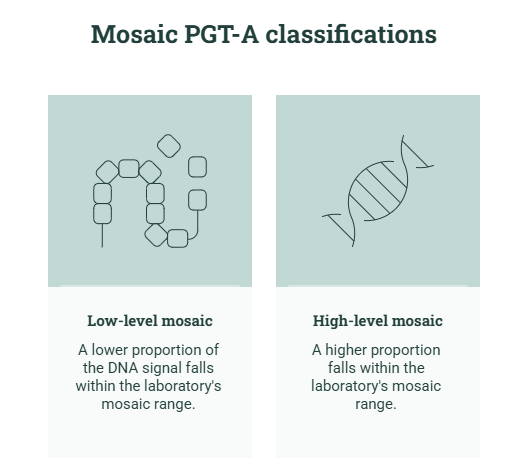
Some laboratories classify mosaic PGT-A results according to the estimated proportion of abnormal DNA detected in the biopsy.
For example:
- Low-level mosaic: A lower proportion of the DNA signal falls within the laboratory’s mosaic range.
- High-level mosaic: A higher proportion falls within the laboratory’s mosaic range.
However, mosaic percentage should not be treated as a precise measurement of the entire embryo’s abnormal cells.
There is currently no universally reliable cutoff that can predict whether a mosaic embryo will result in a healthy or unhealthy child.
Laboratories may use different:
- Testing platforms
- Algorithms
- Thresholds
- Reporting criteria
- Classification systems
ASRM notes that there is currently no evidence-based method for reliably ranking mosaic embryos according to prenatal or postnatal risk based only on the percentage of mosaicism.
Do not make a transfer decision based only on “low-level” versus “high-level.”
The complete PGT-A report should be reviewed with a fertility specialist and, ideally, a genetic counselor.
Should a Mosaic Embryo Be Transferred?
A mosaic embryo may be considered for transfer in selected circumstances, particularly when no euploid embryo is available.
The decision should consider:
- The exact PGT-A result
- Which chromosome or chromosomes are involved
- Whether the finding is whole-chromosome or segmental
- The laboratory’s testing and reporting methodology
- Embryo morphology and developmental stage
- Whether euploid embryos are available
- The patient’s age and reproductive history
- The patient’s preferences after counseling
- Available prenatal screening and diagnostic options
Mosaic embryo transfer is therefore not a simple “safe versus unsafe” decision.
Both ASRM and PGDIS recognize mosaic embryo transfer as a possible option in appropriately counseled patients, while emphasizing that evidence remains limited and outcomes can vary according to the specific mosaic finding and other clinical factors. Patients who are unsure which embryo to transfer or whether to pursue another cycle can begin with fertility counseling and treatment planning. A consultation can help review PGT-A results, embryo options, and personal fertility goals.
Are Some Mosaic Embryos More Concerning Than Others?
Yes. The chromosome involved matters.
Certain chromosome abnormalities can be associated with serious medical conditions if they are present in the fetus. For example, abnormalities involving chromosomes 13, 18, and 21 can be associated with Patau syndrome, Edwards syndrome, and Down syndrome.
However, a mosaic PGT-A result involving one of these chromosomes does not automatically diagnose the fetus with that condition.
The result comes from a limited trophectoderm biopsy. It does not directly test every fetal cell.
The interpretation should therefore consider the specific chromosome, type of finding, laboratory report, clinical history, and genetic counseling.
What Are the Chances of Pregnancy After Mosaic Embryo Transfer?
There is no single success rate that applies to every mosaic embryo.
Research summarized by ASRM indicates that some studies have found lower implantation rates and higher miscarriage rates after mosaic embryo transfer compared with euploid embryo transfer.
However, outcomes vary because mosaic embryos are not one uniform group. Differences may relate to:
- The chromosome involved
- Whole-chromosome versus segmental findings
- The reported mosaic range
- Embryo quality
- Patient age
- Previous reproductive history
- Laboratory testing and reporting methods
For this reason, quoting a single figure such as “30–40%” or “35–45%” for all mosaic embryos can be misleading.
The PGT-A report should be interpreted individually rather than using one universal success rate.
What Happens Before a Mosaic Embryo Transfer?
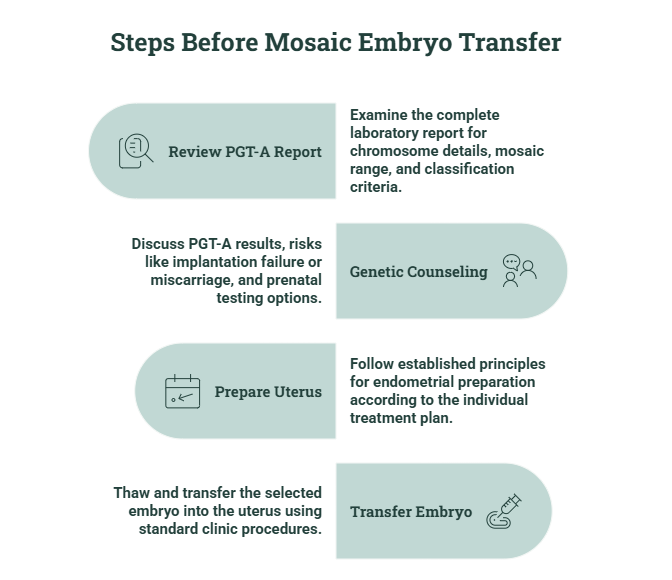
1. Review the PGT-A Report
The first step is to review the complete laboratory report, not simply the word “mosaic.”
The report may provide information about:
- The chromosome involved
- Whole-chromosome or segmental findings
- The reported mosaic range
- The laboratory’s classification criteria
- Whether more than one chromosome is involved
These details can affect how the result is interpreted.
2. Receive Genetic Counseling
Genetic counseling is an important part of the decision-making process.
Patients should understand:
- What the PGT-A result means
- What it does not mean
- The possibility of implantation failure
- The possibility of miscarriage
- The limitations of embryo biopsy
- The uncertainty surrounding prenatal and long-term outcomes
- Available prenatal screening and diagnostic testing
ASRM recommends specialized genetic counseling before mosaic embryo transfer.
3. Prepare the Uterus for Transfer
If the decision is made to proceed, the endometrium is prepared according to the patient’s individual treatment plan, similar to other frozen embryo transfer (FET) cycles.
There is no evidence that a particular endometrial thickness causes a mosaic embryo to “self-correct.”
Uterine preparation should instead follow established principles for embryo transfer.
4. Transfer the Embryo
The selected embryo is thawed and transferred into the uterus using the clinic’s standard embryo-transfer procedure.
The transfer itself does not change the genetic status reported by PGT-A.
What Prenatal Testing Is Recommended After Mosaic Embryo Transfer?
Pregnancy following mosaic embryo transfer requires appropriate prenatal counseling and testing.
NIPT should not automatically be considered a substitute for diagnostic testing when definitive information about fetal chromosomes is required.
NIPT analyzes cell-free DNA in the mother’s blood, much of which originates from the placenta. Because the original mosaic PGT-A result also comes from trophectoderm cells, placental and fetal findings can sometimes differ.
Patients who become pregnant after mosaic embryo transfer should discuss prenatal testing with their:
- Obstetrician
- Maternal-fetal medicine specialist
- Genetic counselor
Amniocentesis may be recommended in some cases because it is a diagnostic test that can provide direct information about fetal chromosomes. The appropriate testing strategy depends on the specific PGT-A finding and the individual pregnancy.
Does a Mosaic Embryo “Correct Itself”?
This is one of the most common questions patients ask.
It is tempting to say that a mosaic embryo simply “repairs itself,” but this is an oversimplification.
Possible biological mechanisms may contribute to differences between cells detected in the trophectoderm biopsy and cells that eventually form the fetus. Abnormal cells may also be distributed unevenly during early embryo development.
However, current evidence does not allow doctors to guarantee that a mosaic embryo will eliminate abnormal cells or become completely chromosomally normal.
The more accurate explanation is:
A mosaic PGT-A result does not necessarily predict an abnormal fetus, but it cannot guarantee a chromosomally normal pregnancy or healthy baby.
This distinction is important when making an informed transfer decision.
Can a Mosaic Embryo Cause a Miscarriage?
It can. Some studies have reported lower implantation rates and higher miscarriage rates after mosaic embryo transfer compared with euploid embryo transfer.
The exact risk varies according to the specific mosaic result and other clinical factors.
A mosaic result should therefore not be interpreted as either:
- “The embryo cannot develop.”
- “The embryo is definitely healthy.”
Both conclusions go beyond what PGT-A can establish.
What If All of My Embryos Are Mosaic?
If all available embryos have mosaic PGT-A results, there may still be treatment options.
A fertility specialist may discuss:
- Whether a specific mosaic embryo is appropriate for transfer
- Whether another IVF cycle should be considered
- Whether additional embryos can be obtained
- Age and ovarian reserve
The exact chromosome findings - Expected treatment burden, cost, and time
Genetic counseling before making a decision
There is no single answer that applies to every patient.
For some patients, transferring an appropriately selected mosaic embryo may be reasonable. For others, another IVF cycle to try to obtain a euploid embryo may be preferable. Review GFC’s current ICSI costs for package tiers, eligibility criteria, medication limits, and additional services including PGT-A.
The decision should be individualized. For patients considering future treatment cycles, read about egg freezing in Thailand, including how ovarian reserve testing and stimulation protocols are planned.
What Does Current Research Say About Mosaic Embryo Transfer?
Evidence on mosaic embryo transfer continues to evolve. A 2021 review of 25 studies, cited in ASRM guidance, included 2,759 mosaic embryo transfers and found that fewer than 1% resulted in an ongoing aneuploid pregnancy confirmed in the fetus or newborn and related to the original PGT‑A mosaic finding.
Overall, the evidence is generally reassuring regarding fetal or neonatal confirmation of the original mosaic result. However, mosaic embryos have lower implantation and live‑birth rates and higher miscarriage rates than euploid embryos.
Long‑term pediatric data remain limited, and PGT‑A cannot predict a child’s overall long‑term health beyond the specific chromosomal abnormalities it assesses.
Frequently Asked Questions
Can a mosaic embryo be transferred?
Yes. Mosaic embryo transfer may be considered in selected circumstances, particularly when no euploid embryo is available. The decision should be individualized after reviewing the PGT-A result and receiving appropriate genetic counseling.
Is a mosaic embryo abnormal?
Not necessarily. A mosaic PGT-A result indicates an intermediate chromosome copy-number result in the biopsied sample suggesting possible mosaicism. It does not prove that every cell in the embryo is abnormal.
Can a mosaic embryo become a healthy baby?
Yes. Healthy live births have been reported after mosaic embryo transfer. However, a mosaic embryo should not be described as guaranteed to “self-correct,” and the PGT-A result cannot predict pregnancy or fetal health with certainty.
Is a low-level mosaic embryo better than a high-level mosaic embryo?
A lower mosaic-range result may be associated with more favorable reproductive outcomes in some studies. However, mosaic percentage alone cannot reliably predict fetal or neonatal health.
Laboratory thresholds and testing methods also differ.
Does mosaic embryo transfer increase miscarriage risk?
Some studies have reported higher miscarriage rates after mosaic embryo transfer compared with euploid embryo transfer. The exact risk varies according to the type of mosaic finding and other patient and embryo factors.
Should I do NIPT after mosaic embryo transfer?
Prenatal testing should be discussed with an obstetrician and genetic counselor.
NIPT is a screening test, not a definitive diagnostic test. Its interpretation can be particularly important after mosaic embryo transfer.
Is amniocentesis necessary after mosaic embryo transfer?
Amniocentesis may be recommended because it is a diagnostic test that can provide direct information about fetal chromosomes.
Whether it is appropriate depends on the specific mosaic PGT-A finding and the circumstances of the pregnancy. The decision should be discussed with a qualified prenatal genetic specialist.
Why Choose Genesis Fertility Center (GFC)?

Every fertility journey is unique, and choosing the right fertility clinic is an important step toward building your family. At Genesis Fertility Center (GFC), our experienced team of reproductive specialists provides personalized treatment plans using advanced Assisted Reproductive Technology (ART), including IVF, ICSI, Egg Freezing, Embryo Freezing, and PGT-A genetic testing by NGS. We combine advanced laboratory technology with treatment protocols to deliver care tailored to your individual fertility needs.
Our fertility team of obstetricians, gynecologists, fertility specialists, and embryologists is committed to providing compassionate care, clear communication, and transparent pricing throughout every stage of your fertility journey.
To learn more or schedule a consultation, please contact Genesis Fertility Center (GFC).
Call Center: 097-484-5335
Medical Disclaimer
This article is for general information and does not replace a personal medical consultation. Individual results vary; your fertility specialist will advise on what is appropriate for your situation.