IVF Embryo Grading at a Glance
Embryo grading is a laboratory assessment used during IVF and ICSI to evaluate an embryo’s appearance and developmental stage before embryo transfer or freezing. Embryologists examine embryos under a microscope and assign grades based on cell structure, symmetry, fragmentation, and blastocyst development.
In general, higher-grade embryos have a better chance of implanting and resulting in a successful pregnancy. However, embryo grading evaluates morphology (appearance) rather than genetic health. A lower-grade embryo can still lead to the birth of a healthy baby, while a high-grade embryo may still have chromosomal abnormalities that prevent implantation or normal development.
Embryo grading is therefore one important part of embryo selection, but fertility specialists also consider factors such as maternal age, uterine health, previous pregnancy history, and, when appropriate, Preimplantation Genetic Testing for Aneuploidy (PGT-A) before recommending embryo transfer.
Why Is Embryo Grading Important in IVF and ICSI?
Embryo selection is one of the most important steps in an IVF or ICSI treatment cycle. After fertilization occurs in the laboratory, multiple embryos may begin developing. The goal is to identify the embryo with the greatest potential to implant successfully and develop into a healthy pregnancy.
Careful embryo grading helps embryologists:
- Identify embryos with the highest implantation potential
- Decide which embryo should be transferred first
- Select embryos suitable for freezing (cryopreservation)
- Support decisions about single versus double embryo transfer
- Improve the overall efficiency of IVF treatment
Although embryo grading cannot guarantee pregnancy, it provides valuable information that helps fertility specialists make evidence-based recommendations for each patient.
How Are Embryos Graded During IVF?
Embryologists monitor embryo development every day after fertilization. Two internationally recognized grading systems are used because embryos change significantly as they grow.
The evaluation occurs during two major stages:
- Cleavage Stage (Days 2–3)
- Blastocyst Stage (Days 5–6)
Each stage uses different grading criteria because the embryo’s structure becomes more complex over time.
Stage 1: Cleavage Stage Embryo Grading (Days 2–3)
During the first few days after fertilization, the embryo divides into multiple individual cells called blastomeres. At this stage, embryologists evaluate:
- Number of cells
- Cell symmetry
- Cell size
- Degree of fragmentation
- Overall appearance
Embryos are commonly assessed using internationally accepted criteria based on the Istanbul Consensus for embryo assessment.
Cleavage Grade 1 (Good Quality)
A Grade 1 embryo demonstrates excellent early development.
Characteristics include:
- Evenly sized blastomeres
- Round, symmetrical cells
- Minimal or no fragmentation (less than 10%)
- Healthy overall appearance
These embryos generally have the greatest potential to continue developing into high-quality blastocysts.
Cleavage Grade 2 (Fair Quality)
Grade 2 embryos show mild developmental variation.
Typical characteristics include:
- Slight differences in cell size
- Mild fragmentation (approximately 10–25%)
- Good overall developmental potential
Although not considered ideal, many Grade 2 embryos continue developing normally and may become suitable blastocysts for transfer.
Cleavage Grade 3 (Poor Quality)
Grade 3 embryos display more noticeable structural abnormalities.
Characteristics include:
- Uneven blastomere sizes
- Significant fragmentation (greater than 25%)
- Less organized cell structure
Despite their lower morphological grade, these embryos are usually kept in culture because some continue developing into transferable blastocysts. Embryo appearance alone does not determine whether implantation will occur.
What Is Embryo Fragmentation?
Fragmentation refers to small pieces of cellular material that separate from the main embryo cells during early development.
A small amount of fragmentation is common and does not automatically prevent pregnancy. However, higher levels of fragmentation may reduce embryo quality because they can interfere with normal cell communication and development.
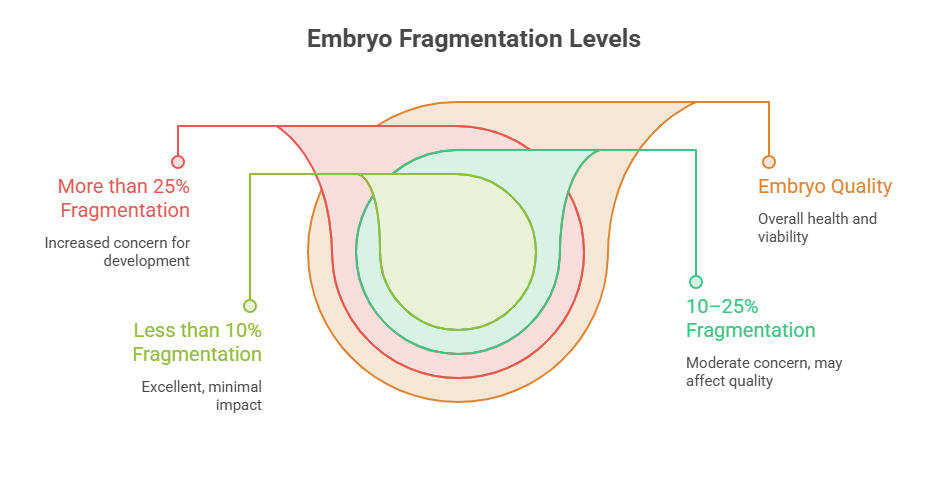
Generally:
- Less than 10% fragmentation: Excellent
- 10–25% fragmentation: Moderate
- More than 25% fragmentation: Increased concern
Fragmentation is only one factor among many that embryologists evaluate when assessing embryo quality.
Stage 2: Blastocyst Grading (Days 5–6)
By Day 5 or Day 6, many embryos develop into a blastocyst, a more advanced stage of development that closely resembles the stage at which embryos naturally reach the uterus.
Blastocyst grading provides more detailed information than cleavage-stage grading and is widely used to select embryos for transfer or freezing.
The most commonly used grading method is the Gardner and Schoolcraft Blastocyst Grading System, which evaluates three important characteristics:
- Blastocyst expansion
- Inner Cell Mass (ICM)
- Trophectoderm (TE)
Together, these three components form the familiar embryo grades such as 4AA, 5AA, 4AB, or 3BB.
The next section explains exactly what these numbers and letters mean and why they are important when choosing the best embryo for transfer.
Understanding Blastocyst Grades: What Do 4AA, 5AA, 4AB, and 3BB Mean?
Once an embryo reaches the blastocyst stage (Day 5 or Day 6), embryologists use a more advanced grading system to evaluate its developmental progress. This grading helps identify embryos with the highest potential for implantation and pregnancy.
Each blastocyst receives a grade made up of one number and two letters, such as 4AA, 5AB, or 3BB.
The grade evaluates three separate characteristics:
- The number (1–6): How much the blastocyst has expanded.
- The first letter (A–C): The quality of the Inner Cell Mass (ICM), which develops into the baby.
- The second letter (A–C): The quality of the Trophectoderm (TE), which develops into the placenta.
Together, these three components provide a detailed assessment of embryo morphology before transfer or freezing.
Step 1: Blastocyst Expansion Grade (1–6)
The expansion grade describes how far the embryo has developed and how much the fluid-filled cavity (blastocoel) has expanded.
| Expansion Grade | Description |
| 1 | Early blastocyst. The blastocoel occupies less than half of the embryo. |
| 2 | Blastocyst. The blastocoel occupies more than half of the embryo. |
| 3 | Full blastocyst. The cavity fills almost the entire embryo. |
| 4 | Expanded blastocyst. The embryo has enlarged, and the outer shell (zona pellucida) has thinned. |
| 5 | Hatching blastocyst. The embryo is beginning to emerge from the zona pellucida. |
| 6 | Hatched blastocyst. The embryo has completely escaped from the outer shell and is ready for implantation. |
Generally, embryos graded 4, 5, or 6 are considered well developed and are commonly selected for embryo transfer or cryopreservation when the cell quality is also favorable.
Step 2: Inner Cell Mass (ICM) Grade
The Inner Cell Mass (ICM) is the cluster of cells inside the blastocyst that develops into the fetus.
Embryologists evaluate the number, organization, and appearance of these cells.
Grade A
Characteristics:
- Many cells
- Tightly packed together
- Well organized
- Excellent developmental appearance
Grade A represents the highest-quality Inner Cell Mass.
Grade B
Characteristics:
- Moderate number of cells
- Slightly looser arrangement
- Good overall appearance
Many successful pregnancies result from embryos with a Grade B Inner Cell Mass.
Grade C
Characteristics:
- Few cells
- Poor organization
- Difficult to distinguish
A Grade C ICM indicates reduced developmental potential compared with Grades A and B, although pregnancy may still be possible in selected cases.
Step 3: Trophectoderm (TE) Grade
The Trophectoderm forms the placenta and supports implantation into the uterine lining.
Healthy placental development is essential for establishing and maintaining pregnancy.
Grade A
Characteristics:
- Large number of cells
- Uniform appearance
- Continuous, organized outer layer
This is considered the highest-quality trophectoderm.
Grade B
Characteristics:
- Moderate number of cells
- Slight variation in size
- Less organized than Grade A
Grade B remains a good-quality finding and is commonly seen in embryos that result in healthy pregnancies.
Grade C
Characteristics:
- Few cells
- Sparse distribution
- Irregular appearance
Grade C suggests lower implantation potential but does not automatically mean an embryo cannot lead to pregnancy.
How to Read Embryo Grades
Many patients receive embryo reports containing grades such as 4AA, 5AA, or 3BB.
Understanding these codes can make fertility treatment less confusing.
What Does a 4AA Embryo Mean?
A 4AA embryo is considered one of the highest-quality blastocysts.
It consists of:
- 4 = Expanded blastocyst
- A = Excellent Inner Cell Mass
- A = Excellent Trophectoderm
Because all three components receive excellent scores, a 4AA embryo is often prioritized for transfer when available.
What Does a 5AA Embryo Mean?
A 5AA embryo has begun hatching from its outer shell and has excellent cell quality.
It consists of:
- 5 = Hatching blastocyst
- A = Excellent Inner Cell Mass
- A = Excellent Trophectoderm
A 5AA embryo is also considered an excellent-quality embryo with high implantation potential.
What Does a 4AB Embryo Mean?
A 4AB embryo consists of:
- Expanded blastocyst
- Excellent Inner Cell Mass
- Good-quality Trophectoderm
Because the cells that develop into the baby receive the highest grade, a 4AB embryo is still regarded as an excellent option for embryo transfer.
What Does a 3BB Embryo Mean?
A 3BB embryo consists of:
- Full blastocyst
- Good-quality Inner Cell Mass
- Good-quality Trophectoderm
Although not as highly graded as a 4AA or 5AA embryo, many 3BB embryos successfully implant and result in healthy live births.
Which Embryo Grade Is Best?
In general, embryos with the following grades are considered among the highest quality:
- 4AA
- 5AA
- 6AA
- 4AB
- 5AB
- 4BA
However, embryo grading is not a ranking system that guarantees pregnancy. The best embryo for one patient may not be the best choice for another.
Fertility specialists consider several additional factors, including:
- Maternal age
- Previous IVF outcomes
- Uterine health
- Endometrial thickness
- Hormonal status
- Results of genetic testing (if performed)
- Medical history
Embryo transfer decisions are therefore individualized rather than based solely on morphology.
Does a Higher Embryo Grade Mean a Higher Chance of Pregnancy?
Generally, yes.
Studies consistently show that embryos with better morphology tend to have higher implantation and clinical pregnancy rates than embryos with lower grades.
However, embryo grading evaluates appearance under the microscope, not chromosome health.
This distinction is important because:
- A beautifully graded embryo may still have chromosomal abnormalities that prevent implantation.
- A lower-grade embryo may be chromosomally normal and develop into a healthy baby.
For this reason, embryo grading should always be interpreted alongside the patient’s age, medical history, and, when appropriate, Preimplantation Genetic Testing for Aneuploidy (PGT-A).
Embryo Grade vs. Genetic Health
One of the most common misconceptions is that the highest-grade embryo is always genetically normal.
This is not necessarily true.
| Embryo Grading | PGT-A Testing |
| Evaluates embryo appearance | Evaluates chromosome number |
| Performed using microscopy | Performed by analyzing embryo cells |
| Assesses developmental quality | Detects many chromosomal abnormalities |
| Helps prioritize embryos | Helps identify embryos with normal chromosome complements |
| Cannot confirm genetic normality | Provides additional genetic information but does not guarantee pregnancy |
When used together, embryo grading and PGT-A provide complementary information that can help fertility specialists select the embryo with the greatest likelihood of a successful pregnancy.
How Do Fertility Specialists Choose Which Embryo to Transfer?
Although embryo grading is an essential part of IVF and ICSI treatment, it is only one factor used when selecting the embryo for transfer. Fertility specialists evaluate each patient’s unique medical history to recommend the embryo with the highest chance of achieving a healthy pregnancy while minimizing risks.
Factors commonly considered include:
- Maternal age
- Cause of infertility
- Previous IVF or ICSI treatment outcomes
- History of recurrent miscarriage
- Uterine health and endometrial thickness
- Hormone levels at the time of transfer
- Embryo grade and stage of development
- Results of Preimplantation Genetic Testing for Aneuploidy (PGT-A), when performed
The goal is not simply to transfer the highest-looking grade but to select the embryo that offers the best overall chance of a successful singleton pregnancy.
Is a Day 5 Blastocyst Better Than a Day 6 Blastocyst?
Both Day 5 and Day 6 blastocysts can result in healthy pregnancies.
In general:
- Day 5 blastocysts develop slightly faster and are often associated with higher implantation rates.
- Day 6 blastocysts may develop more slowly but can still have excellent pregnancy outcomes, particularly when they are chromosomally normal.
The timing of blastocyst development is only one consideration. Embryo grade, genetic testing results (if available), and individual patient factors are equally important when determining which embryo to transfer.
Can Lower-Grade Embryos Result in Healthy Babies?
Yes.
A lower-grade embryo should not automatically be considered unsuccessful.
Embryo grading reflects how an embryo looks under the microscope, not whether it is genetically normal or capable of producing a healthy baby.
Many families have achieved successful pregnancies using embryos with grades such as:
- 3BB
- 4BB
- 4BC
- BC
Conversely, even embryos with excellent morphology, such as 4AA or 5AA, may fail to implant if chromosomal abnormalities or other clinical factors are present.
For this reason, embryo grading should always be interpreted within the broader clinical context.
Single Embryo Transfer vs. Double Embryo Transfer
One important decision during IVF treatment is whether to transfer one embryo or two embryos.
Single Embryo Transfer (SET)
Single embryo transfer is increasingly recommended, particularly for patients with high-quality blastocysts.
Benefits include:
- Lower risk of twins
- Reduced risk of premature birth
- Lower likelihood of pregnancy complications
- Improved maternal safety
- Better neonatal outcomes
When a high-quality embryo is available, transferring a single embryo often provides an excellent chance of pregnancy while minimizing the risks associated with multiple gestations.
Double Embryo Transfer (DET)
In selected circumstances, transferring two embryos may be considered.
Potential advantages include:
- Increased chance of pregnancy during that treatment cycle for some patients
Potential disadvantages include:
- Higher likelihood of twin pregnancy
- Increased risk of premature delivery
- Greater chance of pregnancy-related complications
- Increased risks for both mother and babies
The decision to transfer one or two embryos should always be made in consultation with a fertility specialist after carefully evaluating the patient’s age, embryo quality, reproductive history, and overall health.
Frequently Asked Questions
What is the highest embryo grade?
Embryos such as 4AA, 5AA, and 6AA are generally considered among the highest-quality blastocysts because they demonstrate excellent expansion, a high-quality Inner Cell Mass, and a high-quality Trophectoderm. However, embryo grade alone does not guarantee pregnancy.
Is a 4BB embryo good?
Yes.
A 4BB embryo is considered a good-quality blastocyst and is commonly selected for embryo transfer or cryopreservation. Many healthy pregnancies result from 4BB embryos.
Is a 3BB embryo good?
Yes.
A 3BB embryo is a full blastocyst with good-quality Inner Cell Mass and Trophectoderm. Although its morphology is not considered excellent, it still has meaningful implantation potential and can result in a healthy live birth.
Is a 5AA embryo better than a 4AA embryo?
Both are considered excellent-quality embryos.
The primary difference is that a 5AA embryo has begun hatching from the zona pellucida, while a 4AA embryo is an expanded blastocyst. In clinical practice, both grades are typically regarded as highly favorable for embryo transfer.
Can a Grade C embryo implant successfully?
Yes.
Although Grade C embryos generally have lower implantation rates than Grade A or Grade B embryos, successful pregnancies have been reported. Treatment decisions depend on the number of available embryos, patient characteristics, and the recommendations of the fertility team.
Does embryo grading change after freezing?
Embryos are graded before cryopreservation and reassessed after thawing. While some embryos maintain excellent appearance after warming, others may show minor changes. The post-thaw assessment helps embryologists determine whether an embryo remains suitable for transfer.
Does PGT-A replace embryo grading?
No.
PGT-A and embryo grading provide different but complementary information.
Embryo grading evaluates how an embryo develops and appears under the microscope, while PGT-A assesses chromosome number. When both are available, they help fertility specialists make more informed embryo selection decisions.
Begin Your Fertility Journey with Genesis Fertility Center (GFC)
Choosing the right fertility clinic is just as important as selecting the right embryo.
At Genesis Fertility Center (GFC), our multidisciplinary team provides individualized fertility care using advanced laboratory techniques and evidence-based treatment protocols. From comprehensive fertility evaluations to IVF, ICSI, embryo freezing, and PGT-A, we work closely with each patient to develop a treatment plan tailored to their unique needs and reproductive goals.
Our team is committed to providing clear communication, transparent pricing, and compassionate support throughout every stage of your fertility journey.
Our services include:
- IVF (In Vitro Fertilization)
- ICSI (Intracytoplasmic Sperm Injection)
- PGT-A (Preimplantation Genetic Testing for Aneuploidy)
- Egg Freezing (Oocyte Cryopreservation)
- Embryo Freezing (Cryopreservation)
- Personalized Fertility Consultation
Current Package Pricing
- ICSI Package: 190,000 Baht
- Egg Freezing (Oocyte Cryopreservation): 150,000 Baht
Contact Genesis Fertility Center
Call Center: 097-484-5335
Clinic Hours
- Monday–Friday: 9:00 AM–8:00 PM
- Saturday–Sunday: 8:00 AM–8:00 PM
Our team is here to answer your questions, explain your treatment options, and help you take the next step toward building your family with confidence.