Can you have twins with IVF or ICSI?
Yes. IVF and ICSI can result in twin pregnancies, but the chance depends mainly on how many embryos are transferred, not on the fertilization method itself. Fraternal twins usually occur when two embryos implant successfully, while identical twins can occur when a single embryo naturally splits into two. Although IVF has historically been associated with higher twin rates, many fertility clinics now recommend elective single embryo transfer (eSET) to reduce the risks associated with multiple pregnancies while maintaining high pregnancy success rates.
What Couples Hoping for Twins Through IVF or ICSI Should Know
Twin birth rates are steadily rising worldwide, driven significantly by Assisted Reproductive Technology (ART) such as IVF (In Vitro Fertilization) and ICSI (Intracytoplasmic Sperm Injection). These advanced options make it possible for modern couples who desire twins, as well as those overcoming infertility, to successfully achieve a multiple pregnancy.
Historically in Thailand, natural twin pregnancies occurred at a rate of roughly 1 in 89 pregnancies. Triplets were far rarer, appearing at a rate of approximately 1 in 7,921 pregnancies, while quadruplets were rarer still. To help hopeful couples understand how twin pregnancies happen, they are categorized into two primary types:
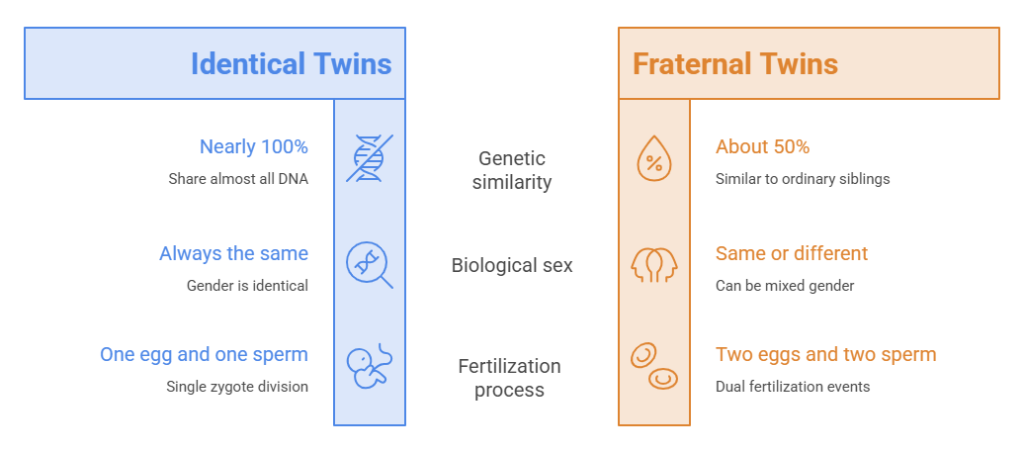
1. Identical Twins (Monozygotic)
Identical twins develop from a single egg fertilized by a single sperm. During the early cellular division process, this single fertilized egg splits into two separate embryos, which then develop into two babies.
- Characteristics: They share 100% identical genetic material, meaning they are always the same biological sex and look virtually indistinguishable.
- Frequency: Identical twins make up about 1/3 of all twin pregnancies. Science has yet to find a definitive explanation or root cause for why a fertilized egg randomly splits like this.
2. Fraternal Twins (Dizygotic)
Fraternal twins occur when a woman releases two separate eggs during a single menstrual cycle, and each egg is fertilized by a different sperm cell. These two distinct embryos develop inside the uterus at the same time.
- Characteristics: Because they come from separate eggs and sperm, they only share about 50% of their DNA, just like regular siblings. They can be the same sex or different sexes, and they may look completely different from one another.
- Frequency: Fraternal twins account for about 2/3 of all twin pregnancies.
Identical Twins vs. Fraternal Twins
Frequently Asked Questions
How does IVF/ICSI increase the chance of a twin pregnancy compared to natural conception?
In IVF/ICSI, to increase the chance of a successful pregnancy, the doctor and the couple may decide together to transfer two embryos into the uterus in the same cycle. If both embryos implant successfully, a twin pregnancy results — a mechanism that is far more controllable and predictable than natural conception, which typically releases only a single egg.
How do identical twins and fraternal twins differ in how they form and in their characteristics?
Fraternal twins form when two separate eggs are each fertilized by a separate sperm (in ICSI, this means transferring two distinct embryos). Their appearance and sex can be similar or different, just like regular siblings. Identical twins form from a single egg fertilized by a single sperm, creating one embryo that later splits into two. Identical twins share 100% of the same genetic material, appearance, and sex.
In a medical sense, why do specialists usually recommend transferring only a single embryo (Single Embryo Transfer)?
Because medically, a twin pregnancy is classified as a high-risk pregnancy. It carries significantly higher risks for both mother and babies than a singleton pregnancy — including up to a 50% risk of preterm birth, preeclampsia, gestational diabetes, low birth weight, or twin-to-twin transfusion syndrome (TTTS). Transferring a single, chromosomally-screened embryo is therefore the safest approach.
If a twin pregnancy is achieved through ICSI, what special care and monitoring does the mother need?
Mothers carrying twins need closer monitoring than usual — more frequent prenatal visits and ultrasounds to track both babies' growth and check amniotic fluid and placental status, careful weight and nutrition management, additional nutrients and vitamins as prescribed by the doctor, avoiding strenuous exercise or high-impact activity, and watching for warning signs such as early tightening of the abdomen or uterine contractions.
If only a single embryo is transferred, is there still a chance of a twin pregnancy?
Yes, though the chance is very small (about 1-2%). This is natural identical-twin splitting: after a single blastocyst-stage embryo is transferred into the uterus, it can spontaneously split into two groups of cells that implant in parallel, resulting in identical twins with the exact same appearance and sex.
| Feature | Identical Twins | Fraternal Twins |
|---|---|---|
| Number of eggs | One | Two |
| Number of sperm | One | Two |
| Genetic similarity | Nearly 100% | About 50% |
| Biological sex | Always the same | Same or different |
| Physical appearance | Usually very similar | Similar to ordinary siblings |
| Common cause after IVF | One embryo naturally splits | Two embryos implant successfully |
Factors That Influence Twin Pregnancies
- Ethnicity: Studies indicate that East Asian and Hispanic women have a lower natural probability of conceiving twins compared to African and non-Hispanic white women.
- Family History: A history of twins on either side of the family plays a role, though the maternal lineage has a significantly higher impact. Your chances increase if your mother, sister, or grandmother gave birth to fraternal twins, or if you are a fraternal twin yourself.
- Maternal Age: The likelihood of having twins increases with age. Research shows that up to 16% of pregnant women over the age of 45 carry twins. Women in their 30s and 40s often experience higher baseline estrogen levels, which can cause the ovaries to release more than one egg in a single cycle.
- Obstetric History: If a woman has been pregnant before, especially if she has already carried twins, her chances of conceiving twins again are higher.
- Higher Body Weight: Women with a higher Body Mass Index (BMI) have a slightly elevated chance of twins. Excess adipose tissue raises circulating estrogen levels, which can overstimulate the ovaries into releasing multiple eggs.
- Fertility Medications: Ovulation-inducing pills or injections stimulate the ovaries to mature and release more than one egg per cycle, driving up fraternal twin rates.
- Assisted Reproductive Technology (ART): Procedures like IVF directly increase twin rates when reproductive specialists transfer more than one embryo into the uterus.
- Discontinuing Birth Control Pills: After stopping oral contraceptives (especially after using them for 3 consecutive years or longer), a hormonal rebound effect can occur, occasionally causing the ovaries to release multiple eggs in the initial cycles.
Does IVF Increase the Chance of Twins?
Historically, IVF was associated with a significantly higher rate of twin pregnancies because fertility specialists often transferred two or more embryos to improve pregnancy success rates.
Today, IVF technology has advanced considerably.
Improvements in:
- embryo culture
- blastocyst development
- embryo grading
- embryo freezing
- embryo selection
allow many patients to achieve excellent pregnancy rates using a single high-quality embryo.
As a result, twin pregnancy rates from IVF have decreased substantially in clinics that routinely perform elective single embryo transfer.
Instead of asking whether IVF causes twins, a more accurate question is:
How many embryos are transferred during IVF?
That decision has the greatest influence on the likelihood of twins.
Does ICSI Increase the Chance of Twins?
No. ICSI itself does not directly increase the chance of twins.
ICSI is simply a fertilization technique in which a single healthy sperm is carefully injected into one mature egg.
The chance of twins depends on what happens after fertilization, particularly:
- the number of embryos transferred
- embryo quality
- maternal age
- uterine conditions
- implantation success
Whether fertilization occurs through conventional IVF or ICSI, transferring two embryos increases the likelihood of fraternal twins, while transferring one embryo carries only a small possibility of identical twins if the embryo naturally divides.
IVF vs. ICSI vs. IUI: Which Fertility Treatment Has the Highest Chance of Twins?
| Treatment | How Fertilization Occurs | Can Twins Occur? | Why? |
|---|---|---|---|
| IVF | Egg and sperm are combined in the laboratory | Yes | Usually when two embryos implant |
| ICSI | One sperm is injected directly into one egg | Yes | Depends on the number of embryos transferred |
| IUI | Sperm is placed directly into the uterus | Yes | Ovulation medications may stimulate the release of multiple eggs |
Although IVF and ICSI receive the most attention regarding twin pregnancies, fertility medications used alongside IUI can also increase the chance of fraternal twins by stimulating multiple ovulations.
The Pros and Cons of a Twin Pregnancy
The Rewards
Many families view twins as a wonderful blessing. Twins grow up with an automatic best friend, learn to share, and can hand down clothes, shoes, and toys to each other, often saving costs in the long run since they tend to share similar interests.
The Risks and Complications
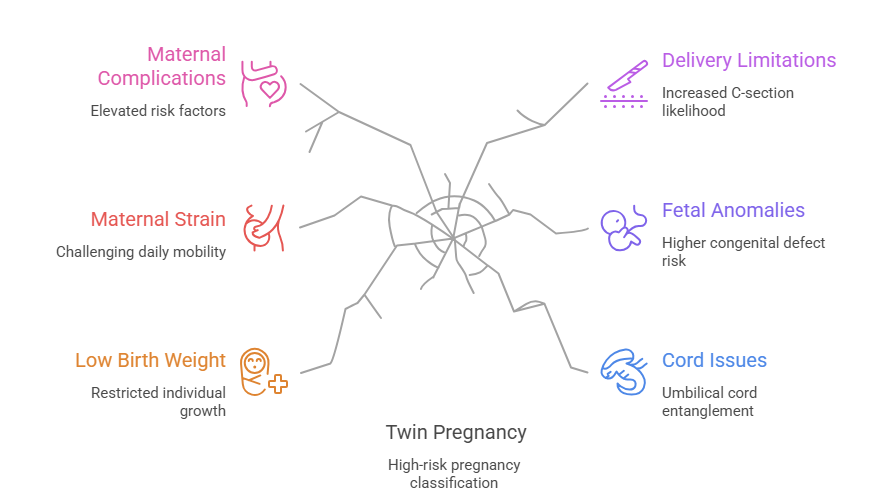
Medically speaking, a twin pregnancy is classified as a high-risk pregnancy because it introduces distinct vulnerabilities:
- Low Birth Weight: Twins must share maternal nutrients, which can restrict their individual growth. This is caused by intrauterine growth restriction (IUGR) or preterm birth.
- Maternal Physical Strain: A much larger uterine size makes daily mobility and comfort more challenging for the mother.
- Maternal Complications: Elevated risks of preeclampsia (pregnancy-induced high blood pressure), gestational diabetes, preterm labor, miscarriage, and postpartum hemorrhage.
- Delivery Limitations: The likelihood of a natural vaginal birth drops; most twin deliveries require a scheduled C-section for safety.
- Fetal Anomalies: Congenital birth defects carry a 4% risk rate in twins compared to the baseline 2% seen in singletons.
- Cord and Placental Issues: In rare cases where twins share an amniotic sac, they face a risk of umbilical cord entanglement. For twins sharing a single placenta, Twin-to-Twin Transfusion Syndrome (TTTS) can cause life-threatening imbalances where one twin becomes severely anemic while the other experiences fluid overload or heart failure.
Frequently Asked Questions
Can IVF guarantee twins?
No. IVF cannot guarantee twins. The chance depends mainly on the number of embryos transferred and whether an embryo naturally divides.
Can one IVF embryo become twins?
Yes. A single embryo can occasionally split after fertilization, resulting in identical twins, although this is uncommon.
Is it safer to transfer one embryo or two?
For many patients, Elective single embryo transfer (eSET) is the safest option because it reduces the risk of multiple pregnancy while maintaining high success rates in appropriate candidates.
Are IVF twins more common than naturally conceived twins?
Historically, yes. However, the increased use of single embryo transfer has significantly reduced IVF twin pregnancy rates.
Does frozen embryo transfer (FET) increase the chance of twins?
No. The likelihood of twins depends primarily on the number of embryos transferred, not whether the transfer is fresh or frozen.
Can you choose the sex of twins through IVF?
In some countries, PGT can identify an embryo’s sex, but sex selection is subject to local laws, ethical guidelines, and medical indications.
Are twin pregnancies considered high risk?
Yes. Twin pregnancies generally require closer monitoring because they carry a higher risk of complications than singleton pregnancies.
When Should You See a Fertility Specialist?
If you have difficulty conceiving or are considering IVF, ICSI, or other fertility treatments, consult a fertility specialist. They can evaluate your fertility, explain your treatment options, and recommend the most appropriate embryo transfer strategy based on your individual circumstances.
Conclusion
Because a twin pregnancy carries significant health risks for both the mother and the babies, reproductive medicine does not actively encourage or promote elective twin procedures. However, if you are experiencing infertility or hope to explore your options safely, we highly recommend a thorough physical evaluation to see if your body can safely support a multiple pregnancy.
At Genesis Fertility Center (GFC), our expert medical team combines advanced reproductive innovations with compassionate care to build a treatment plan tailored specifically to your body’s readiness.
- ICSI Package: 190,000 Baht
- Egg Freezing (Oocyte Cryopreservation): 150,000 Baht
- Embryo grading and screening services fully available.
For more information, please contact:
- Call Center: 097-484-5335
- Operating Hours:
- Monday – Friday: 9:00 AM – 8:00 PM
- Saturday – Sunday: 8:00 AM – 8:00 PM