Quick Answer
For many women, the late 20s to early 30s can be a favorable time to consider egg freezing, with many fertility specialists emphasizing the benefits of freezing eggs before age 35.
However, age 35 is not an absolute cutoff. Egg freezing may still be an option after 35, and some women may benefit from freezing their eggs in their late 30s or beyond. The potential benefit depends on individual factors, including ovarian reserve and the number of mature eggs that can be retrieved and successfully frozen.
If you are considering egg freezing, an individualized fertility assessment can help you understand your current ovarian reserve and make a more informed decision about timing.
Why Does Age Matter When Freezing Eggs?
Age is an important factor in egg freezing because both egg quantity and egg quality change over time, a pattern well documented in ACOG’s clinical guidance on ovarian-factor fertility decline.
Women are born with all the eggs they will have during their lifetime. As they age, the number of remaining eggs gradually decreases. Egg quality also tends to decline with age, particularly as women move through their mid-to-late 30s.
Changes in egg quality can affect the likelihood that an egg will:
- Survive the thawing process
- Fertilize successfully
- Develop into a healthy embryo
- Implant in the uterus
- Result in an ongoing pregnancy and live birth
This is why the age at which eggs are frozen is an important consideration.
Egg freezing can preserve eggs at the biological age they had when they were frozen. However, freezing eggs at a younger age does not guarantee a future pregnancy. The eventual outcome depends on several factors, including the number of mature eggs stored, egg survival after thawing, fertilization, embryo development, and other reproductive factors.
What Is the Best Age to Freeze Eggs?
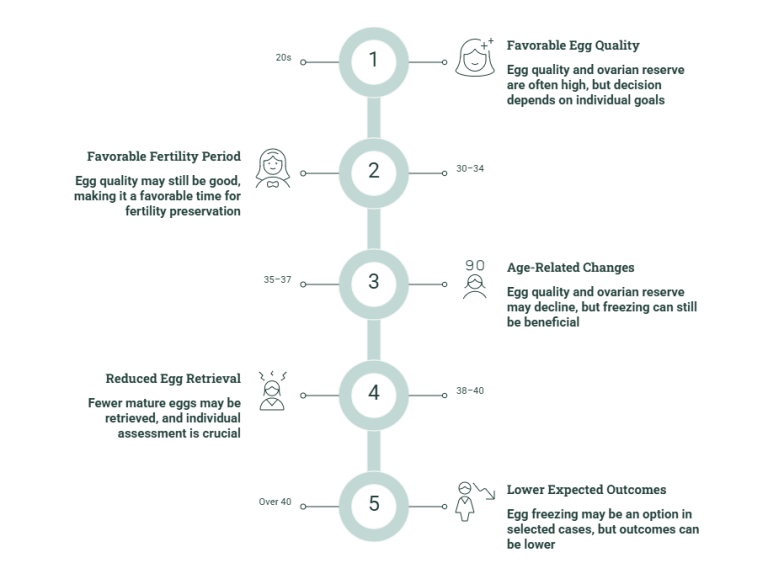
There is no universal age that is right for every woman. However, the following age ranges can provide a general framework.
| Age when eggs are frozen | General Considerations |
|---|---|
| 20s | Egg quality and ovarian reserve are often favorable, although the decision to freeze eggs depends on individual reproductive goals. |
| 30–34 | Often considered a favorable period for fertility preservation because egg quality may still be relatively good compared with later reproductive ages. |
| 35–37 | Egg freezing may still be beneficial, but age-related changes in egg quality and ovarian reserve become increasingly important. |
| 38–40 | Egg freezing may still be possible for some women, although fewer mature eggs may be retrieved and individual assessment becomes particularly important. |
| Over 40 | Egg freezing may be an option in selected cases, but expected outcomes can be lower, making consultation with a fertility specialist especially important. |
These age ranges are general guidelines rather than strict rules. Two women of the same age can have different ovarian reserve and fertility profiles.
Is 30 a Good Age to Freeze Your Eggs?
Yes. Age 30 is within a commonly considered favorable window for egg freezing because egg quality and ovarian reserve are generally better than they are at later reproductive ages.
Freezing eggs at 30 may be worth considering if you:
- Do not plan to have children in the near future
- Want to preserve more reproductive options for later
- Are concerned about delaying pregnancy
- Are not currently ready to start a family
- Have personal, professional, or relationship circumstances that may delay childbearing
- Are facing a medical treatment that could affect fertility
However, egg freezing is an individual decision. Some women may choose to freeze their eggs earlier, while others may decide to wait. A fertility assessment can provide additional information about your ovarian reserve and help you make a decision based on your personal circumstances.
Is 35 Too Old to Freeze Your Eggs?
No. Age 35 is not an automatic cutoff for egg freezing, and freezing your eggs after 35 may still be an option depending on your individual fertility profile. However, egg quantity and quality generally decline with age, which may affect the number of mature eggs retrieved and potential future outcomes.
If you are considering egg freezing after 35, a fertility specialist can assess your ovarian reserve and overall fertility to help you understand the potential benefits and limitations based on your individual circumstances.
If you are 35 or older and considering egg freezing, your fertility specialist may assess factors such as:
- Ovarian reserve
- AMH level
- Antral follicle count (AFC)
- Menstrual and reproductive history
- Medical history
- Previous ovarian surgery or fertility treatment
- Your plans for future pregnancy
- How many children you may wish to have
Your doctor can also discuss your likely response to ovarian stimulation, the potential number of mature eggs that may be retrieved, and what those results may mean for your future reproductive plans.
The goal is to help you make an informed decision based on your age, individual fertility profile, and family-building goals rather than relying on age alone.
Can I Freeze My Eggs at 40?
Yes, some women can freeze their eggs at 40, although egg quantity and quality may be lower than at younger ages, which can affect potential future outcomes. However, age alone does not determine whether egg freezing is appropriate or beneficial.
If you are 40 or older, a fertility specialist can assess your ovarian reserve and overall fertility to help you understand your options and set realistic expectations. Egg freezing can preserve reproductive potential but does not guarantee a future pregnancy or live birth.
How Does Egg Quality Change With Age?
Egg quality is closely associated with reproductive age.
As women get older, the proportion of eggs with chromosomal abnormalities tends to increase. This can affect the ability of an egg to develop into a viable embryo and may increase the risk of miscarriage or difficulty achieving a successful pregnancy.
This is one reason why the age at egg freezing matters.
Egg freezing allows a woman to preserve eggs at the age they are collected. The eggs do not continue to age biologically while they are stored. However, the future use of those eggs still involves several steps, and not every frozen egg will ultimately result in a live birth.
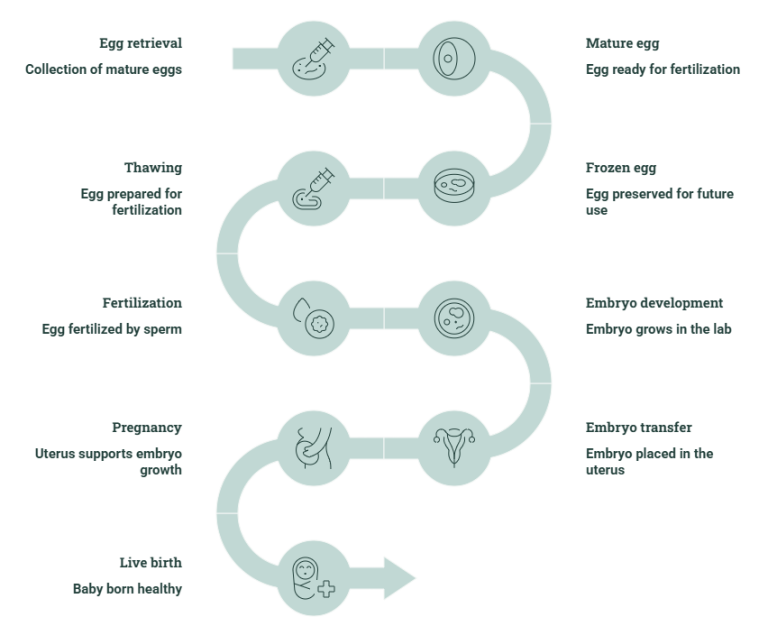
The reproductive journey may involve:
Egg retrieval → Mature egg → Frozen egg → Thawing → Fertilization → Embryo development → Embryo transfer → Pregnancy → Live birth
Does AMH Tell Me the Best Time to Freeze My Eggs?
Anti-Müllerian hormone(AMH), is useful for assessing ovarian reserve, but it does not determine egg quality by itself.
AMH can help fertility specialists estimate the remaining pool of developing follicles and anticipate how the ovaries may respond to stimulation during an egg-freezing cycle.
However, AMH should not be interpreted in isolation.
Your doctor may consider AMH together with:
- Your age
- Antral follicle count (AFC)
- Ultrasound findings
- Menstrual history
- Medical history
- Previous fertility treatment
- Other relevant clinical factors
A lower AMH level does not necessarily mean that pregnancy is impossible, and a higher AMH level does not guarantee successful egg freezing or future pregnancy.
For this reason, there is no single AMH value that can tell every woman when she should freeze her eggs.
How Many Eggs Should I Freeze?
There is no universal number of eggs that guarantees a future baby.
The number of mature eggs a woman may want to freeze depends on several factors, including:
- Age when eggs are frozen
- Ovarian reserve
- Number of mature eggs retrieved
- Whether she hopes to have one child or more than one child in the future
- Individual reproductive history
Clinic-specific outcomes
In general, freezing a larger number of mature eggs may provide more opportunities for future use, consistent with ASRM’s evidence-based outcomes guideline on oocyte cryopreservation. However, the quality and age of the eggs are also important.
Your fertility specialist can help you understand how many eggs may be appropriate to aim for based on your age and individual circumstances.
In some cases, more than one egg-freezing cycle may be considered to increase the number of eggs stored.
Does Egg Freezing Guarantee a Future Pregnancy?
No. Egg freezing does not guarantee a future pregnancy or live birth.
Egg freezing is a fertility-preservation option that may increase reproductive choices later in life, but not every frozen egg will result in a baby.
When frozen eggs are eventually used, several steps must be successful. An egg must survive thawing, fertilize successfully, develop into a viable embryo, implant in the uterus, and result in an ongoing pregnancy.
The outcome can be influenced by:
- Age when the eggs were frozen
- Number of mature eggs stored
- Egg survival after thawing
- Sperm quality
- Fertilization method
- Embryo development
- Uterine and maternal factors
- Overall reproductive health
For this reason, egg freezing should be viewed as a way to preserve reproductive potential, not as a guarantee of future fertility.
What Tests Are Needed Before Egg Freezing?
Before egg freezing, your fertility specialist may recommend tests to assess your ovarian reserve and overall reproductive health, including:
- AMH test: Helps assess ovarian reserve and predict how your ovaries may respond to stimulation.
- Antral follicle count (AFC): An ultrasound-based assessment that provides additional information about ovarian reserve.
- Transvaginal ultrasound: Evaluates the ovaries and uterus and checks for any relevant conditions.
- Medical and reproductive history: Reviews your menstrual cycle, previous pregnancies, surgeries, medications, and medical conditions.
- Additional tests: Blood tests or other examinations may be recommended based on your individual health and medical history.
These assessments help your fertility specialist develop a personalized egg-freezing treatment plan.
What Is the Egg-Freezing Process?
Egg freezing generally involves several stages.
1. Initial fertility assessment
You meet with a fertility specialist to discuss your reproductive goals, medical history, ovarian reserve, and treatment options.
2. Ovarian stimulation
Fertility medications are used to stimulate the ovaries so that multiple follicles can develop during one menstrual cycle.
3. Monitoring
Ultrasound examinations and, when appropriate, blood tests are used to monitor follicle development and determine when the eggs are ready for retrieval.
4. Egg retrieval
When the follicles are ready, the mature eggs are collected through a minimally invasive procedure performed under appropriate medical supervision.
5. Vitrification and storage
Mature eggs are rapidly frozen using vitrification and stored at very low temperatures for potential future use.
When you decide to try for pregnancy, the eggs can be thawed and fertilized, typically using intracytoplasmic sperm injection (ICSI), before the resulting embryo is considered for transfer and, when appropriate, screened for chromosomal health through PGT-A.
Is It Better to Freeze Eggs at 25 or 30?
Both ages may be favorable for egg freezing, but the best decision depends on your individual circumstances.
Egg quality and ovarian reserve are generally more favorable at younger reproductive ages. However, freezing eggs at 25 may not be necessary or appropriate for every woman.
The decision should consider:
- Your plans for future childbearing
- Whether you expect to delay pregnancy
- Your ovarian reserve
- Your personal and medical circumstances
- Your preferences and reproductive goals
The key principle is that egg freezing is generally more effective when performed before significant age-related decline in egg quality occurs.
Is Egg Freezing Right for You?
The decision to freeze your eggs is highly personal.
You may want to consider egg freezing if you are concerned that you may not be ready to have children during the years when fertility is naturally higher.
You may also want to discuss egg freezing with a fertility specialist if:
- You expect to delay pregnancy for several years
- You are concerned about declining fertility
- You have a family history of early menopause
- You have been diagnosed with a condition that may affect ovarian reserve
- You are planning medical treatment that may affect fertility
- You want to understand your current fertility status
A fertility consultation can help you understand your options based on your individual circumstances rather than relying on age alone.
Frequently Asked Questions
What is the best age to freeze your eggs?
The late 20s to early 30s is often considered a favorable time to freeze eggs, with many women considering egg freezing before age 35. However, there is no universal best age, and individual ovarian reserve and reproductive goals should also be considered.
Is 35 too old to freeze eggs?
No. Age 35 is not an automatic cutoff. Egg freezing may still be an option after 35, although the number and quality of eggs retrieved may be lower than at younger ages.
Can I freeze my eggs at 40?
Yes, some women can freeze their eggs at 40. However, egg quantity and quality may be lower, so an individualized fertility assessment is especially important.
Is 30 a good age to freeze eggs?
Yes. Age 30 is within a commonly considered favorable window for egg freezing, although individual fertility and ovarian reserve vary.
Does AMH determine whether I should freeze my eggs?
No. AMH provides information about ovarian reserve and may help predict ovarian response to stimulation, but it does not measure egg quality or guarantee future pregnancy.
How many eggs should I freeze?
There is no single number that guarantees a future pregnancy. The number of eggs to freeze depends on factors such as your age, ovarian reserve, number of mature eggs retrieved, and future family-building goals.
Does egg freezing guarantee a baby?
No. Egg freezing does not guarantee pregnancy or live birth. The eventual outcome depends on several stages, including egg thawing, fertilization, embryo development, implantation, and pregnancy.
Do frozen eggs continue to age?
No. Eggs are preserved at the biological age they had when they were frozen. However, this does not guarantee that they will result in a future pregnancy.
How long can frozen eggs be stored?
Eggs can be stored using vitrification at extremely low temperatures. The permitted storage period depends on applicable regulations and clinical circumstances.
How long does the egg-freezing process take?
The treatment timeline varies between individuals and clinics. A typical egg-freezing cycle involves an initial assessment, ovarian stimulation, monitoring, egg retrieval, and vitrification.
Is egg freezing painful?
Experiences vary. Ovarian stimulation may cause temporary discomfort or bloating, while the egg retrieval procedure is performed with appropriate pain management or sedation. Your fertility specialist can explain what to expect based on your treatment plan.
How much does egg freezing cost?
The cost of egg freezing varies depending on the fertility clinic, medications, number of treatment cycles, egg storage, and additional services. Ask your fertility clinic for a current, itemized estimate of treatment and storage costs.
Why Choose Genesis Fertility Center (GFC)?

Every fertility journey is unique, and choosing the right fertility clinic is an important step toward building your family. At Genesis Fertility Center (GFC), our experienced team of reproductive specialists provides personalized treatment plans using advanced Assisted Reproductive Technology (ART), including IVF, ICSI, Egg Freezing, Embryo Freezing, and PGT-A. We combine advanced laboratory technology with evidence-based treatment protocols to deliver care tailored to your individual fertility needs.
Our multidisciplinary team of obstetricians, gynecologists, fertility specialists, and embryologists is committed to providing compassionate care, clear communication, and transparent pricing throughout every stage of your fertility journey.
To learn more or schedule a consultation, please contact Genesis Fertility Center (GFC).
Call Center: 097-484-5335
Clinic Hours
- Monday – Friday: 9:00 AM – 8:00 PM
- Saturday – Sunday: 8:00 AM – 8:00 PM