


Your first fertility appointment is an opportunity to understand your fertility history, assess factors affecting both partners, and decide which investigations are actually needed.
At Genesis Fertility Center (GFC), the first appointment does not automatically mean that you need every fertility test or that you will start IVF or ICSI immediately.
Instead, the doctor reviews your medical and fertility history, considers your goals, selects appropriate tests based on your individual circumstances, and explains the available treatment options, expected timeline, risks and costs before you decide how to proceed.
Quick answer: Before your first appointment, book in advance and prepare your passport or identification, menstrual history, medication and supplement list, previous fertility test results and treatment records, and relevant information for both partners. If you want a semen analysis on the same day, tell GFC when booking and follow the clinic’s instructions about the required abstinence period.
When Should You See a Fertility Specialist?
In general, a fertility assessment is recommended when you have been having regular unprotected intercourse without becoming pregnant for approximately:
- 12 months if the female partner is under 35
- 6 months if the female partner is 35 or older
- Sooner rather than later if the female partner is over 40
You should also consider seeing a fertility specialist earlier if there are factors that may affect fertility, such as:
- Irregular or absent menstrual periods
- Suspected endometriosis
- Previous pelvic surgery
- Recurrent miscarriage
- Problems with erection or ejaculation
- Previous abnormal semen analysis
- Previous treatment that may affect fertility
If you are unsure whether it is the right time to have an assessment, you can start with a fertility consultation to discuss your age, health history and how long you have been trying to conceive.
Do You Need to Have Your First Appointment During Your Period?
Not necessarily.
You can book a fertility consultation and review your medical history at any point during your menstrual cycle.
However, some tests are more appropriate on specific days of the cycle. For example, certain hormone tests may be scheduled during the early part of the cycle, while other investigations may need to be coordinated with your menstrual cycle and the doctor’s treatment plan.
AMH can generally be tested at different points during the menstrual cycle, while other results need to be interpreted together with the cycle day, symptoms, medications and ultrasound findings.
If you are travelling to Thailand and have limited time, tell the GFC team:
- The first day of your most recent period
- Your usual cycle pattern
- The dates when you will be in Thailand
- Which days you are available for appointments
This allows the team to help plan which investigations may be possible during your visit.
What Information Should You Provide When Booking?
Providing basic information before your appointment helps the clinic prepare the appropriate time and advice.
Try to provide:
- The age of both partners and how long you have been trying to conceive
- The first day of your most recent menstrual period and whether your cycles are regular
- Previous pregnancies, miscarriages, deliveries, surgery or fertility treatment
- Existing medical conditions, medications, supplements and drug allergies
- Previous test results, such as AMH, hormone tests, ultrasound, fallopian-tube testing, semen analysis or previous IUI/IVF reports
- Whether you want a semen analysis on the same day
- Any limitations relating to travel dates, language, budget or when you want to begin treatment
For international patients, providing this information before travelling can make the appointment considerably more efficient.
What Should You Bring to Your First Fertility Appointment?
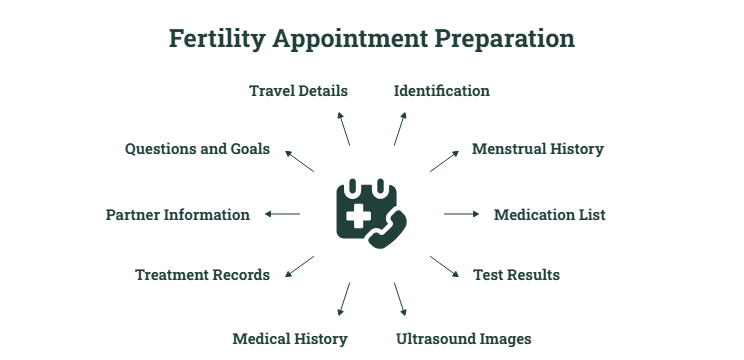
The following checklist can help you prepare.
| What to Bring | Why it may be Useful |
|---|---|
| Passport or identification | Registration and identity verification |
| Previous menstrual history | Helps assess ovulation and plan investigations |
| Medication, vitamin and supplement list | Identifies treatments or supplements that may affect assessment |
| Previous test results and medical reports | May prevent unnecessary repeat testing when results are still useful |
| Previous ultrasound or imaging | Helps the doctor review previous findings |
| Pregnancy, miscarriage and surgery history | Helps identify relevant fertility factors |
| Previous IUI or IVF records | Helps the doctor understand previous treatment and outcomes |
| Your partner's medical and fertility information | Infertility may involve either partner, both partners, or remain unexplained |
| Questions and treatment goals | Helps ensure the consultation addresses your priorities |
| Travel dates and budget | Important when planning treatment as an international patient |
If your previous results were obtained overseas, bring the original documents or clear digital copies where possible.
Reports should ideally include:
- The name of the test
- The date of testing
- The laboratory or medical facility
- The measurement units and reference ranges where applicable
- The complete result rather than only a summary
The doctor will decide which previous results are still suitable for treatment planning and which may need to be repeated.
Do Both Partners Need to Attend?
It is preferable for both partners to attend if possible.
Fertility problems may involve the female partner, the male partner, both partners, or no clearly identifiable cause.
Having information from both partners available at the beginning can therefore help the doctor assess the situation more completely.
However, if you cannot attend together, one partner can begin the consultation and the other partner can provide previous test results or attend a later appointment according to the clinic’s plan.
For international couples, this can be particularly useful when travel schedules are different.
What Happens During the First Fertility Appointment?
Your first appointment generally involves several stages.
1. Registration and Review of Your Goals
The clinic team reviews your personal information, medical history, previous test results, how long you have been trying to conceive and your reason for seeking fertility care.
Your goal may be to:
- Become pregnant naturally
- Understand why pregnancy has not occurred
- Have a fertility assessment before treatment
- Obtain a second opinion
- Plan IUI, IVF or ICSI
- Consider egg freezing
- Review previous fertility treatment
2. The Doctor Reviews Both Partners’ Medical History
The doctor may ask about:
- Menstrual cycles
- Previous pregnancies and miscarriages
- Previous surgery
- Existing medical conditions
- Medications
- Family history
- Sexual history
- Problems with erection or ejaculation
- Previous fertility treatment
- Factors that may affect egg or sperm quality
Answering these questions honestly and completely can help reduce unnecessary investigations and make the treatment plan more targeted.
What Fertility Tests May Be Done at the First Appointment?
There is no single set of tests that every patient needs.
The doctor selects investigations according to your age, medical history, previous results, how long you have been trying to conceive and the treatment being considered.
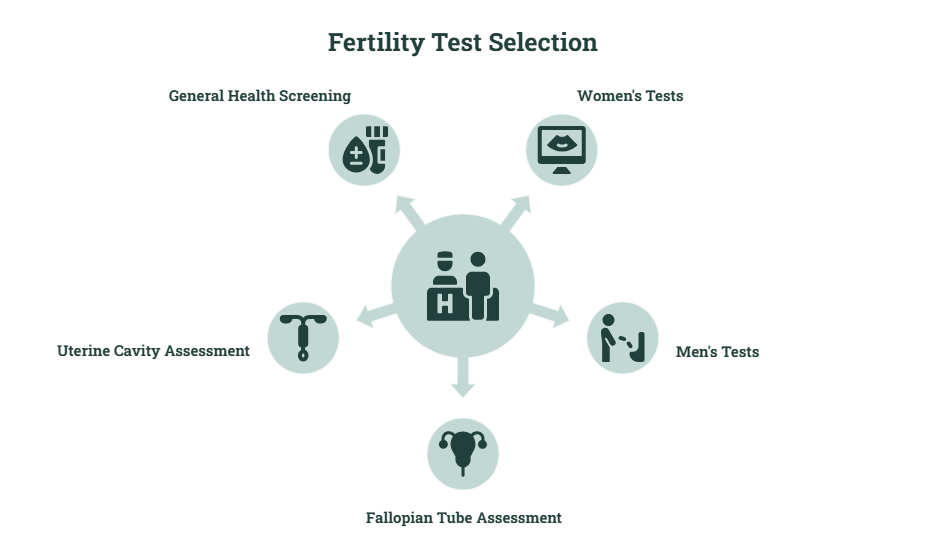
For Women
Depending on your circumstances, assessment may include:
- Pelvic or transvaginal ultrasound
- Antral follicle count (AFC)
- AMH
- Selected hormone blood tests
- Fallopian-tube assessment
- Uterine-cavity assessment
- Other specialised investigations when clinically indicated. The
ESHRE guidelines and consensus documents
provide evidence-based recommendations on fertility assessment, diagnostic testing, and treatment planning for both male and female partners.
These tests do different jobs and should not be treated as interchangeable.
For example, AMH and AFC can help assess ovarian reserve and plan ovarian stimulation, but they do not independently predict whether you will become pregnant naturally. Learn more about comparing AFC and AMH levels for ovarian reserve testing, including how both tests are used to assess egg quantity before treatment.
For Men
Male fertility assessment may include a semen analysis.
A semen analysis can assess factors such as:
- Semen volume
- Sperm concentration
- Sperm motility
- Sperm morphology
- Other semen parameters
If the result or medical history indicates a need for further assessment, the doctor may recommend additional testing. The
AUA/ASRM guideline on male infertility
recommends that clinicians initiate concurrent assessment of both male and female partners during initial infertility evaluation, including reproductive history and semen analysis.
A single semen-analysis result should not automatically be interpreted in isolation. If a result is abnormal, repeat testing or additional assessment may be recommended.
Fallopian-Tube and Uterine Assessment
Depending on your history and the treatment being considered, the doctor may recommend assessment of the fallopian tubes or uterine cavity.
These tests are not required for every patient at the first appointment.
The timing depends on your circumstances and the treatment plan.
General Health and Infection Screening
Before some fertility procedures, the doctor may recommend health or infection screening to help prepare for treatment and ensure appropriate safety.
The tests required depend on the treatment, your medical history and your individual circumstances.
If You Want a Semen Analysis on the Same Day
Tell the clinic when booking your appointment.
GFC needs to reserve time and confirm how the sample should be collected.
GFC’s previously published guidance recommends approximately 3–5 days of abstinence and no more than 7 days, but you should follow the specific instructions provided by the GFC team for your appointment.
Before the test:
- Follow the clinic’s recommended abstinence period.
- Tell the clinic if you have recently had a fever or illness.
- Inform the team about relevant medications.
- Tell the clinic if you have previously had difficulty producing a sample.
- Do not collect a sample at home or use another container unless the clinic has specifically confirmed the collection method, container and transport requirements.
- Bring previous semen-analysis reports if you have them.
The time required to receive results depends on the test and laboratory schedule.
If you want to see the doctor to discuss your semen-analysis results on the same day, ask the clinic about the expected turnaround time before your appointment.
A single semen analysis may not represent long-term sperm health. If the result is abnormal, your doctor may recommend repeating the test or carrying out additional assessment.
Do You Need a Marriage Certificate at the First Consultation?
The first consultation and preliminary assessment can begin with identification documents.
The relationship documents, consent forms and other documentation required before starting assisted reproductive treatment depend on the treatment and the requirements in force at that time.
If you are already married and expect to begin treatment soon, it is sensible to bring your marriage certificate or ask GFC to confirm what documents are required.
International Couples
If you are travelling from another country, send a copy of your relevant documents to GFC in advance so the team can confirm:
- Which documents are required
- Whether your documents are acceptable
- Whether translation is needed
- Whether additional certification is required
Do not arrange international travel for a procedure based only on a general document checklist. For a comprehensive overview of the treatment journey, read the guide to IVF in Thailand for Foreigners, which covers documentation, travel planning, and treatment timelines for international patients.
Your specific documents should be reviewed before you travel.
How Much Does the First Fertility Appointment Cost?
The cost depends on what is included in your appointment.
For example, an appointment may involve:
- Doctor consultation
- Clinic or facility fees
- Ultrasound
- Blood tests
- Semen analysis
- Other investigations
- Medication or follow-up
If you are already planning treatment, there may also be separate costs for:
- IUI
- IVF/ICSI
- Laboratory procedures
- Embryo freezing
- Storage
- PGT-A
- Frozen embryo transfer(FET)
Before paying, ask GFC to confirm exactly what is included in your quotation and which services are charged separately.
For international patients, requesting an itemised quotation is particularly useful because it makes it easier to plan your total treatment and travel budget. Review GFC’s current ICSI treatment pricing for 2026 for package tiers, eligibility criteria, medication limits, and optional genetic testing to understand future treatment costs.
What Questions Should You Ask the Doctor?
Your first appointment is not only about answering the doctor’s questions. It is also an opportunity to understand your options.
Consider asking:
- Based on our information so far, which factors may be affecting our fertility?
- What information is still missing?
- Which tests are necessary now and which can wait?
- Are there alternatives to the treatment being recommended?
- How will we measure whether treatment has been successful?
- How do age, ovarian reserve, semen results and previous treatment affect the recommended plan?
- How long will the treatment cycle take?
- How many times will we need to visit the clinic?
- Will we need to take time off work?
- What are the main risks and possible side effects?
- What could cause a cycle to be cancelled or the treatment plan to change?
- Which costs are included in the quotation?
- Which costs could be added later?
- If the first treatment cycle is unsuccessful, what happens next?
Understanding the answers before treatment begins can help you make a more informed decision. Use this guide on selecting an IVF clinic in Bangkok based on laboratory quality and specialist expertise to evaluate success-rate methodology, laboratory technology, and international-patient support.
What Happens After the First Appointment?
Your next step may be:
- Waiting for test results
- Completing additional investigations
- Adjusting medication
- Returning on a specific day of your menstrual cycle
- Choosing between treatment options
- Starting a treatment cycle
Some treatment plans begin early in the menstrual cycle, but this does not mean that every patient needs to call on the first day of their period or start treatment on cycle day 1–3.
Follow the individual schedule provided by your doctor.
Before leaving, ask for a clear summary of your plan covering:
- The problem or possible causes being assessed
- Tests that need to be completed
- Test dates and follow-up appointments
- Recommended treatment and alternatives
- Medication and precautions
Itemised costs and exclusions - Who to contact if your period starts, you develop symptoms or need to change an appointment
What Should International Patients Prepare Before Travelling to Thailand?
International patients need to consider both medical preparation and travel logistics.
Before booking your flight, send GFC:
- A summary of your fertility history
- Your most recent test results
- A copy of your passport
- Your planned travel dates
- The number of days you expect to stay in Thailand
If you have undergone previous IVF or ICSI treatment, also provide relevant information such as:
- Medication names and doses
- Ovarian stimulation dates
- Number of eggs retrieved
- Fertilisation results
- Embryo-development reports
- Previous PGT results
An online assessment can help the team prepare for your visit, but physical examination, ultrasound, sample collection and medical procedures still need to be performed according to your doctor’s plan. Read about GFC’s advanced lab technology and AI embryo assessment, including controlled laboratory environments and quality-assurance protocols.
Do Not Book Your Return Flight Too Early
If you are travelling specifically for fertility treatment, avoid fixing your return date before the clinical team has confirmed the necessary treatment window.
Ovarian and reproductive responses can differ between patients, so the actual timing may not always match the initial estimate.
This is particularly important for patients travelling from overseas who need to coordinate:
- Flights
- Hotels
- Time away from work
- Medication
- Follow-up appointments
- Additional treatment visits
Frequently Asked Questions
Do I need to wait until my period before having a fertility consultation?
No. You can begin a fertility consultation at any point in your menstrual cycle. If a particular test needs to be performed on a specific cycle day, the doctor can arrange an additional appointment.
Does everyone need AMH, ultrasound and semen analysis at the first appointment?
No. Tests are selected according to your age, medical history, previous results, how long you have been trying to conceive and the treatment being considered.
Does my partner need to attend?
It is preferable for both partners to attend when possible because fertility should be assessed for both partners. However, one partner can begin the consultation and the other can provide results or attend later if necessary.
How many days should I abstain before a semen analysis?
GFC’s previously published guidance recommends approximately 3–5 days and no more than 7 days. However, confirm the specific instructions with GFC when booking because requirements may vary according to the test and individual circumstances.
Can I have a fertility consultation without a marriage certificate?
You can begin a consultation and preliminary assessment. However, documentation requirements for starting assisted reproductive treatment depend on the treatment and the current applicable requirements. International patients should have their documents checked by GFC before travelling.
Can treatment start on the first appointment?
Sometimes a step may be possible if your medical information, documentation, cycle timing and treatment decisions are ready. However, many patients need to wait for test results or further planning first.
Do not assume that everyone will start medication on the first appointment.
Can I use fertility tests from another clinic or country?
Yes, you can bring previous results.
The doctor will consider the test date, testing method, reference units and completeness of the report before deciding whether the results can still be used for treatment planning or should be repeated.
How long does the first appointment take?
The required time depends on whether you are having a consultation only or also having ultrasound, blood tests, semen analysis or other investigations.
If you need to travel elsewhere on the same day, ask the GFC team for an estimated timeframe when confirming your appointment.
Is the first fertility consultation free?
Do not assume that every appointment or investigation is free.
The cost depends on the services included, and some tests or procedures may be charged separately. Ask GFC to confirm the services included and the applicable cost before travelling.
Book Your First Fertility Appointment at GFC
At Genesis Fertility Center (GFC), the first fertility appointment is designed to understand your situation before deciding which investigations or treatments are appropriate.
You do not necessarily need every fertility test, and you do not necessarily need to start IVF or ICSI immediately.
The goal is to understand the relevant factors, identify what information is still needed, discuss your options and create a treatment plan that fits your medical needs and personal circumstances.
For international patients, send your medical history and previous test results before travelling whenever possible. This gives the GFC team an opportunity to review your situation and help you plan the appropriate appointments, investigations and treatment timeline.