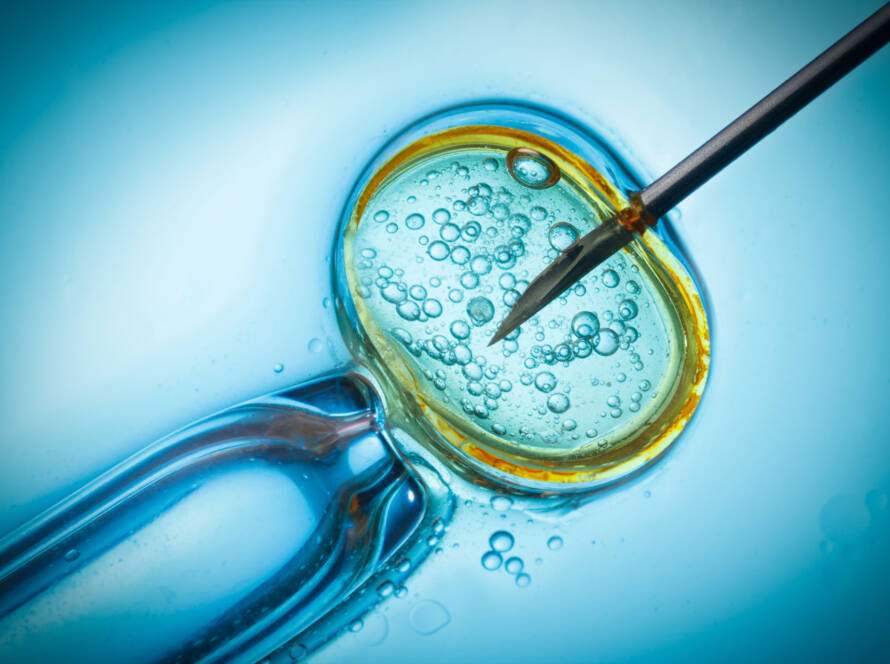
Genesis Fertility Center (GFC) combines IVF and ICSI treatment in Bangkok with advanced laboratory technologies, including AI-assisted embryo assessment with iDAScore, MACS sperm selection, PGT-A, NGS, and vitrification.
Each technology serves a different purpose, from assessing embryo development and screening chromosomes to selecting sperm and preserving eggs or embryos. Not every patient needs every technology; the appropriate approach depends on individual factors and the recommendation of a fertility specialist. For an overview of how these technologies fit into treatment, read the complete IVF and ICSI fertility treatment guide.
What IVF technologies are available at Genesis Fertility Center?
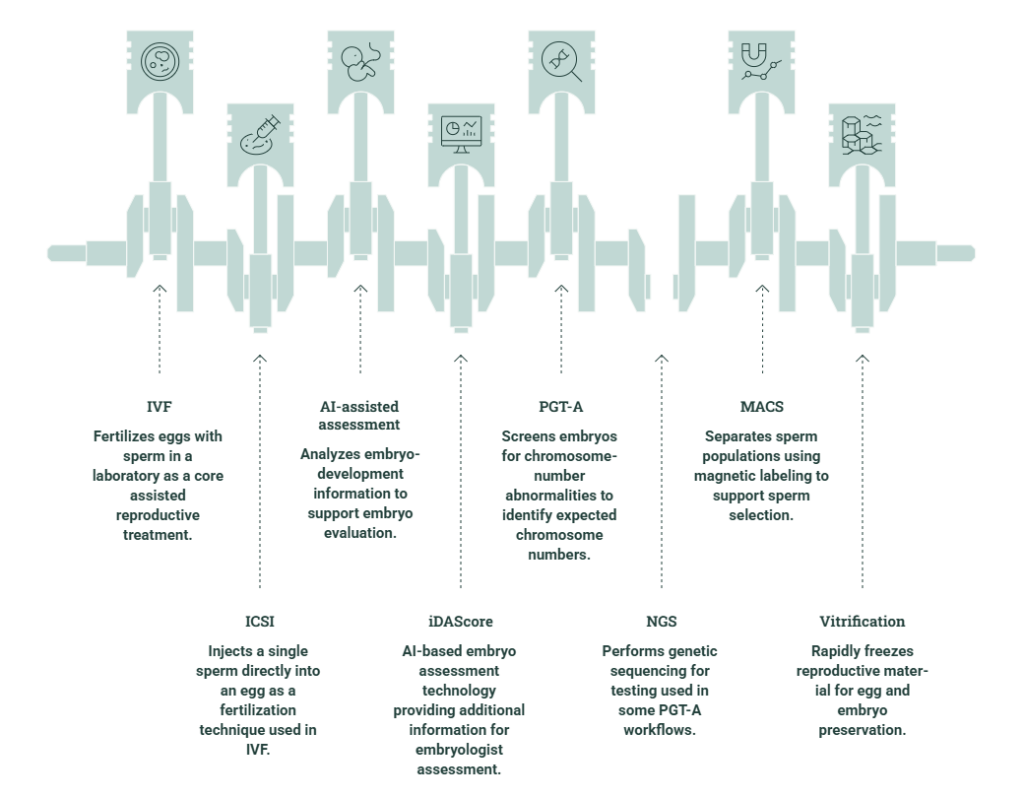
GFC’s current embryology laboratory technology includes several tools that can be used at different stages of IVF and ICSI treatment.
| Technology | What it does | Main role in fertility treatment |
|---|---|---|
| IVF | Fertilizes eggs with sperm in a laboratory | Core assisted reproductive treatment |
| ICSI | Injects a single sperm directly into an egg | Fertilization technique used in IVF |
| AI-assisted embryo assessment | Analyzes embryo-development information | Supports embryo evaluation |
| iDAScore | AI-based embryo assessment technology | Provides additional information for embryologist assessment |
| PGT-A | Screens embryos for chromosome-number abnormalities | Helps identify embryos with expected chromosome number |
| NGS | Performs genetic sequencing for testing | Used in some PGT-A workflows |
| MACS | Separates sperm populations using magnetic labeling | Supports sperm selection in appropriate cases |
| Vitrification | Rapidly freezes reproductive material | Used for egg and embryo preservation |
The purpose of these technologies is to provide fertility specialists and embryologists with additional laboratory capabilities and information. They should be selected according to the patient’s individual circumstances rather than simply adding every available technology to a treatment cycle. Before choosing a provider, use this guide on how to choose an IVF clinic in Bangkok to evaluate specialist experience, laboratory standards, success-rate definitions, package inclusions, and international-patient support.
What is AI-assisted embryo assessment?
AI-assisted embryo assessment uses computer-based analysis to evaluate information about embryo development and provide additional data that may assist embryologists when assessing embryos.
At GFC, iDAScore is used as an AI-assisted embryo assessment technology. GFC describes it as a tool that supports more objective embryo evaluation and helps embryologists identify embryos with higher implantation potential.
Importantly, AI does not replace the fertility specialist or embryologist. The American Society for Reproductive Medicine (ASRM) describes AI in the IVF laboratory as a potentially useful adjunct for embryo selection, while emphasizing that the technology remains at an early stage and that appropriately designed studies are still needed to establish its risks and benefits.
Does AI choose the embryo by itself?
No. AI-assisted embryo assessment should be viewed as an additional source of information rather than an autonomous medical decision-maker.
Embryologists consider AI-generated information alongside embryo-development characteristics, laboratory observations, clinical information, and the patient’s treatment plan.
This distinction is important because no embryo-assessment technology can guarantee implantation, pregnancy, or a live birth.
What is time-lapse embryo monitoring?
Time-lapse embryo monitoring captures images of embryos throughout their development, giving embryologists additional information to assess embryo progression over time. It can support embryo selection but does not guarantee higher pregnancy rates. Its clinical value depends on the available evidence and the laboratory’s protocols.
What is PGT-A?
PGT-A stands for preimplantation genetic testing for aneuploidy. It is a laboratory test used to assess whether an embryo has an abnormal or expected number of chromosomes before embryo transfer.
PGT-A is different from embryo morphology or AI-assisted embryo assessment.
- AI-assisted embryo assessment evaluates embryo-development information.
- Embryo morphology evaluates physical characteristics and developmental appearance.
- PGT-A evaluates chromosome copy number.
- NGS is a sequencing technology that can be used to analyze genetic material obtained for PGT-A.
GFC currently offers PGT-A using NGS. Its published information describes embryo culture to the blastocyst stage, biopsy, genetic analysis and subsequent embryo transfer following the testing process.
PGT-A does not test for every possible genetic or developmental condition. It is specifically focused on chromosome-number abnormalities, and the decision to use it should be made with a fertility specialist based on the patient’s circumstances. Patients can also read the complete PGT-A embryo-screening guide to learn more about embryo chromosomes, testing limitations, and how results may be used during treatment.
What is NGS in PGT-A?
NGS means next-generation sequencing. In the context of IVF, NGS can be used as the laboratory sequencing technology for PGT-A.
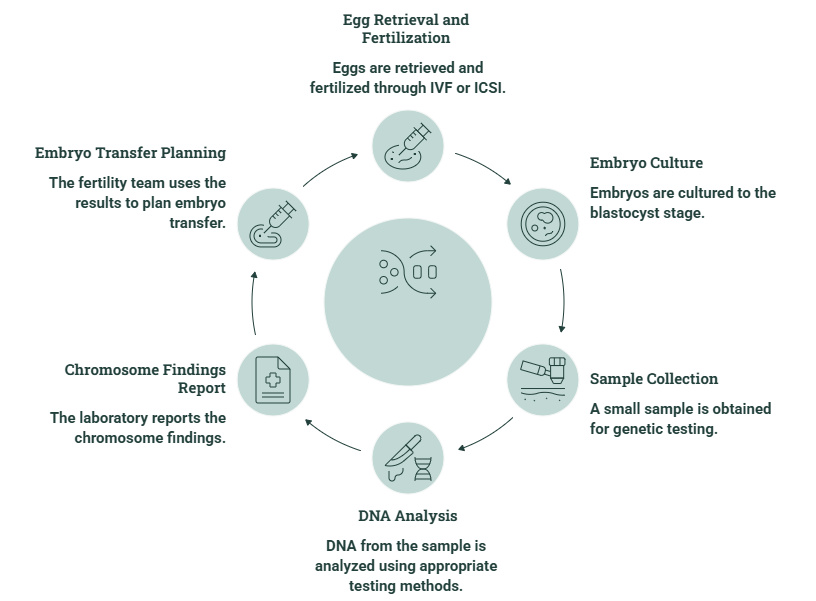
A simplified PGT-A process is:
- Eggs are retrieved and fertilized through IVF or ICSI.
- Embryos are cultured to the blastocyst stage.
- A small sample is obtained for genetic testing.
- DNA from the sample is analyzed using the appropriate testing method.
- The laboratory reports the chromosome findings.
- The fertility team uses the results together with other clinical information when planning embryo transfer.
GFC’s current English-language content states that its PGT-A testing uses NGS and that results are typically available within 24 hours.
Patients should ask their clinic exactly what test is being performed, what the result means, and what limitations apply to the test.
Are NGS and PGT-A the same thing?
No.
PGT-A is the test. NGS is a sequencing technology that can be used to perform the analysis.
A simple way to remember the difference is:
- PGT-A = what is being tested.
- NGS = how the genetic material can be analyzed.
What is MACS sperm selection?
MACS stands for Magnetic-Activated Cell Sorting. It is a laboratory sperm-selection technique that uses magnetic labeling to separate sperm populations according to specific cellular characteristics.
GFC lists MACS among the advanced laboratory technologies available at its clinic.
MACS may be considered in selected fertility-treatment situations, but it is not automatically required for every IVF or ICSI cycle.
What is vitrification?
Vitrification is a rapid-freezing technique used to preserve eggs and embryos.
During vitrification, reproductive material is cooled extremely rapidly using specialized cryopreservation procedures. The goal is to minimize ice-crystal formation that can damage cells during freezing.
GFC uses vitrification for egg and embryo freezing.
Vitrification can be used for several reasons, including:
- Fertility preservation through egg freezing
- Embryo freezing after IVF or ICSI
- Embryo storage following PGT-A
- Delayed frozen embryo transfer
- Preserving reproductive material for future treatment
Egg freezing and embryo freezing are related but different procedures. Eggs are frozen before fertilization, while embryos are created first and then cryopreserved.
How are IVF, ICSI, PGT-A and embryo assessment different?
These terms are sometimes grouped together even though they describe different parts of fertility treatment.
IVF
In vitro fertilization (IVF) is a treatment in which eggs and sperm are brought together in a laboratory so that fertilization can occur outside the body.
ICSI
Intracytoplasmic sperm injection (ICSI) is a fertilization technique in which an embryologist injects a single sperm directly into an egg. For a detailed explanation of the differences between conventional IVF and ICSI, see the IVF and ICSI treatment in Bangkok page.
ICSI is therefore not a completely separate category from IVF. It is a technique that can be used during an IVF cycle.
Embryo Assessment
Embryo assessment involves evaluating embryos as they develop in the laboratory. This may include conventional embryology assessment and, where available, additional technologies such as AI-assisted analysis.
PGT-A
PGT-A is a genetic test that evaluates chromosome copy number in embryos.
Vitrification
Vitrification is a freezing technique used to preserve eggs or embryos.
Understanding these distinctions makes it easier to understand why a fertility clinic may use several technologies during a single treatment cycle.
How does GFC’s embryology laboratory support IVF?
An IVF cycle involves a sequence of clinical and laboratory steps. Different technologies may be used at different points.
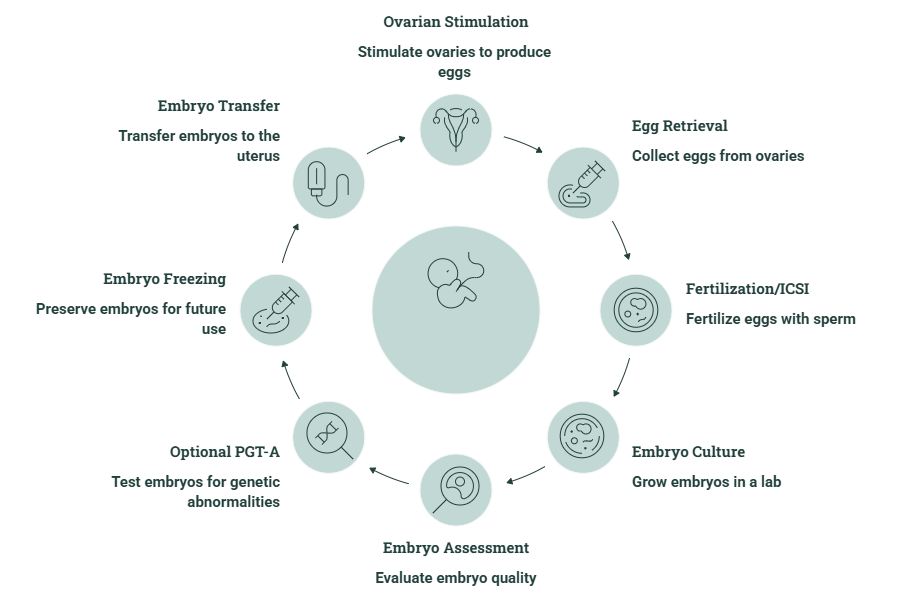
A simplified pathway is:
Ovarian stimulation → egg retrieval → fertilization/ICSI → embryo culture → embryo assessment → optional PGT-A → embryo freezing when appropriate → embryo transfer
The laboratory is therefore an important part of IVF treatment.
GFC describes its on-site embryology laboratory as supporting multiple stages of treatment with technologies including AI-assisted embryo assessment, MACS, PGT-A and vitrification.
The specific technologies used depend on the treatment plan recommended for each patient.
Does advanced IVF technology guarantee pregnancy?
No. No IVF technology can guarantee pregnancy or a live birth.
Technologies such as AI-assisted embryo assessment, PGT-A, MACS and vitrification are tools used to support different aspects of fertility treatment. They do not eliminate the biological factors that influence IVF outcomes.
Important factors can include:
- Maternal age
- Ovarian reserve and egg quality
- Sperm quality
- Embryo development
- Uterine and endometrial factors
- Underlying fertility diagnosis
- Previous fertility treatment
- Overall health and individual medical circumstances
Even when an embryo has favorable laboratory characteristics or a PGT-A result considered appropriate for transfer, implantation and pregnancy cannot be guaranteed.
A reputable fertility clinic should therefore explain both the potential benefits and the limitations of each technology. For context on how GFC presents and explains its reported outcomes, read the clinic’s guide to IVF success rates in Thailand. Success figures should be compared only when the patient group, embryo type, outcome definition, and denominator are similar.
Which IVF technology is right for me?
There is no single technology that is best for every fertility patient.
Your fertility specialist may consider different technologies depending on your diagnosis and treatment history.
IVF or ICSI
The choice of fertilization method depends on the clinical circumstances and laboratory considerations.
AI-assisted embryo assessment
AI-assisted assessment may provide additional information that helps embryologists evaluate embryo development.
PGT-A
PGT-A may be considered when chromosome screening is clinically appropriate.
NGS
NGS may be used as part of a PGT-A testing workflow.
MACS
MACS may be considered when the fertility team believes an additional sperm-selection technique is appropriate.
Vitrification
Vitrification may be used when eggs or embryos need to be preserved for future treatment.
The most advanced treatment is not necessarily the treatment containing the greatest number of technologies. The goal is to use the right technology for the right patient at the right stage of treatment.
How should I compare fertility clinics based on technology?
Technology is one factor to consider when choosing an IVF clinic, but it should not be the only factor. GFC’s guide to choosing a fertility clinic in Bangkok provides additional points to compare, including medical expertise, laboratory capability, pricing, and patient care.
When comparing clinics, ask:
- What embryology technologies are actually available on site?
- Which technologies are appropriate for my situation?
- Who performs and reviews embryo assessments?
- What genetic tests are available, and what exactly do they test?
- How are embryos cultured, assessed and stored?
- How does the clinic monitor laboratory quality and safety?
- How does the clinic calculate and report its IVF outcomes?
- What additional costs apply to optional laboratory technologies?
- Will a fertility specialist explain why a particular technology is recommended?
This approach helps patients compare clinics based on evidence, laboratory quality and individualized medical care rather than simply counting the number of technologies advertised.
Frequently Asked Questions
What IVF technology does Genesis Fertility Center use?
GFC currently highlights AI-assisted embryo assessment using iDAScore, MACS sperm selection, PGT-A, NGS and vitrification among its embryology and reproductive technologies.
Does GFC use AI to select embryos?
GFC uses AI-assisted embryo assessment with iDAScore to provide additional information for embryo evaluation. AI should be considered an adjunct to embryologist and specialist assessment rather than a replacement for clinical judgment.
What is iDAScore?
iDAScore is an AI-assisted embryo assessment technology used to analyze embryo-development information and support embryo evaluation.
What is the difference between AI embryo assessment and PGT-A?
AI embryo assessment analyzes information about embryo development, while PGT-A evaluates embryo chromosome copy number. They answer different questions and may provide complementary information.
What is NGS in IVF?
NGS, or next-generation sequencing, is a genetic sequencing technology that can be used to analyze genetic material obtained for tests such as PGT-A.
Does every IVF patient need PGT-A?
No. PGT-A is not automatically necessary for every IVF patient. Whether it is appropriate depends on individual clinical circumstances and should be discussed with a fertility specialist.
Does advanced IVF technology guarantee a successful pregnancy?
No. Advanced laboratory technologies can provide additional information or capabilities, but no fertility treatment can guarantee pregnancy or live birth.
Is vitrification the same as embryo transfer?
No. Vitrification is the rapid freezing of eggs or embryos. Embryo transfer is the later procedure in which an embryo is placed into the uterus.
Why Choose Genesis Fertility Center (GFC)?

Every fertility journey is unique, and choosing the right fertility clinic is an important step toward building your family. At Genesis Fertility Center (GFC), our experienced team of reproductive specialists provides personalized treatment plans using advanced Assisted Reproductive Technology (ART), including IVF, ICSI, Egg Freezing, Embryo Freezing, and PGT-A. We combine advanced laboratory technology with treatment protocols to deliver care tailored to your individual fertility needs.
Our fertility team of obstetricians, gynecologists, fertility specialists, and embryologists is committed to providing compassionate care, clear communication, and transparent pricing throughout every stage of your fertility journey. Learn more about the GFC medical team and doctor schedules.
To learn more or schedule a consultation, please contact Genesis Fertility Center (GFC).
Call Center: 097-484-5335