If you are researching IVF success rates in Thailand, the most important thing to know is that there is no single success rate that applies to every patient or every fertility clinic. IVF outcomes depend on factors such as female age, egg quality, ovarian reserve, sperm quality, embryo quality, fertility diagnosis, uterine health, and the laboratory process.
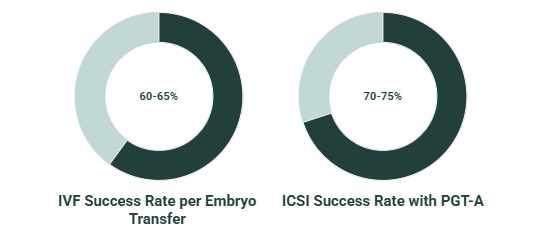
At Genesis Fertility Center (GFC), fertility treatment is planned around the individual patient rather than a fixed success-rate promise. GFC treats more than 2,000 patients each year, and its reported IVF success rate is 60–65% per embryo transfer, increasing to 70–75% with PGT-A genetic screening in appropriate cases. These figures are GFC’s reported ICSI data and should not be interpreted as a universal IVF success rate or a guarantee of pregnancy.
What Is the IVF Success Rate in Thailand?
There is no single national IVF success rate for Thailand that accurately predicts the outcome for every patient.
When comparing IVF success rates in Thailand, patients should first ask:
- Is the figure a pregnancy rate, clinical pregnancy rate, implantation rate, or live birth rate?
- Is it measured per embryo transfer, per treatment cycle, or cumulatively?
- What is the average patient age?
- Does the figure include patients using their own eggs or donor eggs?
- Are embryos tested with PGT-A?
- How many embryos are transferred?
- Is the statistic from the clinic’s own patients or from a national database?
At Genesis Fertility Clinic, the reported IVF success rate is 60–65% per embryo transfer, rising to 70–75% with PGT-A. These are clinic-reported figures for IVF/ICSI and PGT-A cases, not a blanket success rate for every IVF patient.
The most useful question is, “What is the expected chance of success for someone with my age, fertility diagnosis, ovarian reserve, embryo quality, and treatment plan?“
That is the number a fertility specialist can help estimate after an individual assessment. Patients who are unsure which treatment or testing is appropriate can begin with fertility counseling and treatment planning. A consultation can help review age, ovarian reserve, sperm factors, previous treatment, embryo history, uterine health, and personal fertility goals before a clinic-specific success estimate is discussed.
What Do IVF Success Rates in Thailand Really Mean?
One of the biggest problems when comparing fertility clinics is that the term “IVF success rate” can mean different things.
For example, a clinic may report:
| Success measure | What it means |
|---|---|
| Positive pregnancy test | Pregnancy hormone is detected after treatment |
| Clinical pregnancy rate | Pregnancy is confirmed clinically, usually by ultrasound |
| Implantation rate | Proportion of transferred embryos that implant |
| Live birth rate | Percentage of treatments resulting in a live birth |
| Per-transfer rate | Outcome calculated for each embryo transfer |
| Per-cycle rate | Outcome calculated from the beginning of a treatment cycle |
| Cumulative success rate | Combined chance after multiple transfers or treatment cycles |
These figures should not be compared as if they are interchangeable.
A clinic reporting a 70% per-transfer rate is measuring something different from a clinic reporting a 50% live birth rate per initiated cycle. The treatment populations may also be different.
For patients comparing IVF success rates in Thailand, transparency about the denominator and outcome measure is therefore just as important as the percentage itself.
What Factors Affect IVF Success Rates in Thailand?
The country where IVF treatment takes place is only one part of the decision. The patient’s individual fertility profile and the quality of the treatment process are usually much more important.
1. Female Age
Age is one of the most important factors affecting IVF outcomes, particularly because egg quantity and egg quality generally decline with age.
At GFC, fertility specialists assess factors such as:
- Age
- AMH and ovarian reserve
- Antral follicle count
- Previous IVF or ICSI outcomes
- Egg quality indicators
- Medical and reproductive history
This is why two women of the same age can have very different expected outcomes.
A published clinic success rate should therefore never be treated as an individual prediction.
2. Egg Quality and Ovarian Reserve
The number of eggs retrieved is not the same as the number of healthy embryos available for transfer.
During an IVF or ICSI cycle, there is a natural progression:
Follicles → Retrieved eggs → Mature eggs → Fertilized eggs → Embryos → Blastocysts → Transfer
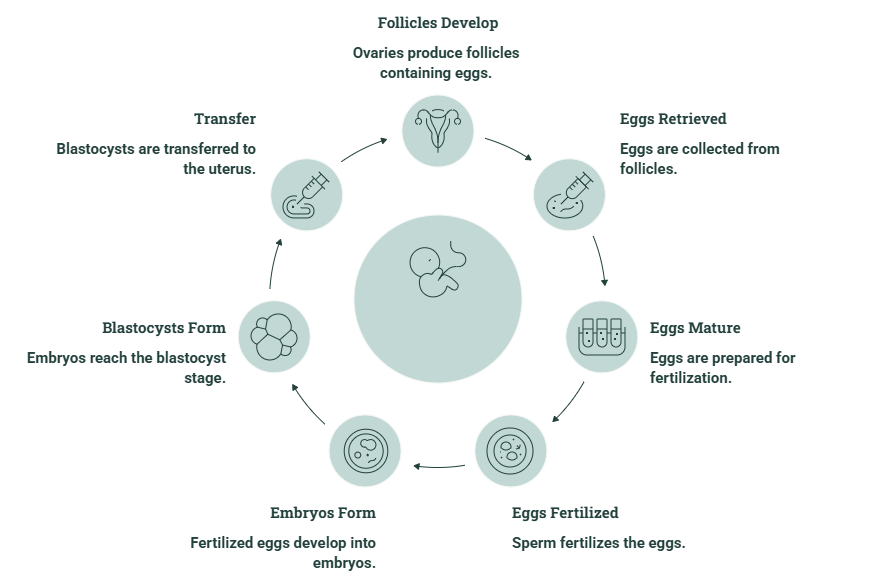
At each stage, the number may decrease.
A patient may therefore have a good ovarian response but still produce fewer embryos suitable for transfer. Conversely, another patient may produce fewer eggs but achieve a good outcome.
3. Embryo Quality
Embryo development is another major factor.
At Genesis Fertility Clinic, embryos are evaluated by experienced embryologists, with AI-assisted embryo assessment using iDAScore available as part of the clinic’s laboratory technology.
The goal is not simply to produce more embryos. It is to identify embryos with the best potential for successful implantation and pregnancy based on the available clinical and laboratory information.
4. Chromosomal Status
Embryo chromosome abnormalities become more common as maternal age increases and can contribute to implantation failure or miscarriage.
PGT-A can be used in selected cases to assess embryos for chromosome abnormalities before transfer. See ASRM’s committee opinion on PGT-A for the current clinical evidence.
The GFC Content Playbook reports a 70–75% success rate with PGT-A Genetic Testing by NGS compared with 60–65% per embryo transfer for IVF/ICSI in the clinic’s reported data. These figures should be understood in their specific context and are not a guarantee that PGT-A will result in pregnancy or live birth for every patient.
PGT-A is also not automatically appropriate for everyone. A fertility specialist should assess whether it is suitable based on age, reproductive history, embryo numbers, and other clinical factors.
5. Sperm Quality
Male fertility factors can affect fertilization and embryo development.
Depending on the situation, the fertility team may consider:
- Sperm concentration
- Motility
- Morphology
- Previous fertilization results
- Severe male-factor infertility
- Previous IVF fertilization failure
This is one reason some patients may be advised to consider ICSI rather than conventional IVF.
6. Uterine and Endometrial Factors
Even when an embryo develops well, the uterus and endometrium must provide a suitable environment for implantation.
Conditions that may affect fertility treatment include:
- Fibroids
- Endometrial polyps
- Adenomyosis
- Endometriosis
- Pelvic adhesions
- Abnormal uterine anatomy
- Endometrial problems
For patients with a history of pelvic adhesions, GFC provides additional information about pelvic adhesion and fertility.
A thorough fertility assessment can help identify factors that may need to be addressed before embryo transfer. The endometrium must also be assessed and prepared before transfer. Learn why uterine-lining preparation is important for IVF success, including how lining thickness, adhesions, fibroids, and hormonal factors may affect implantation planning. If embryos are frozen after IVF, ICSI, or PGT-A, the next treatment stage may be a frozen embryo transfer in Thailand. A frozen transfer uses a later, prepared cycle rather than transferring an embryo immediately after ovarian stimulation, so its outcome should be reported separately from fresh-transfer results.
IVF vs. ICSI: Does the Fertilization Method Affect Success?
IVF and ICSI are often discussed together, but they are not exactly the same procedure.
In conventional IVF, sperm and eggs are placed together in the laboratory, allowing fertilization to occur naturally.
In ICSI, an embryologist injects a selected sperm directly into a mature egg.
IVF and ICSI should also be distinguished from older assisted-reproduction techniques such as GIFT. In IVF, fertilization takes place in the laboratory before embryo transfer, while GIFT places eggs and sperm into the fallopian tube. Read more about the difference between IVF and GIFT.
The rest of the treatment process, including ovarian stimulation, egg retrieval, embryo culture, and embryo transfer, is broadly similar.
ICSI may be recommended in situations such as:
- Male-factor infertility
- Previous fertilization failure
- Certain sperm-quality problems
- Selected cases where PGT-A is planned
The appropriate method depends on the patient’s diagnosis and treatment plan. ICSI should not automatically be assumed to produce a higher overall live birth rate for every patient.
Read GFC’s detailed guide to the difference between IVF and ICSI before comparing treatment options.
Why Do IVF Success Rates Differ Between Clinics in Thailand?
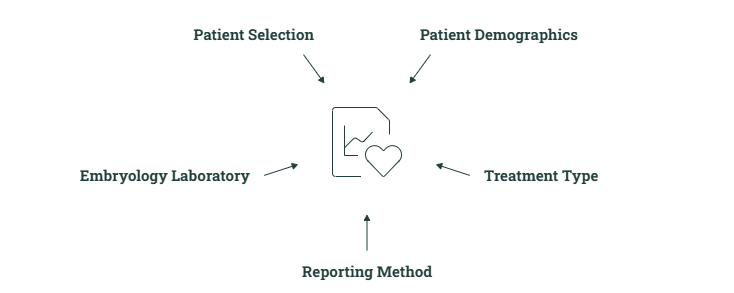
When patients compare fertility clinics in Bangkok or elsewhere in Thailand, differences in reported success rates can be caused by several factors.
Patient Demographics
A clinic treating mainly younger patients may report different results from a clinic treating a higher proportion of patients over 40.
Treatment Type
Success rates can vary depending on whether the clinic reports conventional IVF, ICSI, frozen embryo transfer, PGT-A cycles, or donor-egg treatment.
Reporting Method
Per-transfer, per-cycle, clinical pregnancy, and live birth rates are different measurements.
Embryology Laboratory
Embryo culture conditions, embryologist expertise, laboratory quality control, and embryo assessment can all influence treatment outcomes.
Patient Selection
Some clinics may accept more complex fertility cases, which can affect their overall reported statistics.
For this reason, patients should avoid choosing a fertility clinic based only on the highest percentage advertised online.
IVF Success Rates in Thailand vs. Cost: Should Price Determine Your Choice?
Thailand is attractive to many international fertility patients because it combines specialist fertility care with competitive treatment costs and established medical tourism infrastructure.
However, the cheapest IVF treatment is not necessarily the best value.
When comparing clinics, consider:
- Fertility specialist experience
- Embryology laboratory standards
- Laboratory technology
- What is included in the treatment package
- Medication costs
- Embryo freezing and storage fees
- PGT-A costs
- Embryo transfer fees
- International patient coordination
- Follow-up care
GFC’s published ICSI packages range from ฿150,000 for LiTE to ฿350,000 for Diamond, while PGT-A is listed at ฿39,900 for the first embryo. Treatment costs and inclusions should always be confirmed with the clinic because an individual treatment plan may require additional services.
Patients considering Thailand can also read GFC’s guide to the benefits of IVF treatment in Thailand for a broader comparison of specialist care, technology, costs, and international patient support.
How to Choose an IVF Clinic in Thailand
Instead of asking only, “Which clinic has the highest IVF success rate?”, ask these questions:
- What does your success rate measure?
- Is the rate per cycle or per embryo transfer?
- Is it a pregnancy rate or live birth rate?
- What is the average age of your patients?
- Do you report outcomes by age group?
- How do you assess embryo quality?
- What embryology laboratory technology do you use?
- When do you recommend ICSI instead of conventional IVF?
- When do you recommend PGT-A?
- What costs are included in the IVF package?
- What additional costs should patients expect?
- How do you support international patients after they return home?
The answers can provide more useful information than a single headline percentage.
Learn more about IVF in Thailand for foreigners to understand treatment planning, travel considerations, costs, and international patient support.
Frequently Asked Questions
What is the average IVF success rate in Thailand?
There is no single average IVF success rate that accurately represents every clinic and patient in Thailand. Success rates depend on the patient’s age, fertility diagnosis, egg and sperm quality, embryo quality, treatment type, and how the clinic defines “success.”
What is the IVF success rate in Bangkok?
IVF success rates in Bangkok vary between clinics and patient groups. When comparing clinics, ask whether the published figure represents pregnancy, clinical pregnancy, implantation, or live birth, and whether it is calculated per cycle or per embryo transfer.
Does age affect IVF success rates?
Yes. Female age is one of the most important factors affecting IVF outcomes because egg quantity and quality generally decline with age. However, age alone cannot predict an individual patient’s outcome.
Does PGT-A increase IVF success rates?
PGT-A may be beneficial for selected patients, particularly when chromosome abnormalities are a concern. However, it is not appropriate for every patient and does not guarantee pregnancy or live birth.
At GFC, the reported success rate is 70–75% with PGT-A compared with 60–65% per embryo transfer for ICSI. These figures represent GFC’s reported clinic data and should be interpreted in the context of the treatment population and outcome measure.
Is IVF in Thailand successful for foreigners?
International patients can receive fertility treatment in Thailand, but individual eligibility and treatment outcomes vary. Foreign patients should consider medical factors alongside legal requirements, documentation, travel planning, and follow-up care.
GFC provides dedicated support for international patients and offers English-speaking coordination for patients planning treatment in Thailand.
Is IVF cheaper in Thailand?
Treatment costs in Thailand can be competitive compared with many Western countries, but the total cost depends on the treatment protocol, medication, laboratory procedures, embryo freezing, genetic testing, and other services.
Patients should compare the total treatment cost and package inclusions, rather than choosing a clinic based only on the lowest advertised price.
Why Choose Genesis Fertility Center (GFC)?

Every fertility journey is unique, and choosing the right fertility clinic is an important step toward building your family. At Genesis Fertility Center (GFC), our experienced team of reproductive specialists provides personalized treatment plans using advanced Assisted Reproductive Technology (ART), including IVF, ICSI, Egg Freezing, Embryo Freezing, and PGT-A. We combine advanced laboratory technology with treatment protocols to deliver care tailored to your individual fertility needs.
Our fertility team of obstetricians, gynecologists, fertility specialists, and embryologists is committed to providing compassionate care, clear communication, and transparent pricing throughout every stage of your fertility journey.
To learn more or schedule a consultation, please contact Genesis Fertility Center (GFC).
Call Center: 097-484-5335
This article is for general information and does not replace a personal medical consultation. Individual results vary; your fertility specialist will advise on what is appropriate for your situation.