Book Your Egg Freezing Consultation at GFC:
Reviewed by GFC Medical Team
Assoc. Prof. Dr. Pitak Laokirkkiat
Lead Reproductive Endocrinologist · Thai Medical Council License #18494 · 23 years’ experience.
Dr. Pitak oversees complex cases at Genesis Fertility Center and has reviewed the clinical information on this page.
Egg Freezing in Bangkok, Thailand with Genesis Fertility Clinic
Preserve your fertility with advanced egg freezing (oocyte cryopreservation) in Bangkok. Protect your healthiest eggs today and keep your options open for future family planning with expert fertility specialists and state-of-the-art cryopreservation technology.
Egg freezing (oocyte cryopreservation) collects and freezes your healthy eggs so they can be used for pregnancy later. Because egg quality and quantity fall with age — especially after 35 — freezing eggs while you are younger preserves them at their best. At Genesis Fertility Center, eggs are frozen by Vitrification and stored at −196°C for years; when you are ready, they are thawed and fertilised through ICSI.
Packages start from ฿170,000, including up to 20 eggs and the first year of storage.
What is Egg Freezing?
Egg freezing preserves a woman’s eggs at their current quality. The process involves stimulating the ovaries to produce multiple mature eggs, which are then retrieved through a minimally invasive procedure. The mature eggs are rapidly frozen using vitrification technology and stored safely in liquid nitrogen at -196°C.
- A specialist stimulates the ovaries to mature several eggs, retrieves them, and freezes the healthiest ones by Vitrification — an ultra-fast freezing method that avoids the ice crystals that can damage a cell.
- The eggs are kept in liquid nitrogen at −196°C and can be stored for many years.
- When you are ready to conceive, they are thawed and fertilised with sperm through ICSI.
- Egg freezing enables women to preserve their fertility by storing eggs at a younger age, when egg quality is typically at its highest.
| Egg freezing | Embryo freezing | |
|---|---|---|
| Sperm needed now? | No — eggs frozen unfertilised | Yes — eggs fertilised before freezing |
| Best for | Single women, or keeping options open | Couples ready to commit to a partner's sperm |
| Flexibility | High — choose a partner later | Lower — embryos tied to that sperm |
| Freezing method | Vitrification (−196°C) for both | |
Who Should Consider Egg Freezing?
A woman’s fertility naturally declines with age. Both the number and quality of eggs decrease over time, with a more significant decline beginning around age 35. As egg quality decreases, it becomes more difficult to conceive naturally, and the risks of miscarriage and chromosomal abnormalities increase.
By freezing eggs at a younger age, women can preserve healthier eggs for future use, improving their chances of a successful pregnancy later in life. Timing is an important part of fertility planning. Read more about the best age to freeze eggs and discuss your age, ovarian reserve, AMH level, and family-building goals with a fertility specialist.
For example, if you freeze your eggs at age 30 and decide to have children at age 40, your frozen eggs retain the quality they had when they were collected, rather than reflecting your age at the time of treatment.
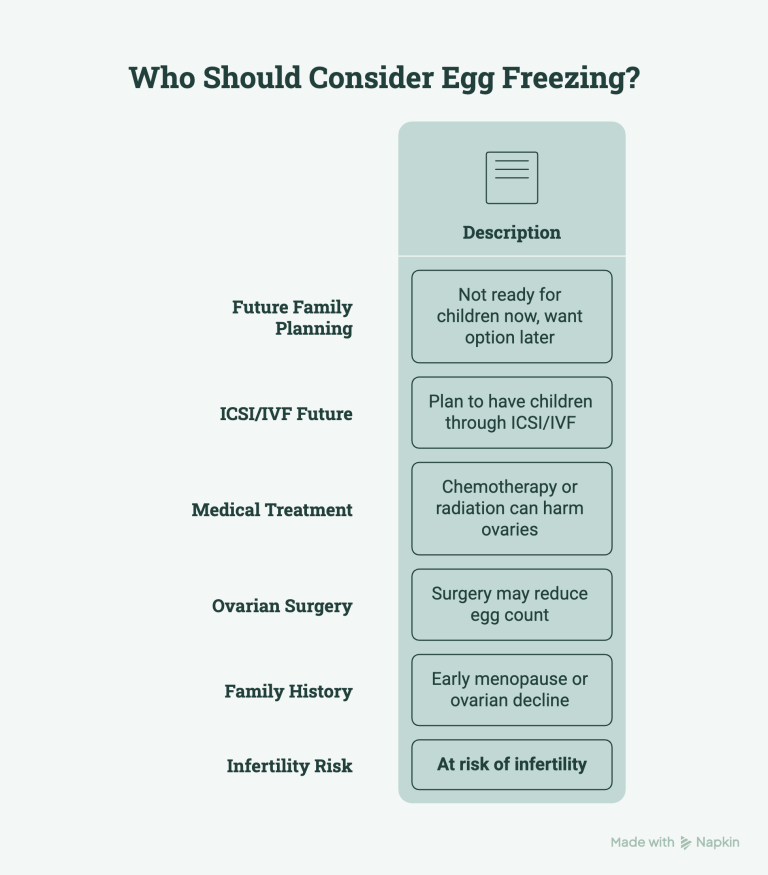
- Are not yet ready to have children but wish to preserve their fertility
- Plan to undergo IVF or ICSI in the future
- Want to delay pregnancy for personal, educational, or career reasons
- Have been diagnosed with cancer and require chemotherapy or radiation treatment that may affect ovarian function
- Need ovarian surgery for conditions such as ovarian cysts or benign ovarian tumors
- Have a family history of premature ovarian insufficiency or early menopause
- Have medical conditions that may reduce ovarian reserve
- Are concerned about age-related fertility decline
- Have been diagnosed with infertility or are at increased risk of infertility
What are the Benefits of Freezing your Eggs Early?
The younger your eggs are when frozen, the greater their potential for future pregnancy. Egg quality and quantity drop with age, especially after 35. Freezing while younger preserves better-quality eggs, raises future pregnancy chances, and lowers the age-related risk of chromosomal abnormalities. The ideal window is 20–35, and before 40 where possible.
Freezing eggs early offers several important benefits:
- Preserves younger, healthier eggs
- Improves the chances of successful fertilization and pregnancy
- Reduces the impact of age-related fertility decline
- Provides greater reproductive flexibility
- Offers reassurance for women who are not yet ready to conceive.
When Is the Best Age to Freeze Your Eggs?
The ideal time to freeze eggs is generally between 20 and 35 years of age, when egg quantity and quality are at their peak.
Although egg freezing is still possible after age 35—and in some cases after age 40—the number of eggs retrieved and their quality may be lower. Women considering fertility preservation later in life should consult a fertility specialist for an individualized assessment.
Early egg freezing offers several advantages:
- Higher-quality eggs
- Greater number of eggs retrieved
- Higher future pregnancy success rates
- Lower risk of age-related chromosomal abnormalities
- Greater flexibility in family planning
Why More Women Are Choosing Egg Freezing
Today, many women choose to delay pregnancy due to career goals, education, financial planning, or waiting for the right partner.
While personal circumstances may change, ovarian aging continues naturally over time. Egg freezing allows women to preserve their fertility without feeling pressured by their biological clock, giving them greater flexibility to decide when they are ready to build a family.
The Egg-Freezing Process at GFC
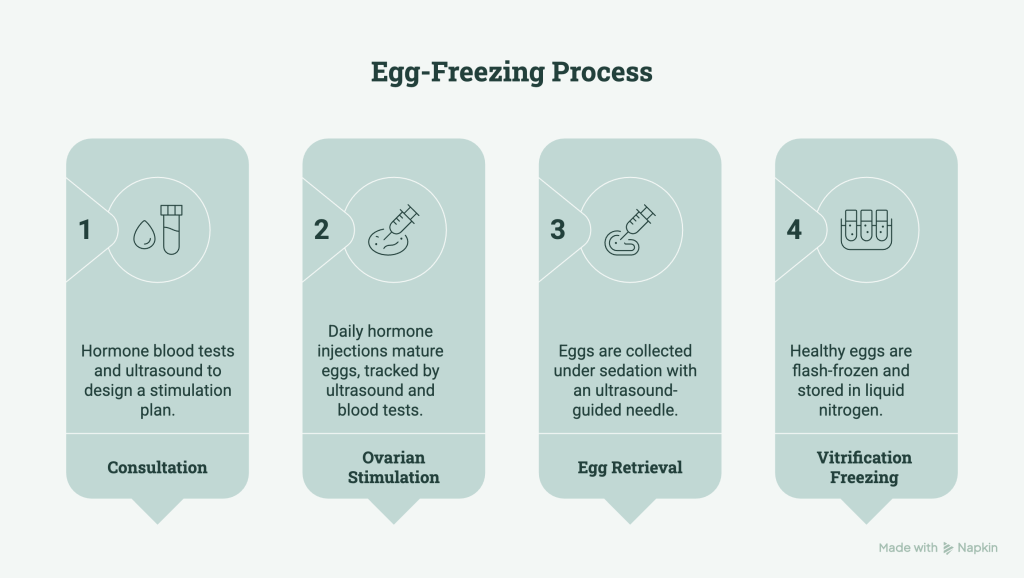
Egg freezing fits inside a single menstrual cycle — about 2 weeks from the first injection to retrieval.
- Consultation & health check — hormone blood tests (FSH, LH, AMH, Estradiol) and an ultrasound of the ovarian follicles, so the doctor can design a stimulation plan for you.
- Ovarian stimulation (8–14 days) — daily hormone injections mature several eggs, tracked by ultrasound and blood tests; a final “trigger shot” ripens the eggs.
- Egg retrieval (~15–20 min) — 34–36 hours after the trigger, eggs are collected under sedation with a fine ultrasound-guided needle. Rest 1–2 hours, then home.
- Vitrification freezing — the healthiest eggs are flash-frozen and stored in liquid nitrogen at −196°C, ready to thaw and fertilise with ICSI whenever you choose. Learn more about how long frozen eggs can be stored, including annual storage arrangements, future-use planning, and the considerations involved if you move or transfer eggs to another clinic.
How to prepare: Eat a high-protein, low-sugar diet; avoid eating after 6pm; take supplements your doctor recommends (e.g. CoQ10, methylfolate, vitamin D); rest and reduce stress; get morning sunlight. Always consult the doctor first.
Before beginning treatment, review our preparation checklist for egg freezing, including guidance on medical preparation, medication timing, retrieval-day instructions, and recovery.
How to Prepare for Egg Freezing Consultation at GFC
Preparing your body before treatment can help optimize egg quality and support your fertility journey.
Before starting the egg freezing process, we generally recommend:
1. Maintain a Healthy Diet
Eat a balanced diet rich in:
- Lean protein
- Fresh vegetables and fruits
- Whole grains
- Healthy fats
Reduce processed foods, excess sugar, and refined carbohydrates to support overall reproductive health.
2. Consider Fertility Supplements
Your fertility specialist may recommend supplements such as:
- Coenzyme Q10 (CoQ10)
- Astaxanthin
- Methyl Folate
- Vitamin D
Supplement recommendations should always be personalized based on your medical history and fertility assessment.
3. Prioritize Sleep and Stress Management
Adequate sleep and effective stress management play an important role in hormonal balance and overall reproductive health. Aim for consistent, high-quality sleep and incorporate relaxation techniques into your daily routine.
4. Get Morning Sunlight
Exposure to natural morning sunlight for approximately 30 minutes each day helps regulate your circadian rhythm, which supports healthy sleep patterns and overall well-being.
Schedule a Fertility Consultation with GFC Today.
Before beginning treatment, your fertility specialist will perform a comprehensive evaluation, including hormone testing and an ultrasound to assess your ovarian reserve.
Egg freezing offers women greater control over their reproductive future by preserving healthy eggs before age-related fertility decline occurs.
Whether you’re focusing on your career, waiting for the right time to start a family, or protecting your fertility before medical treatment, egg freezing provides a safe, effective, and proven option to help keep your future family-building choices open.
Our experienced fertility specialists will guide you through every step of the process with personalized care and advanced reproductive technology.
Based on your age, fertility goals, and medical history, your doctor will develop a personalized egg freezing treatment plan designed to maximize the number and quality of eggs retrieved.