Book Your IVF/ICSI at GFC:
Reviewed by GFC Medical Team
Assoc. Prof. Dr. Pitak Laokirkkiat
Lead Reproductive Endocrinologist · Thai Medical Council License #18494 · 23 years’ experience.
Dr. Pitak oversees complex cases at Genesis Fertility Center and has reviewed the clinical information on this page.
IVF & ICSI Treatment in Bangkok
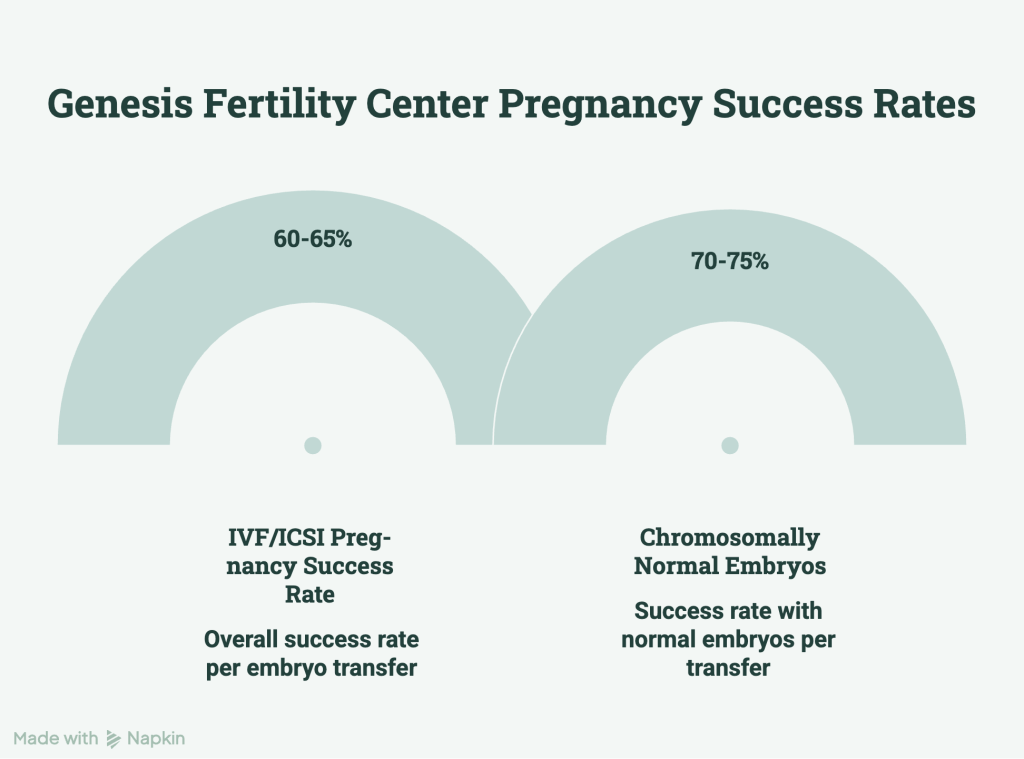
Advanced fertility treatment with Genesis Fertility Clinic in Bangkok with a 60–65% success rate per embryo transfer, transparent all-inclusive pricing, and dedicated English-speaking care for international couples.
What Happens During ICSI Treatment at GFC?
During Intracytoplasmic Sperm Injection (ICSI), the fertility specialist retrieves mature eggs from the ovaries and selects the healthiest sperm from the male partner. Using a highly specialized microscope and an ultra-fine needle, a single healthy sperm is injected directly into each mature egg.
The fertilized eggs are then cultured in a state-of-the-art embryology laboratory for 3–5 days, allowing them to develop into embryos. Once the embryos reach the optimal developmental stage, the embryologist selects the highest-quality embryo(s) typically one or two for transfer into the uterus using a thin, flexible catheter passed gently through the cervix. For a broader explanation of treatment stages, costs, timelines, PGT-A, and success factors, read the complete ICSI and IVF fertility treatment guide.
What Is IVF?
In Vitro Fertilization (IVF) is one of the most effective assisted reproductive technologies for treating infertility.
- The treatment begins with controlled ovarian stimulation, where fertility medications encourage the ovaries to produce multiple mature eggs.
- Once the follicles have reached the appropriate size, the eggs are collected through a minimally invasive transvaginal procedure.
- At the same time, the male partner provides a semen sample.
- In the laboratory, the eggs and sperm are placed together in a culture dish, allowing fertilization to occur naturally without direct sperm injection.
- Successfully fertilized eggs are cultured for 3–5 days until they become embryos suitable for transfer.
IVF vs ICSI: What’s the difference? (Comparison Table)
The primary difference between IVF and ICSI lies in how fertilization occurs. Both are forms of in vitro fertilisation. The difference is only in how the egg is fertilised — everything else in the cycle is identical.
| Conventional IVF | ICSI | |
|---|---|---|
| How fertilisation happens | ~50,000+ prepared sperm placed beside each egg; one penetrates naturally | One selected sperm injected directly into the egg |
| Best suited to | Normal or mild male-factor; unexplained infertility | Male-factor infertility, prior fertilisation failure, frozen eggs |
| Sperm required | Millions of motile sperm | As few as a handful of viable sperm |
| Typical fertilisation rate | Depends on sperm quality | 50–80% of mature eggs |
| Rest of the cycle | Identical — stimulation · retrieval · culture · transfer | |
Because ICSI enables embryologists to select the healthiest sperm before fertilization, it generally provides higher fertilization rates for severe male-factor infertility. For this reason, ICSI has become the preferred treatment over conventional IVF in many fertility centers.
Both IVF and ICSI are highly effective fertility treatments, but choosing the right approach should always be based on an evaluation by a reproductive medicine specialist. Proper preparation by both partners is essential to maximize the chances of a successful pregnancy. Learn more about the difference between IVF and ICSI and why your fertility specialist may recommend one fertilization method over the other.
Your IVF / ICSI journey at Genesis Fertility Clinic
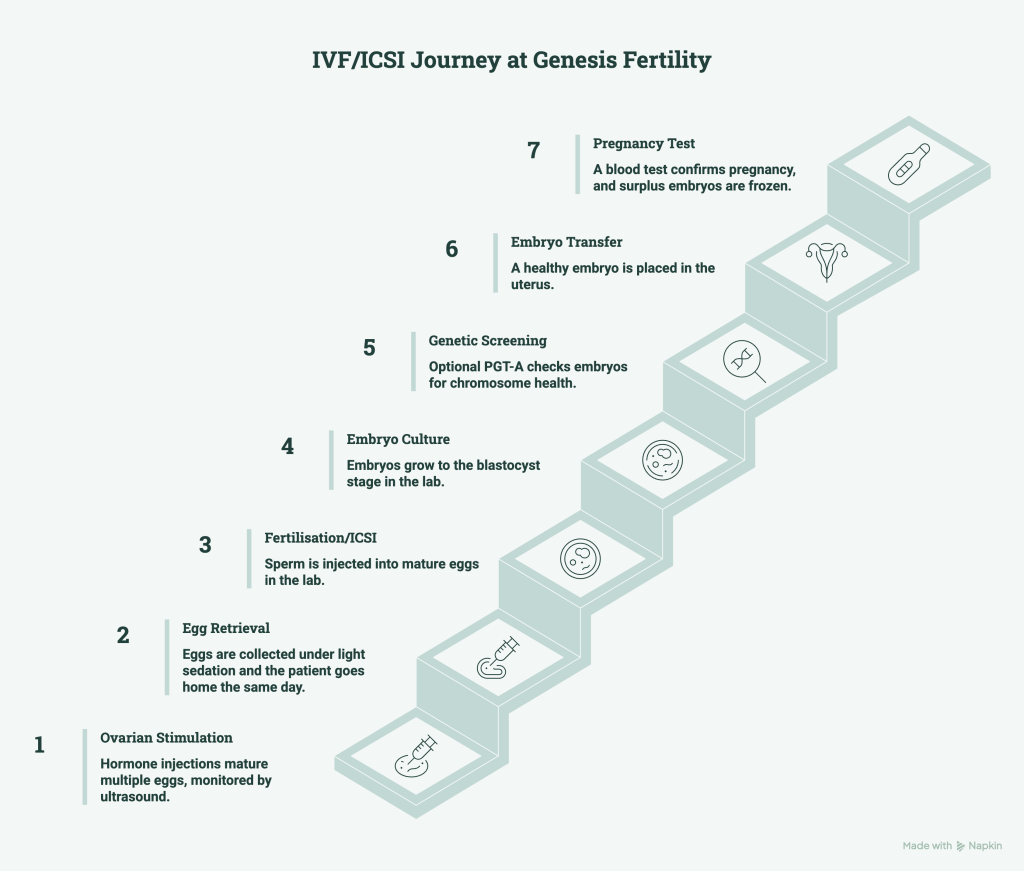
At Genesis Fertility Center (GFC), IVF and ICSI treatments typically take approximately two months from ovarian stimulation to embryo transfer. Treatment begins with an individual fertility counseling and assessment appointment, where your medical history, ovarian reserve, sperm factors, and treatment goals are reviewed.
- Ovarian stimulation (8–12 days) – hormone injections mature several eggs, tracked by ultrasound.
- Egg retrieval (~15–20 min) – eggs collected under light sedation; home the same day.
- Fertilisation / ICSI (same day) – one selected sperm injected into each mature egg.
- Embryo culture (3–5 days) – embryos grow to the blastocyst stage in the lab.
- Genetic screening (optional) – PGT-A checks embryos for chromosome health.
- Embryo transfer (~10 min) – a healthy embryo is placed in the uterus; quick, painless.
- Pregnancy test (10–14 days) – a blood test confirms the result; surplus embryos frozen. When a fresh transfer is not recommended or embryos are reserved for later treatment, patients may return for a frozen embryo transfer.
Patients considering chromosome screening can also read the complete PGT-A embryo-screening guide before discussing the test with their fertility specialist.
Our comprehensive treatment program includes:
- Individualized ovarian stimulation with carefully monitored fertility medications
- Egg retrieval and sperm collection
- Fertilization using IVF or ICSI, depending on your clinical needs
- Continuous embryo culture in a state-of-the-art embryology laboratory
- Embryo transfer into the uterus
- Pregnancy testing and follow-up care
Advanced Embryology Laboratory
Our experienced embryologists carefully monitor embryo development in controlled laboratory conditions using advanced incubation technology to maximize embryo viability and implantation potential.
Patients who are not ready to pursue pregnancy now may also wish to explore egg freezing as a fertility-preservation option.
IVF & ICSI Cost at Genesis Fertility Clinic Thailand
All-inclusive packages, transparently priced.
| Package | Price | Best for |
|---|---|---|
| ICSI LiTE | ฿150,000 | Straightforward cases, standard protocol |
| ICSI Gold | ฿170,000 | Enhanced lab sperm selection |
| ICSI Platinum | ฿230,000 | Advanced embryo culture & added services |
| ICSI Diamond | ฿350,000 | Comprehensive care, senior specialist |
Add-ons:
- PGT-A by NGS: From ฿37,900 THB
- Sperm Premium: ฿34,500 THB
- IUI: from ฿15,000 THB
- Egg Freezing from ฿170,000 THB
See the Full ICSI packages promotions at GFC here. Final cost depends on your protocol and medication — request a personalised quote.
Advanced Genetic Testing (NGS)
Genesis Fertility Center offers Next-Generation Sequencing (NGS) for comprehensive embryo chromosome screening.
NGS enables highly accurate chromosome analysis (up to 99% analytical accuracy) to:
- Select chromosomally normal embryos
- Improve implantation rates
- Increase pregnancy success
- Reduce the risk of miscarriage
- Lower the risk of chromosomal abnormalities such as Down syndrome
NGS may be recommended for patients who:
- Are 35 years or older
- Have experienced recurrent miscarriage
- Have had repeated unsuccessful IVF/ICSI cycles
- Have previously conceived a pregnancy affected by chromosomal abnormalities
- Carry inherited genetic conditions such as thalassemia
Fertility Specialists with Extensive Experience
Genesis Fertility Center is one of Thailand’s leading comprehensive fertility centers, staffed by reproductive endocrinologists, fertility specialists, embryologists, obstetricians, gynecologists, and experienced fertility nurses.
Our multidisciplinary team works closely together throughout every stage of treatment, providing regular embryo development updates and personalized medical care.
Comprehensive Patient Support
International patients receive dedicated support throughout their fertility journey, including:
- Fertility consultations before treatment
- Personalized treatment planning
- Ongoing communication with our nursing team
- Emergency patient support throughout treatment
- Medication reminders to ensure injections are administered at the correct time, an important factor in treatment success
Who Benefits Most from IVF or ICSI?
IVF and ICSI are particularly suitable for couples experiencing:
- Blocked or damaged fallopian tubes
- Male-factor infertility
- Unexplained infertility
- Failed IUI treatment
- Endometriosis
- Ovulation disorders, including PCOS
- Recurrent pregnancy loss
- Advanced maternal age (35+)
- Genetic disorders requiring preimplantation genetic testing (PGT)
A fertility consultation is essential to determine the most effective treatment plan for your individual circumstances.
IVF & ICSI Success Rates at Genesis Fertility Center
Genesis Fertility Center combines experienced fertility specialists, advanced laboratory technology, and evidence-based treatment protocols to achieve excellent clinical outcomes.
- IVF / ICSI pregnancy success rate: 60–65% per embryo transfer
- Success rate with chromosomally normal embryos (after NGS): 70–75% per embryo transfer for suitable candidates
Actual success rates vary depending on maternal age, embryo quality, underlying fertility conditions, and individual medical factors. For more context on how GFC explains its outcomes and the factors that influence treatment results, read the reasons behind GFC’s reported ICSI success rate.