Preparing for egg freezing starts before the day of egg retrieval. The most important steps are to follow your fertility specialist’s medication instructions, attend monitoring appointments, maintain healthy habits, and follow your clinic’s retrieval-day instructions.
Egg freezing, also called oocyte cryopreservation, involves stimulating the ovaries, retrieving mature eggs, and rapidly freezing them using vitrification for potential future use. Learn more about egg freezing at Genesis Fertility Center.
The age at which eggs are frozen and the number of mature eggs stored are important factors when considering future outcomes. However, egg freezing does not guarantee a future pregnancy or live birth.
Quick Egg-Freezing Preparation Checklist
Before egg retrieval, your fertility clinic may advise you to:
- Take fertility medications exactly as prescribed.
- Attend all scheduled ultrasound and blood-test appointments.
- Eat a balanced, nutritious diet.
- Avoid smoking and follow your doctor’s advice about alcohol.
- Follow instructions about exercise and physical activity.
- Take supplements only when recommended by your fertility specialist.
- Tell your doctor about all prescription, over-the-counter, and supplement use.
- Follow the clinic’s specific fasting instructions before retrieval.
- Follow instructions about makeup, nail polish, contact lenses, and hygiene.
- Arrange transportation home if sedation or anesthesia will be used.
- Have a responsible adult accompany you if required after sedation.
What Is Egg Freezing?
Egg freezing is a fertility-preservation procedure in which mature eggs are retrieved from the ovaries and frozen unfertilized for possible use in the future.
When you are ready to try for pregnancy, the frozen eggs can be thawed and typically fertilized using intracytoplasmic sperm injection (ICSI). The resulting embryos can then be cultured and considered for transfer according to your treatment plan. Review GFC’s current ICSI treatment pricing for package tiers, eligibility criteria, medication limits, and genetic testing options.
How Does Genesis Fertility Center Prepare Patients for Egg Freezing?
At Genesis Fertility Center (GFC), preparation for egg freezing is individualized based on factors such as age, ovarian reserve, hormone levels, medical history, and reproductive goals. Most egg freezing cycles involve:
- Initial consultation and fertility assessment
- Ovarian reserve testing
- Ovarian stimulation using fertility medications
- Ultrasound and blood-test monitoring
- Trigger injection to support final egg maturation
- Egg retrieval procedure
- Laboratory assessment of retrieved eggs
- Vitrification and storage of suitable mature eggs
Because every patient responds differently to stimulation medications, treatment schedules may vary. Regular monitoring allows the medical team to determine the optimal timing for egg retrieval while prioritizing patient safety.
When Should You Start Preparing for Egg Freezing?
Ideally, begin planning before the stimulation cycle so there is time for a consultation, ovarian reserve assessment and any necessary tests. Depending on your situation, the doctor may assess anti-Müllerian hormone (AMH), antral follicle count (AFC) by ultrasound and other hormone or health markers. AMH and AFC help estimate likely egg yield and guide treatment planning; they cannot, by themselves, predict a future live birth.
| Stage | What to expect | What to prepare |
|---|---|---|
| Before stimulation | Consultation, medical history, ultrasound and any ordered blood tests. | Share medicines and previous health conditions; discuss treatment dates. |
| Stimulation: usually 8–14 days | Daily injections with scans and sometimes blood tests to monitor follicles. | Follow the prescribed dose and timing; remain available for appointments. |
| Trigger injection | Medication supports final egg maturation; retrieval usually follows about 34–36 hours later. | Confirm the exact time, medicine, dose and emergency contact. |
| Egg retrieval | Usually about 15–20 minutes under appropriate sedation or anesthesia; recovery takes longer. | Follow fasting instructions, bring identification and organize transport. |
| After retrieval | The laboratory assesses eggs and freezes suitable mature eggs by vitrification. | Follow the discharge plan, storage paperwork and symptom guidance. |
A two-week estimate is useful for planning, but actual timing depends on how your follicles develop. Do not book non-refundable travel or work commitments around an assumed retrieval date without speaking to the clinic. Book a GFC consultation or message the team on LINE before starting medication.
Medication and monitoring: the steps that matter most
Take Stimulation Injections at the Prescribed Time
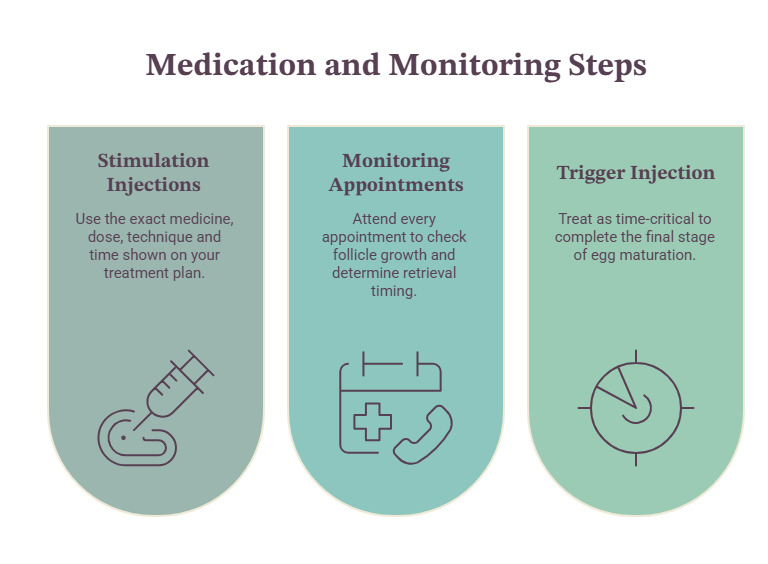
Fertility medications stimulate multiple follicles to grow. Your doctor may adjust the dose after reviewing ultrasound scans and blood results. Use the exact medicine, dose, administration technique, and time shown on your treatment plan. If a dose is missed, delayed or given incorrectly, contact Genesis Fertility Center immediately for instructions rather than trying to fix it yourself.
Attend Every Monitoring Appointment
Monitoring allows the fertility team to check follicle growth, review ovarian response and determine when retrieval should take place. Tell the team if you will be unable to attend an appointment or if new symptoms develop. Your first monitoring scan is usually around day 5–6 of injections. Further scans follow every few days while your dose is adjusted.
Treat the Trigger Injection as Time-Critical
The trigger injection helps complete the final stage of egg maturation. Retrieval is generally planned 34–36 hours later, depending on the prescribed protocol. Before leaving the clinic, check the trigger medication, dose, injection method, exact clock time and the phone number to use if there’s a problem. Never change the timing without the treating team’s advice.
Diet, Supplements, Exercise and Everyday Habits
There is no particular food, supplement, or ‘egg-quality diet’ proven to guarantee a better outcome from egg freezing. Focus on regular meals, a varied diet, and sufficient fluids. Avoid smoking and discuss alcohol use with your clinician. If you take folic acid, vitamin D, CoQ10, or any other supplement, tell your doctor; don’t start, stop, or change a supplement purely because it appears in an online checklist.

As follicles grow, ovaries may become enlarged and uncomfortable. Ask your team whether to avoid running, contact sports, heavy lifting, intense workouts, or intercourse during part of the cycle. Gentle activity may still be appropriate, but the clinic’s advice should reflect your ovarian response. Aim for reasonable sleep and a manageable routine; stress reduction can support wellbeing but should not be sold as a treatment for egg quality.
What to Do in the 24–48 Hours Before Retrieval
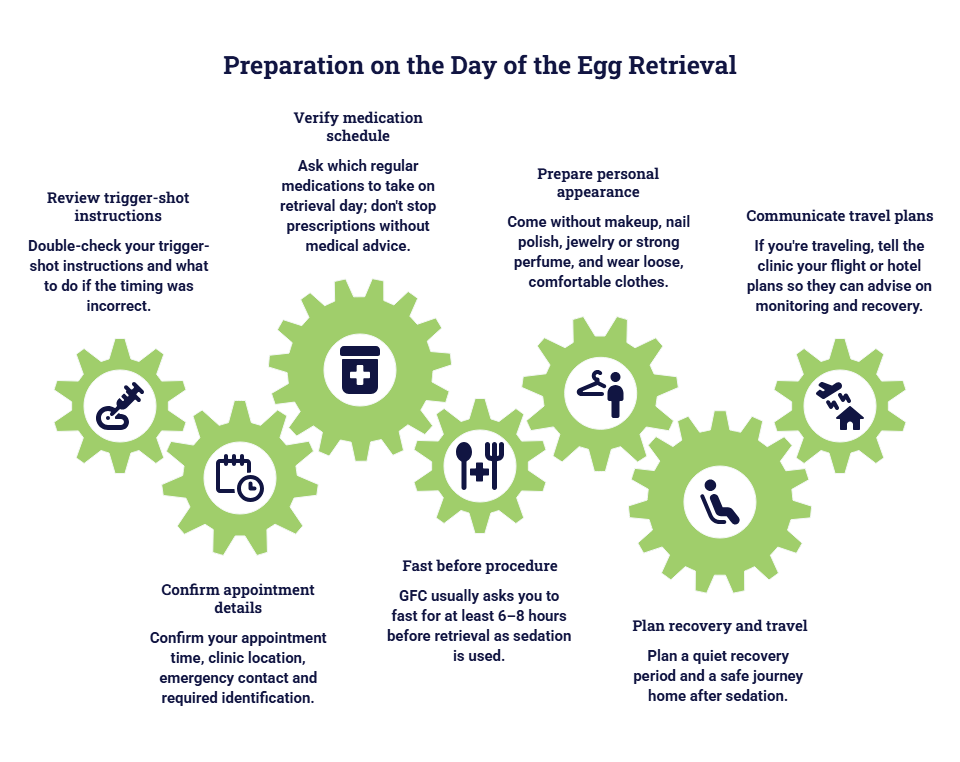
- Double-check your trigger-shot instructions and what to do if the timing was incorrect.
- Confirm your appointment time, clinic location, emergency contact and required identification.
- Ask which regular medications to take on retrieval day; don’t stop prescriptions without medical advice.
- Because sedation is used, GFC usually asks you to fast for at least 6–8 hours before retrieval. Your doctor will confirm the exact cut-off for food and fluids.
- Come without makeup, nail polish, jewelry or strong perfume, and wear loose, comfortable clothes.
- Plan a quiet recovery period and a safe journey home after sedation.
- If you’re traveling, tell the clinic your flight or hotel plans so they can advise on monitoring and recovery.
On the Day of Egg Retrieval
Follow the fasting instructions your team gives you. If you eat or drink during the fasting window, tell the clinic before the procedure.
Wear loose, comfortable clothes and arrive at the scheduled time. The procedure generally uses ultrasound guidance to collect eggs from ovarian follicles through the vagina. You may receive sedation or anesthesia according to your medical plan. The egg-collection procedure often lasts around 15–20 minutes, though the total clinic visit is longer.
Expect to rest at the clinic for about 1–2 hours before going home. If you have received sedation, do not drive, operate machinery or make major decisions until the period specified by your medical team has passed. Arrange a responsible adult to accompany you if required.
Having eggs collected for IVF or ICSI rather than freezing? Preparation is very similar. See ICSI at GFC for the next steps.
Recovery: What’s Common and When to Get Help

Mild cramping, some bloating or light spotting may occur after egg retrieval. Follow your discharge instructions for pain relief, eating and drinking, washing, exercise, sex and follow-up. Recovery differs between patients.
Avoid strenuous exercise for at least 24–48 hours after retrieval, and longer if your ovaries are still enlarged or your doctor advises it.
Call your fertility clinic urgently if you develop significant or worsening abdominal pain, unusual or heavy bleeding, a fever, persistent vomiting, rapidly increasing bloating or much less urine than usual. Breathing difficulties, fainting or severe pain require urgent emergency medical assessment. Rare but serious complications include severe ovarian hyperstimulation syndrome (OHSS), bleeding or infection; don’t wait for a routine follow-up if you feel seriously unwell.
If you’re unsure whether a symptom is normal, contact Genesis Fertility Center. For more detail on potential OHSS symptoms, see our guide to OHSS and the ASRM patient information on OHSS.
What Happens to the Eggs After Retrieval?
The embryology team assesses the retrieved eggs and identifies those suitable for freezing. Mature eggs are generally preserved by vitrification and stored in liquid nitrogen at approximately −196°C. The number of eggs retrieved is not necessarily the same as the number of mature eggs stored. Read more about how long frozen eggs can be stored.
When you choose to use frozen eggs in future, some may not survive warming or fertilize successfully. Treatment commonly involves intracytoplasmic sperm injection (ICSI), with further embryo development and transfer decisions made by the medical team. Egg freezing preserves an option; it does not guarantee pregnancy or live birth.
Age when eggs are frozen is important, but there is no universal ‘right’ number of eggs. AMH and ultrasound testing are useful for planning ovarian stimulation, not for guaranteeing outcomes. See Genesis Fertility Center’s dedicated best-age guide for more on timing, and discuss your individual expectations with a specialist.
How Much Does Egg Freezing at GFC Cost?
Genesis Fertility Center currently lists a standard egg-freezing package starting at THB 170,000, including freezing and first-year storage for up to 20 eggs. Your final bill can depend on additional medication, testing, later storage and any future treatment using the eggs.
For the current package terms and a more detailed cost breakdown, see egg freezing at GFC and GFC’s egg-freezing cost guide. Ask for a written quotation before starting treatment.
Preparing for Egg Freezing in Bangkok from Overseas
If you are traveling from Singapore or elsewhere, the practical challenge is the sequence of monitoring visits, not just the retrieval procedure. Ask Genesis Fertility Center (GFC) which assessments can be completed before arrival, when you must be in Bangkok, how frequently you may need scans, what happens if stimulation takes longer than expected, and when it is safe to travel after retrieval.
Confirm your accommodation, time off work, payment arrangements, language support and how to contact the clinical team between appointments. Ask about storage renewal, consent documents and possible international transport of eggs well before you need them. Legal requirements may change; clinic staff should confirm the rules relevant to your circumstances. If you are comparing providers, read how to choose an egg-freezing clinic in Bangkok.
Frequently Asked Questions
How Long Does the Egg Freezing Cycle Take?
Many patients have 8–14 days of ovarian stimulation before retrieval, with extra time for consultation, testing, the trigger injection and recovery. Dates depend on your response to treatment.
Do I Need to Fast Before Egg Retrieval?
Yes. Because sedation is used, GFC usually asks you to fast for at least 6–8 hours before egg retrieval. Your doctor will confirm exactly when to stop eating and drinking; do not rely on a generic “fast after midnight” instruction.
Is Egg Retrieval Painful?
Retrieval is done under sedation, so you should not feel pain during the procedure. Mild, period-like cramping afterwards is common and usually settles within a day or two. Contact the clinic if pain is severe or worsening.
Can I Work During Ovarian Stimulation?
Many patients can continue working while attending monitoring appointments, although bloating, fatigue and changing appointment times may affect their schedule. Plan time away from work for retrieval and immediate recovery.
Can I Fly During Treatment?
Travel may interfere with scan and injection timing. Discuss all flights with Genesis Fertility Center before booking and ask when travel is appropriate after retrieval.
Can I Have Sex or Exercise During Stimulation?
Restrictions depend on how enlarged the ovaries become and your individual protocol. Follow the team’s guidance, especially later in stimulation.
How Long After Egg Retrieval Can I Exercise?
Avoid strenuous exercise for at least 24–48 hours after retrieval, and longer if your ovaries are still enlarged or your doctor advises it. Ask your treating team when you can return to your usual exercise routine.
Why Choose Genesis Fertility Center (GFC)?

Every fertility journey is unique, and choosing the right fertility clinic is an important step toward building your family. Genesis Fertility Center (GFC), a fertility provider with three centres in Thailand, has provided fertility care in more than 3,600 cases and helped achieve more than 2,300 pregnancies using advanced Assisted Reproductive Technology (ART), including IVF, ICSI, Egg Freezing, Embryo Freezing, and PGT-A. We combine advanced laboratory technology with treatment protocols to deliver care tailored to your individual fertility needs.
Since it was founded in 2016, Genesis Fertility Center has cared for more than 3,600 cases and helped achieve more than 2,300 pregnancies.
Our fertility team of obstetricians, gynecologists, fertility specialists, and embryologists is committed to providing compassionate care, clear communication, and transparent pricing throughout every stage of your fertility journey.
To learn more or schedule a consultation, please contact Genesis Fertility Center (GFC).
Call Center: 097-484-5335
This article is for general information and does not replace a personal medical consultation. Results vary from person to person.