Medically reviewed by: Assoc. Prof. Dr. Pitak Laokirkkiat, M.D., reproductive medicine specialist, Thai Medical Council Licence 18494
A second opinion after failed IVF is a review of your past cycles by a fertility doctor who did not treat you. Its job is to find what can change in the next attempt. It makes sense after two or more transfers of good-quality embryos fail, or after any cycle that went differently from the plan. In 2026, the American Society for Reproductive Medicine (ASRM) set the bar for “recurrent implantation failure” at roughly 3–6 failed transfers of genetically tested embryos. Many patients reasonably want a fresh look well before that.
This guide covers when a second opinion is worth it, the records to bring, the questions to ask, and how to tell a useful review from a sales pitch. It also covers how Genesis Fertility Center (GFC) in Bangkok handles complex cases referred from other clinics.
When is a second opinion worth getting?

A second opinion is worth getting when you can no longer get a clear answer to one question: what will be different next time? These are the common triggers:
- Two or more good-quality embryos transferred without a pregnancy.
- Fewer eggs than expected, or eggs that did not fertilise or develop to day 5.
- A cycle cancelled for poor response or early ovulation.
- Two or more pregnancy losses after IVF. This is a different problem from implantation failure. See which tests to have after recurrent miscarriage.
- The same protocol was repeated after a failed cycle with no explanation.
- You are 38 or older and want to know whether to keep trying with your own eggs. See IVF after 40 with your own eggs.
One failed transfer on its own is rarely a sign that something is wrong. Even a chromosomally normal embryo does not implant every time. ASRM’s 2026 committee opinion notes that many patients reach a pregnancy if they continue with further transfers.
What records should you bring?
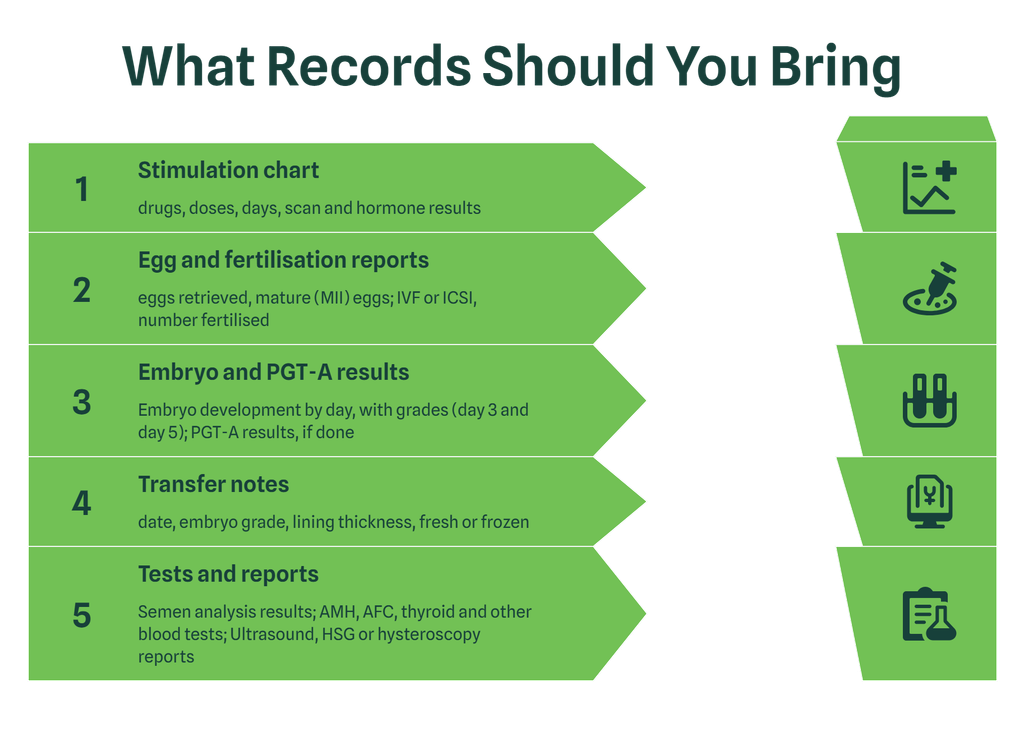
The records you bring decide how useful a second opinion can be. Ask your current clinic for copies of everything below. Most clinics will release them on a written request, sometimes for an admin fee.
| Record | Why it matters |
| Stimulation chart: drugs, doses, days, scan and hormone results | Shows how your ovaries responded and whether the protocol fit |
| Egg collection report: eggs retrieved, mature (MII) eggs | Shows egg quantity and maturity |
| Fertilisation report: IVF or ICSI, number fertilised | Separates egg, sperm and lab factors |
| Embryo development by day, with grades (day 3 and day 5) | Shows where embryos stopped growing |
| PGT-A results, if done | Tells whether failed embryos were chromosomally normal |
| Transfer notes: date, embryo grade, lining thickness, fresh or frozen | Shows the conditions on transfer day |
| Semen analysis results | Male factor is often under-checked |
| AMH, AFC, thyroid and other blood tests | Baseline for the next plan |
| Ultrasound, HSG or hysteroscopy reports | Shows whether the uterus has been properly checked |
Embryo photos or time-lapse videos are useful too, if your clinic recorded them.
What questions should you ask?
Ask questions that force a specific answer about your next cycle. These work well:
- Where did my cycle fall short: egg numbers, fertilisation, embryo development or implantation?
- Was my stimulation protocol right for my age and AMH, and what would you change?
- Has my uterus been checked properly? A polyp, fibroid, scarring or chronic endometritis can stop implantation.
- Would PGT-A change my plan? For many patients over 35, it can explain failures. Read the PGT-A embryo screening guide.
- Is an ERA test justified in my case, or is it too early?
- Should sperm DNA fragmentation be tested?
- What are my realistic odds next cycle, and what are they based on?
- At what point would you suggest donor eggs or a different path?
A good second-opinion doctor answers each one with reasons drawn from your records. Vague reassurance is a warning sign.
Which add-on tests are worth it after failed IVF?
The evidence on add-on tests after failed IVF is mixed. A good second opinion tells you which ones fit your case, not which ones are available. The ASRM 2026 committee opinion on implantation failure says:
| Test or treatment | ASRM 2026 position |
| Repeat check of the uterine cavity (hysteroscopy) | Reasonable after implantation failure |
| Chronic endometritis testing and antibiotics | May be considered; observational evidence only |
| ERA (endometrial receptivity analysis) | Not supported for routine use |
| Immune therapies (IVIG, G-CSF, heparin) | Not currently recommended |
ESHRE takes a related approach in its 2023 good practice recommendations. It advises investigating once the predicted chance of implantation across the transfers you have had passes 60% (ESHRE, Human Reproduction Open, 2023). For a young woman transferring good embryos, that point comes sooner than for an older woman.
ERA can still be the right test for some patients. GFC offers it, and it adds about 2 months to an ICSI pathway. Your doctor should be able to explain why it fits your history.
Should you switch clinics?
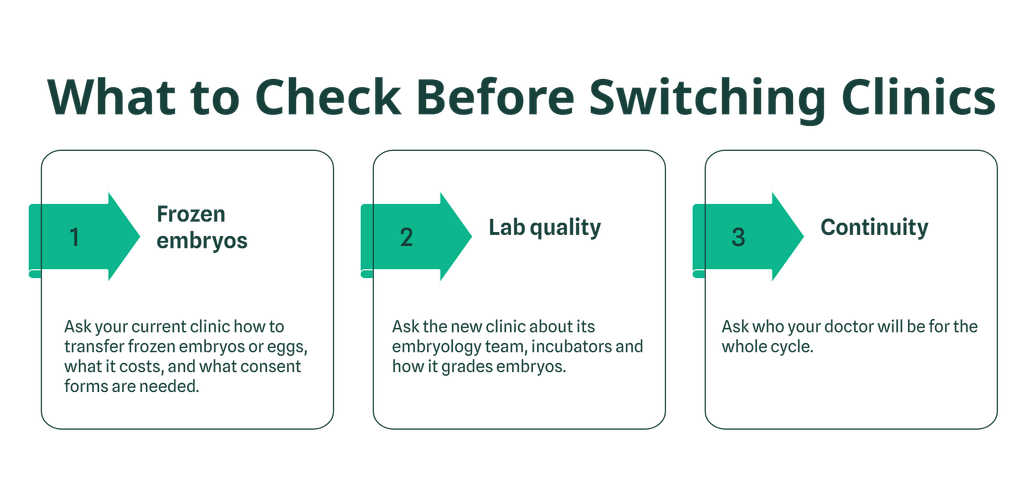
Switch clinics when your current clinic can’t explain the failure or won’t change the plan. Switching is not a failure, and good doctors don’t take it personally. Before you move, check three things:
- Frozen embryos. Ask your current clinic how to transfer frozen embryos or eggs to another clinic, what it costs, and what consent forms are needed. Moving embryos between countries has extra rules.
- Lab quality. Ask the new clinic about its embryology team, its incubators and how it grades embryos.
- Continuity. Ask who your doctor will be for the whole cycle.
The cause of a failure often sits in the lab as much as with the doctor. That makes the embryology team a fair thing to compare.
How does GFC review cases from other clinics?
Genesis Fertility Center (GFC) is a Bangkok fertility clinic, listed on the Stock Exchange of Thailand, that takes on complex cases, including patients whose IVF failed at another clinic. Since opening in 2016, GFC has provided fertility care in more than 3,600 cases and helped achieve more than 2,400 pregnancies. GFC reviews cases from other clinics with a doctor consultation and a reading of your full records. Your records are read by one of seven licensed reproductive medicine doctors, led by Assoc. Prof. Dr. Pitak Laokirkkiat.
When the review points to a lab or embryo question, GFC’s lab offers:
- EmbryoScope Plus and Geri time-lapse incubators;
- six ESHRE-certified clinical embryologists;
- PGT-A by NGS with a polyploidy check, through the group’s Genosomics laboratory, rated “Satisfactory” in the UK GenQA external quality assessment;
- sperm selection by MACS, PICSI and microfluidic sorting where sperm quality is a factor;
- ERA and Embryo Glue at the transfer stage.
Your next step

Gather your records, write down your questions, and book a consultation at GFC Rama 9 International, 20 minutes from Suvarnabhumi Airport. If you’re not sure whether your case needs a review, the Bangkok fertility clinic guide can help you weigh your options.
This page is general information, not medical advice. Decisions about tests and treatment should be made with your own doctor.
Why Choose Genesis Fertility Center (GFC)?

Every fertility journey is unique, and choosing the right fertility clinic is an important step toward building your family. Genesis Fertility Center (GFC), a fertility provider with three centres in Thailand, has provided fertility care in more than 3,600 cases and helped achieve more than 2,300 pregnancies using advanced Assisted Reproductive Technology (ART), including IVF, ICSI, Egg Freezing, Embryo Freezing, and PGT-A. We combine advanced laboratory technology with treatment protocols to deliver care tailored to your individual fertility needs.
Our fertility team of obstetricians, gynecologists, fertility specialists, and embryologists is committed to providing compassionate care, clear communication, and transparent pricing throughout every stage of your fertility journey.
To learn more or schedule a consultation, please contact Genesis Fertility Center (GFC).
Call Center: 097-484-5335 (Bangkok) or (+66) 62-978-8515 (Ubon Ratchathani)
LINE: @gfcclinic
Online: Book a consultation
Clinic Hours
• Monday – Friday: 9:00 AM – 8:00 PM
• Saturday – Sunday: 8:00 AM – 8:00 PM