A standard semen analysis can show that sperm count, motility and morphology are within an acceptable range. However, these results do not directly show whether the DNA inside the sperm is intact.
For some couples, particularly those experiencing unexplained infertility, repeated unsuccessful IVF or ICSI treatment, or recurrent pregnancy loss, a fertility specialist may consider additional testing such as a Sperm DNA Fragmentation Test.
So, what does this test measure? How is it different from a standard semen analysis? And if sperm DNA fragmentation is high, does that mean ICSI will not work?
This article explains what sperm DNA fragmentation means, who may benefit from testing, what contributes to sperm DNA damage and which treatment options may be considered.
If you are unsure which fertility tests are appropriate, a fertility assessment can help identify clinically relevant investigations before treatment.
What Is a Sperm DNA Fragmentation Test?
A Sperm DNA Fragmentation Test measures damage or breaks in the DNA contained within sperm cells.
Sperm DNA carries genetic information delivered to the egg during fertilisation. A sperm cell may appear normal in terms of movement and shape while still having DNA damage.
This is why sperm DNA fragmentation is considered a different aspect of sperm quality from the parameters measured by conventional semen analysis.
However, the result should not be interpreted alone. Its meaning depends on the testing method, medical history, other fertility findings and previous treatment outcomes.
How Is Sperm DNA Fragmentation Different From a Semen Analysis?
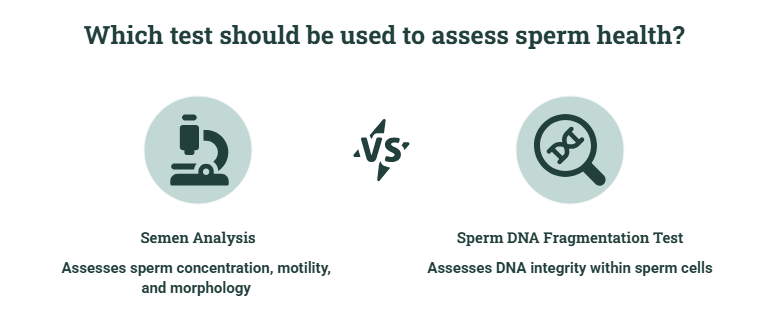
A conventional semen analysis and a Sperm DNA Fragmentation Test answer different questions.
| Test | What it mainly assesses |
|---|---|
| Semen analysis | Sperm concentration, motility and morphology |
| Sperm DNA Fragmentation Test | Integrity of DNA inside sperm cells |
A normal semen analysis does not necessarily rule out sperm DNA damage.
For example, a man may have acceptable semen parameters but elevated DNA fragmentation. Conversely, abnormal semen parameters do not automatically mean DNA fragmentation is high.
The two tests provide different information and should be interpreted together when clinically indicated.
If you have not yet undergone a complete male fertility evaluation, your doctor may begin with semen analysis and male fertility assessment before considering additional tests.
Why Can Sperm DNA Become Damaged?
Several factors may contribute to sperm DNA damage, including:
- Increasing paternal age
- Cigarette smoking
- Oxidative stress
- Prolonged excessive heat exposure around the testicles
- Varicocele
- Certain reproductive tract infections or inflammation
- Environmental and lifestyle factors
Not every case has one identifiable cause.
When fragmentation is elevated, a fertility specialist may review medical history, lifestyle, reproductive history, physical findings and other semen parameters to identify potentially modifiable factors.
What Does High Sperm DNA Fragmentation Mean for Fertility?
Higher sperm DNA fragmentation has been associated with certain adverse reproductive outcomes, including pregnancy loss. However, the relationship is complex, and the result does not predict an individual couple’s outcome with certainty.
A high result does not mean pregnancy is impossible or that ICSI will necessarily fail.
Female age, ovarian function, sperm quality, embryo development and other factors also influence treatment outcomes.
For patients considering genetic testing, read the guide to PGT-A embryo screening for chromosomal abnormalities.
PGT-A evaluates embryo chromosome number; it does not directly measure or repair sperm DNA fragmentation. The tests answer different clinical questions.
Who May Need a Sperm DNA Fragmentation Test?
Sperm DNA fragmentation testing is not routinely required for every man undergoing an initial fertility evaluation.
A specialist may consider testing in selected circumstances, including:
- Unexplained infertility after an appropriate initial assessment
- Recurrent pregnancy loss, particularly when unexplained
- Previous unsuccessful IVF or ICSI treatment in selected cases
- Clinical findings suggesting a male reproductive factor
- Older paternal age alongside other relevant risk factors
- Medical or lifestyle factors potentially contributing to DNA damage
The decision should be individualised.
The ESHRE guideline on recurrent pregnancy loss states that sperm DNA fragmentation testing may be considered for diagnostic purposes in couples with recurrent pregnancy loss.
The AUA/ASRM male infertility guideline advises against routine sperm DNA fragmentation testing during the initial evaluation of infertile couples.
These recommendations are compatible: testing may be useful in selected clinical situations without being necessary for everyone.
If you have experienced recurrent pregnancy loss or unsuccessful fertility treatment, discuss your history during a fertility consultation.
For couples who previously conceived but are now experiencing difficulties, see the guide to secondary infertility causes and evaluation after prior pregnancy.
Do You Need a Sperm DNA Fragmentation Test Before ICSI?
Not necessarily. A Sperm DNA Fragmentation Test is not a routine requirement before every ICSI cycle.
The AUA/ASRM guideline advises against using sperm DNA fragmentation analysis as part of the initial evaluation of every infertile couple.
However, testing may be considered when medical or treatment history suggests that information about sperm DNA integrity could influence clinical management.
The key question is:
If the result is abnormal, would it change how the couple is investigated or treated?
If the answer is yes, testing may provide useful additional information.
When Might Testing Be Considered?
| Clinical situation | Possible next step |
|---|---|
| Initial fertility evaluation | Begin with semen analysis and appropriate clinical assessment |
| Normal semen analysis without other concerning history | SDF testing is generally not routine |
| Recurrent pregnancy loss | Consider additional male-factor evaluation, including SDF testing |
| Previous unsuccessful ICSI | Review embryo development and both partners' fertility factors before deciding |
| Elevated SDF result | Investigate potentially modifiable causes |
| Persistently elevated SDF | Discuss individualised treatment options; no approach guarantees live birth |
If ICSI is recommended, read the complete ICSI and IVF treatment guide to understand ovarian stimulation, egg retrieval, fertilisation, embryo culture and transfer.
For patients planning treatment in Thailand, explore IVF and ICSI treatment options in Bangkok, including male-factor infertility assessment.
How Do You Interpret a Sperm DNA Fragmentation Result?
Results may be reported as a DNA Fragmentation Index (DFI) or another measurement, depending on the laboratory method.
A higher result generally indicates a greater proportion or degree of sperm DNA damage according to that assay.
However, there is no single universally applicable DFI cut-off across every testing method.
Common methods include:
| Testing method | General approach |
|---|---|
| SCSA | Assesses sperm DNA susceptibility to denaturation using flow cytometry |
| TUNEL | Detects DNA strand breaks using labelled molecular markers |
| SCD | Evaluates sperm chromatin dispersion patterns |
| Comet assay | Assesses DNA damage using gel electrophoresis |
These tests are not directly interchangeable.
For example, a percentage obtained through SCSA should not automatically be interpreted using a threshold developed for another method.
The doctor should consider the laboratory’s reference criteria, testing method, semen findings and the couple’s clinical history.
An elevated result is not, by itself, a diagnosis of infertility or proof that ICSI will fail.
What Should You Do If Sperm DNA Fragmentation Is High?
A high result does not automatically mean treatment must change immediately.
The specialist may first investigate potentially reversible causes.
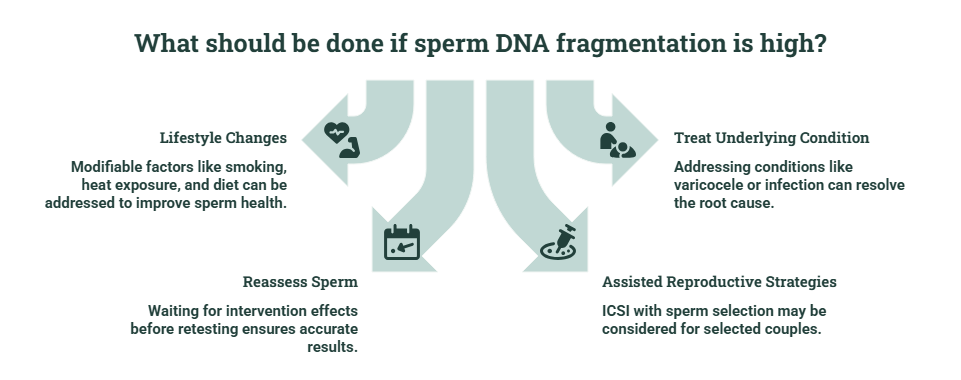
1. Lifestyle Changes
Potentially beneficial measures include:
- Stopping smoking
- Avoiding unnecessary prolonged heat exposure
- Maintaining a healthy body weight
- Exercising regularly
- Limiting excessive alcohol consumption
- Reviewing relevant environmental exposures
These measures support general reproductive health, although they cannot guarantee improved fertility outcomes.
2. Treating an Underlying Condition
If varicocele, infection or another male reproductive condition is identified, appropriate treatment may be considered.
The objective is to address a clinically relevant underlying problem rather than treating the fragmentation number alone.
3. Reassessing Sperm After an Appropriate Interval
Sperm production takes time.
After lifestyle changes or medical treatment, the doctor may recommend waiting before repeating testing to allow newly produced sperm to develop.
The interval depends on the intervention, clinical circumstances and testing method.
4. Considering Assisted Reproductive Strategies
For selected couples undergoing ICSI, a specialist may discuss additional sperm-selection approaches or other strategies.
Review GFC’s current ICSI treatment packages and pricing for 2026 to understand package tiers, inclusions and optional laboratory services.
However, additional sperm-selection techniques should not be presented as guaranteed solutions. Evidence that particular interventions improve live-birth outcomes remains limited in several clinical situations.
Before choosing a provider, use the guide on selecting an IVF clinic in Bangkok based on laboratory quality and specialist expertise.
Does High DNA Fragmentation Mean You Cannot Have ICSI?
No. High sperm DNA fragmentation does not automatically prevent ICSI or mean that treatment will fail.
A specialist may still consider ICSI while evaluating underlying male-factor conditions, previous treatment outcomes and whether additional strategies are appropriate.
The important question is not simply whether fragmentation is elevated.
It is why fragmentation may be elevated and whether addressing it could meaningfully change the couple’s treatment plan.
For more information, see what can affect ICSI success.
Can Sperm DNA Fragmentation Improve?
Sperm DNA fragmentation may improve in some men when an underlying or modifiable factor is addressed.
Stopping smoking, treating an identified reproductive condition where appropriate and improving overall health may help reduce factors associated with sperm DNA damage.
However, improvement is not guaranteed.
Repeat testing should use an appropriate method and interval, ideally with the same laboratory technique when results are being compared.
Importantly, a lower fragmentation result does not automatically guarantee pregnancy or live birth.
How Is the Sperm DNA Fragmentation Test Performed?
The test generally uses a semen sample collected similarly to a conventional semen analysis.
The laboratory provides instructions on preparation and sexual abstinence before collection.
Requirements may vary by testing method, so patients should follow their clinic’s instructions.
The test itself does not require surgery.
Are All Sperm DNA Fragmentation Tests the Same?
No. Different laboratory assays measure DNA damage using different techniques and reporting methods.
A result from one assay should not automatically be compared with another assay’s reference range.
Professional guidance recognises that assay variability complicates interpretation and that no single method has been established as universally preferable in every clinical situation.
A 2026 review on sperm DNA fragmentation testing in fertility clinics also discusses the importance of selecting patients appropriately rather than using SDF testing as a universal screening test.
The result should therefore be interpreted using the laboratory’s method-specific criteria and the patient’s clinical history.
Frequently Asked Questions
If my semen analysis is normal, should I still have a DNA fragmentation test?
Not necessarily. Normal semen parameters do not directly assess DNA integrity, but additional testing is generally reserved for situations where it may help clinical decision-making.
Is high DNA fragmentation the reason I cannot get pregnant?
Not necessarily. High fragmentation may be associated with adverse outcomes, but fertility depends on multiple male and female factors.
Does high sperm DNA fragmentation mean ICSI will fail?
No. ICSI may still be appropriate depending on the complete fertility assessment.
Can lifestyle changes reduce sperm DNA fragmentation?
They may help in some cases, particularly when smoking, excessive heat exposure or other modifiable factors are present. Improvement is not guaranteed.
How long should I wait before repeating the test?
Your specialist will recommend an interval based on the intervention and testing method. Sperm production takes several weeks, so immediate retesting may not reflect recent changes.
Is sperm DNA fragmentation testing painful?
No. It generally requires a semen sample and does not involve an invasive procedure.
Should everyone undergoing
ICSI have this test?
No. Testing should be considered when there is a specific clinical reason and when the result may influence management.
Why Choose Genesis Fertility Center (GFC)?

Every fertility journey is unique, and choosing the right fertility clinic is an important step toward building your family. At Genesis Fertility Center (GFC), our experienced team of reproductive specialists provides personalized treatment plans using advanced Assisted Reproductive Technology (ART), including IVF, ICSI, Egg Freezing, Embryo Freezing, and PGT-A. We combine advanced laboratory technology with treatment protocols to deliver care tailored to your individual fertility needs.
Our fertility team of obstetricians, gynecologists, fertility specialists, and embryologists is committed to providing compassionate care, clear communication, and transparent pricing throughout every stage of your fertility journey.
To learn more or schedule a consultation, please contact Genesis Fertility Center (GFC).
Call Center: 097-484-5335
Medical Disclaimer
This article is for educational purposes only and should not replace personalised medical advice. Treatment recommendations vary depending on each individual’s medical history, fertility assessment, and reproductive goals.