If you become pregnant after IVF or ICSI, pregnancy is still measured in gestational weeks, just like a naturally conceived pregnancy. The difference is how the pregnancy is dated. For patients who are not yet pregnant, learn more about IVF treatment in Bangkok, including how embryos are created, cultured, and transferred.
With IVF, the fertility team knows the embryo’s developmental age and the embryo transfer date. These dates allow the pregnancy to be dated more precisely using the assisted reproductive technology (ART) timeline.
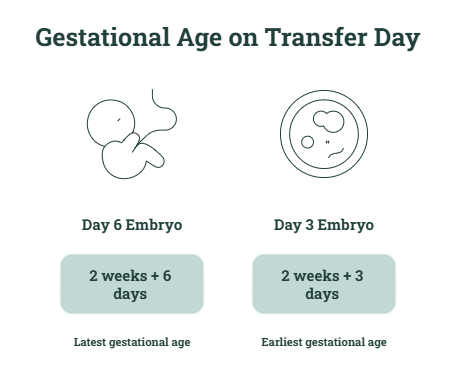
For example, a Day 3 embryo is considered approximately 2 weeks and 3 days pregnant on the day of transfer, while a Day 5 embryo is approximately 2 weeks and 5 days pregnant.
Understanding this calculation can help patients interpret pregnancy tests, ultrasound results and estimated due dates after IVF. Before choosing a provider, use this guide on how to choose an IVF clinic in Bangkok to evaluate specialist experience, laboratory standards, success-rate definitions, package inclusions, and international-patient support.
How Do You Calculate Pregnancy Age After IVF?
The basic formula is:
Gestational age = 14 days + embryo age at transfer + days since embryo transfer
The ACOG guidelines on IVF pregnancy dating provide standardized formulas for calculating gestational age and estimated due dates based on embryo transfer date and embryo age.
Quick Reference
| Embryo transferred | Gestational age on transfer day |
|---|---|
| Day 3 embryo | 2 weeks + 3 days |
| Day 5 embryo | 2 weeks + 5 days |
| Day 6 embryo | 2 weeks + 6 days |
For example, if a Day 5 embryo was transferred 10 days ago:
14 days + 5 days + 10 days = 29 days
That equals:
4 weeks + 1 day pregnant
The same principle applies to a frozen embryo transfer (FET). The embryo’s developmental age and transfer date are used to establish the ART-derived gestational age.
Important: Gestational age is not the same as the embryo’s biological age. Pregnancy is conventionally dated from approximately two weeks before fertilization. This is why an IVF pregnancy can already be considered about two weeks pregnant on the day of embryo transfer.
What Is Gestational Age?
Gestational age describes how far a pregnancy has progressed and is normally expressed in weeks and days.
A typical pregnancy is approximately 40 weeks, or 280 days, when calculated from the first day of the last menstrual period (LMP). With natural conception, the exact date of fertilization is usually unknown, so the LMP is traditionally used to estimate pregnancy age, as explained in this overview of gestational age.
With IVF, the fertility team has additional information, including:
- Egg retrieval date
- Fertilization or ICSI date
- Embryo developmental age
- Embryo transfer date
Because these dates are known, ART-derived dating can be used instead of relying only on the last menstrual period.
How Do You Calculate Pregnancy Age After a Day 3 Embryo Transfer?
A Day 3 embryo has developed for approximately three days before transfer. Using standard IVF pregnancy dating, the gestational age on the day of transfer is assigned as approximately 2 weeks and 3 days, or 17 days.
The calculation is:
Gestational age = 17 days + completed days since embryo transfer
Example: If a Day 3 embryo was transferred 10 completed days ago:
17+10=2717 + 10 = 2717+10=27 days
Twenty-seven days equals 3 weeks and 6 days. Therefore, 10 completed days after a Day 3 embryo transfer, the estimated gestational age is 3 weeks and 6 days.
The same dating convention applies to a fresh or frozen Day 3 embryo transfer. The treating fertility clinic or obstetric provider’s recorded ART dating should be used if it differs from a personal calculation.
How Do You Calculate Pregnancy Age After a Day 5 Embryo Transfer?
A Day 5 embryo is usually a blastocyst that has developed for approximately five days before transfer.
Using standard IVF pregnancy dating, the gestational age on the day of transfer is approximately 2 weeks and 5 days, or 19 days.
The calculation is:
Gestational age = 19 days + completed days since embryo transfer
Example: If a Day 5 embryo was transferred 10 completed days ago:
19+10=2919 + 10 = 2919+10=29 days
Twenty-nine days equals 4 weeks and 1 day. Therefore, 10 completed days after a Day 5 embryo transfer, the estimated gestational age is 4 weeks and 1 day.
This dating method applies to both fresh and frozen Day 5 embryo transfers. The transfer type does not change the calculation; the embryo’s developmental age and transfer date are used to establish the ART-derived gestational age.
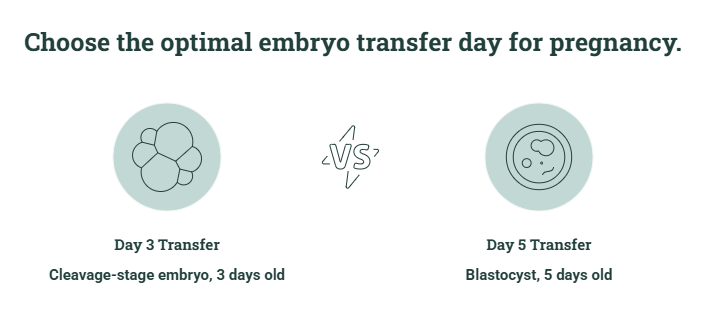
Day 3 vs. Day 5 Embryo Transfer: What Is the Difference?
The main difference is the developmental age of the embryo when it is transferred.
| Factor | Day 3 Transfer | Day 5 Transfer |
|---|---|---|
| Embryo stage | Cleavage-stage embryo | Blastocyst |
| Embryo age at transfer | 3 days | 5 days |
| Gestational age on transfer day | 2w3d | 2w5d |
| Days added to days since transfer | 17 | 19 |
| Estimated due date | 263 days after transfer | 261 days after transfer |
The calculation differs by two days because the embryos are at different developmental stages when transferred.
How Is Pregnancy Age Calculated After a Frozen Embryo Transfer?
A frozen embryo transfer (FET) uses an embryo that was created during an earlier IVF cycle and then cryopreserved.
Pregnancy dating does not start from the day the embryo was frozen.
Instead, the calculation considers:
- The embryo’s developmental age
- The embryo transfer date
- The standard 14-day gestational-age convention
For example, if a Day 5 embryo is transferred on June 14, its equivalent fertilization date is approximately five days earlier. The standard 14-day convention is then added.
Therefore:
14 days + 5 days = 19 days
The gestational age on the transfer date is approximately:
2 weeks + 5 days
This approach accounts for the embryo’s developmental age even though the embryo was frozen during an earlier treatment cycle. International patients can review the guide to IVF in Thailand for foreigners before arranging travel, testing, and follow-up.
How Is Pregnancy Age Calculated After a Fresh Embryo Transfer?
In a fresh IVF cycle, the embryo is transferred during the same treatment cycle in which the eggs were retrieved. Patients who are not ready to pursue pregnancy now may also wish to explore egg freezing in Thailand as a fertility-preservation option.
The egg-retrieval and fertilization dates provide the reference point for ART pregnancy dating.
The timeline can be understood as:
- Egg retrieval/fertilization: approximately 2 weeks 0 days
- Day 3 transfer: approximately 2 weeks 3 days
- Day 5 transfer: approximately 2 weeks 5 days
This is why the embryo transfer date is not treated as the beginning of pregnancy at 0 weeks. You can also use this IVF due-date calculator to estimate gestational age and the expected due date based on the embryo-transfer date and embryo age.
How Do You Calculate Your IVF Due Date?
For an IVF pregnancy, the estimated due date can be calculated using the embryo transfer date and embryo developmental age.
The ART-based calculation is:
- Day 3 embryo: Transfer date + 263 days
- Day 5 embryo: Transfer date + 261 days
Simple IVF Due-Date Formula
Day 3 embryo
Transfer date + 263 days = estimated due date
Day 5 embryo
Transfer date + 261 days = estimated due date
This is more appropriate for IVF dating than simply adding 280 days to the embryo transfer date because the embryo’s developmental age is already known.
Your fertility specialist may confirm the estimated due date using the ART dates together with early ultrasound findings. Review GFC’s current ICSI packages and pricing for package tiers, eligibility criteria, medication limits, and additional services. You can also begin with fertility counseling and treatment planning. A consultation can help review age, ovarian reserve, treatment history, and personal fertility goals.
Why Is Accurate Pregnancy Dating Important After IVF?
Accurate pregnancy dating helps your healthcare team determine the appropriate timing for:
- Prenatal tests
- Ultrasound examinations
- Pregnancy screening
- Fetal growth assessment
- Delivery planning
It also helps the medical team determine whether fetal development is appropriate for the established gestational age.
For IVF pregnancies, using the documented ART dates is particularly important because the embryo’s developmental age and transfer date are known. If embryos have undergone genetic testing, learn more about PGT-A genetic testing by NGS, including what the test evaluates and how results may affect embryo selection and transfer planning.
When Should You Have an Ultrasound After IVF?
After a positive pregnancy test, your fertility team will arrange follow-up based on your treatment and individual clinical circumstances. For additional information about the transfer procedure itself, see the guide to embryo transfer in IVF and ICSI.
An early ultrasound may help assess:
- Whether the pregnancy is located inside the uterus
- Whether a gestational sac is visible
- Whether an embryo is developing
- Whether cardiac activity is visible when appropriate
- Whether pregnancy dating is consistent with expectations
A first-trimester ultrasound can also help confirm or establish gestational age when needed.
The exact timing should be determined by your fertility specialist or obstetrician.
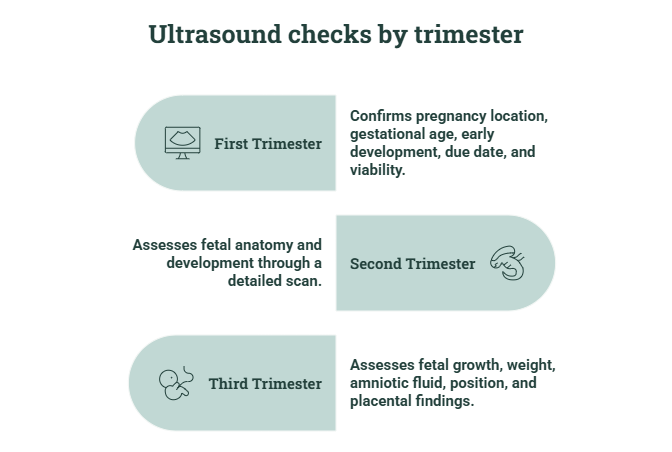
What Does an Ultrasound Check During Each Trimester?
Ultrasound has different purposes as pregnancy progresses.
First Trimester
The assessment may help confirm:
- Pregnancy location
- Gestational age
- Early pregnancy development
- Estimated due date
- Early pregnancy viability
Second Trimester
A detailed ultrasound may assess fetal anatomy and development. The timing of the anatomy scan varies according to clinical practice and individual circumstances.
Third Trimester
When clinically indicated, ultrasound may assess:
- Fetal growth
- Estimated fetal weight
- Amniotic fluid
- Fetal position
- Placental findings
The ultrasound schedule should be individualized by your obstetrician or fertility specialist.
Does IVF Pregnancy Age Differ From Natural Pregnancy Age?
No. The pregnancy is still measured using the same weeks-and-days system.
What differs is how the pregnancy is dated.
With natural conception, gestational age is generally estimated from the first day of the last menstrual period and may later be confirmed by ultrasound.
With IVF, the embryo’s developmental age and transfer date are known. This allows the medical team to use ART-derived dating. For context on how GFC presents and explains its reported outcomes, read the clinic’s guide to IVF success rates in Thailand. Success figures should be compared only when the patient group, embryo type, outcome definition, and denominator are similar.
The important point is:
IVF does not make pregnancy longer or shorter. It provides a more specific treatment timeline for establishing gestational age.
Can You Calculate IVF Pregnancy Age From the Transfer Date?
Yes. You need two pieces of information:
- The embryo transfer date.
- The embryo’s developmental age at transfer, such as Day 3, Day 5, or Day 6.
You can then estimate gestational age from the transfer date using the embryo’s developmental age.
| Time after transfer | Day 3 embryo | Day 5 embryo | Day 6 embryo |
|---|---|---|---|
| Transfer day | 2w3d | 2w5d | 2w6d |
| 7 days later | 3w3d | 3w5d | 3w6d |
| 10 days later | 3w6d | 4w1d | 4w2d |
| 14 days later | 4w3d | 4w5d | 4w6d |
| 21 days later | 5w3d | 5w5d | 5w6d |
| 28 days later | 6w3d | 6w5d | 6w6d |
Here, w means weeks and d means days.
These are estimated gestational ages based on standard ART dating. Use the fertility clinic’s documented ART dates and subsequent clinical assessment for medical care. The final dating and management plan should be confirmed by the treating fertility or obstetric team.
Frequently Asked Questions
How many weeks pregnant are you on the day of a Day 5 embryo transfer?
On the day of a Day 5 embryo transfer, the gestational age is approximately 2 weeks and 5 days.
How many weeks pregnant are you 10 days after a Day 5 embryo transfer?
Ten days after a Day 5 transfer, the estimated gestational age is 4 weeks and 1 day.
How many weeks pregnant are you 14 days after a Day 5 embryo transfer?
Fourteen days after a Day 5 transfer, the estimated gestational age is 4 weeks and 5 days.
How many weeks pregnant are you after a Day 3 embryo transfer?
On the day of transfer, a Day 3 embryo corresponds to approximately 2 weeks and 3 days of gestational age.
Is the IVF due date based on the embryo transfer date?
Yes. IVF pregnancy dating uses the ART timeline, including the embryo’s developmental age and transfer date.
Is a frozen embryo transfer dated differently from a fresh transfer?
The underlying principle is the same. Both use the embryo’s developmental age and transfer date to establish gestational age.
The difference is that a frozen embryo was created and cryopreserved during an earlier cycle rather than transferred during the same cycle as egg retrieval.
Does ICSI change how pregnancy age is calculated?
No. ICSI is a fertilization technique used during IVF. Once the embryo is transferred, pregnancy dating is based on the ART timeline, particularly the embryo’s developmental age and transfer date.
Can the due date change after an ultrasound?
Your healthcare team may review pregnancy dating using early ultrasound together with the ART dates.
For IVF pregnancies, the documented ART-derived gestational age should be considered when assigning the estimated due date. Any change should be determined and documented by the treating clinician.
Why Choose Genesis Fertility Center (GFC)?

Every fertility journey is unique, and choosing the right fertility clinic is an important step toward building your family. At Genesis Fertility Center (GFC), our experienced team of reproductive specialists provides personalized treatment plans using advanced Assisted Reproductive Technology (ART), including IVF, ICSI, Egg Freezing, Embryo Freezing, and PGT-A genetic testing by NGS. We combine advanced laboratory technology with treatment protocols to deliver care tailored to your individual fertility needs.
Our fertility team of obstetricians, gynecologists, fertility specialists, and embryologists is committed to providing compassionate care, clear communication, and transparent pricing throughout every stage of your fertility journey.
To learn more or schedule a consultation, please contact Genesis Fertility Center (GFC).
Call Center: 097-484-5335
Medical Disclaimer
This article is for general information and does not replace a personal medical consultation. Individual results vary; your fertility specialist will advise on what is appropriate for your situation.