Medically reviewed by: Assoc. Prof. Dr. Pitak Laokirkkiat, M.D., reproductive medicine specialist, Thai Medical Council Licence 18494
IVF after 40 with your own eggs is possible, but the odds fall sharply with each year past 40. In the UK’s national register for 2023, each embryo transferred from a woman aged 40–42 led to a birth 15% of the time. At 43–44 that fell to 8%. For women under 35, it was 37%. Those numbers come from the UK fertility regulator, the HFEA, and they are the clearest public picture of what age does to IVF.
This guide gives you the age-by-age odds, explains why they drop, and covers what tests decide whether your own eggs are still a real option. It also covers how Genesis Fertility Center (GFC) in Bangkok handles complex cases like IVF after 40, and when donor eggs are worth discussing.
Can you do IVF after 40 with your own eggs?

Yes. IVF after 40 with your own eggs is a standard treatment. At GFC, the ICSI Platinum and ICSI Diamond packages carry no age limit. The LiTE and Gold packages are limited to ages 35 and 37. Full package details are on the ICSI price and package page.
Whether IVF should go ahead depends on more than age. A doctor reads three things together: your age, your ovarian reserve (AMH and antral follicle count), and your history. A 41-year-old with a good AMH may respond better to stimulation than a 39-year-old with a very low one.
What are the IVF success rates with your own eggs at 40, 42, 43, and 45?
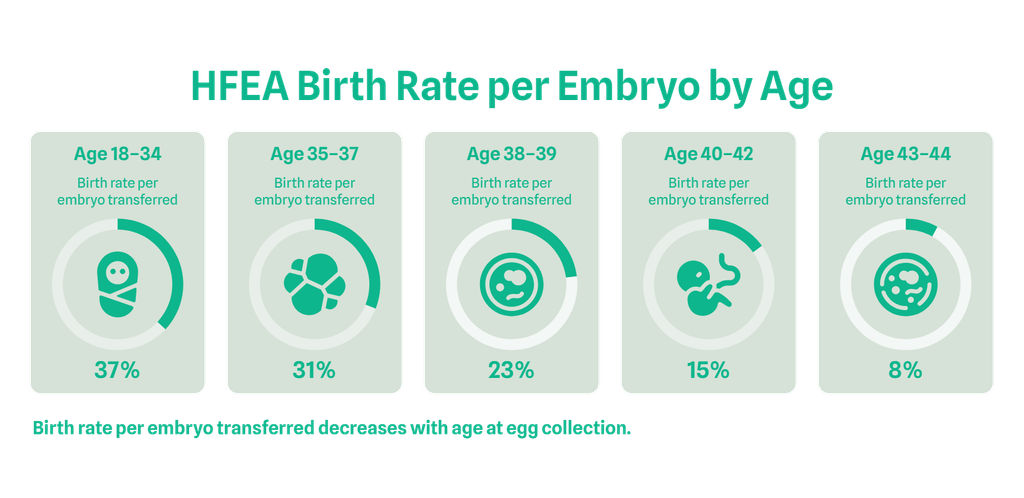
The success rate of IVF with your own eggs drops by roughly half between the late 30s and the early 40s, then halves again by 43–44. Here are the UK national figures for 2023, the latest validated year:
| Age at egg collection | Birth rate per embryo transferred (own eggs, fresh + frozen, 2023) |
| 18–34 | 37% |
| 35–37 | 31% |
| 38–39 | 23% |
| 40–42 | 15% |
| 43–44 | 8% |
Source: HFEA Fertility Treatment 2024: Trends and Figures, Figure 2 data. Excludes donor eggs and PGT-A cycles. Preliminary 2024 figures are similar (16% at 40–42, 8% at 43–44).
Two things to keep in mind when you read this table:
- It is per embryo, not per cycle. One egg collection can produce several embryos, or none. Your odds across a whole cycle depend on how many usable embryos you get.
- The HFEA does not publish a separate 45+ own-egg band. Own-egg births after 45 are rare enough that most national registers group them or report them as very low.
For GFC’s own clinic data and how it compares across age groups, see the IVF success rates in Thailand guide.
Why do IVF odds drop so fast after 40?
IVF odds drop after 40 mainly because more eggs carry the wrong number of chromosomes. An egg with a chromosome error usually makes an embryo that does not implant, or a pregnancy that ends in miscarriage. Large biopsy studies of IVF embryos show the share of chromosomally abnormal embryos climbing steeply through the early 40s (Franasiak et al., Fertility and Sterility, 2014).
There are fewer eggs, too. Ovarian reserve falls with age, so stimulation tends to produce fewer eggs at 42 than at 35. Fewer eggs means fewer embryos, and fewer embryos means fewer chances to find a healthy one.
Your uterus ages far more slowly than your eggs. That is why, with donor eggs, results depend mainly on the donor’s age rather than yours.
Which tests decide whether your own eggs are still an option?
Three tests tell a fertility doctor most of what they need before IVF after 40:
- AMH (anti-Müllerian hormone). A blood test that estimates how many eggs remain. See what an AMH result means for IVF.
- Antral follicle count (AFC). An ultrasound count of the small follicles visible at the start of a cycle. The AFC vs AMH guide explains how the two work together.
- Day 2–3 hormones (FSH, LH, estradiol). These show how hard your ovaries are working.
Doctors often use the Bologna criteria to describe a “poor responder”. You meet them if you have two of three features: age 40 or over, a low ovarian reserve test, or 3 eggs or fewer in a past standard cycle (Ferraretti et al., Human Reproduction, 2011). Being a poor responder does not rule out IVF. It changes the plan and the expectations.
Does PGT-A help women over 40?

PGT-A (preimplantation genetic testing for aneuploidy) can help women over 40 choose which embryo to transfer. It does not make more healthy embryos. It checks each embryo’s chromosome count, so the doctor can choose an embryo with the normal number of chromosomes for transfer.
For women over 40 this matters because more of their embryos are abnormal. PGT-A can spare you transfers that were unlikely to work, and the months they cost. The trade-off: some cycles produce no normal embryo at all. In a US study of 15,169 embryo biopsies, 33% of women aged 42 had no chromosomally normal embryo in a cycle, rising to 53% at 44 (Franasiak et al., 2014).
At GFC, PGT-A is run by NGS (next-generation sequencing) with a polyploidy check, in GFC’s group genetics laboratory, Genosomics. Genosomics was rated “Satisfactory” in the UK GenQA external quality assessment for PGT-A. Read the full PGT-A guide before you decide.
How does GFC plan IVF for patients over 40?
Genesis Fertility Center (GFC) is a Bangkok fertility clinic, listed on the Stock Exchange of Thailand, that takes on complex cases, including IVF after 40 with the patient’s own eggs. GFC sets no age limit on its ICSI Platinum and ICSI Diamond packages. Since opening in 2016, GFC has provided fertility care in more than 3,600 cases and helped achieve more than 2,400 pregnancies. Embryos are assessed by six ESHRE-certified clinical embryologists, certified in 2023 and 2024.
GFC plans IVF over 40 around one goal: getting as many embryos as possible to test, then transferring the best one. In practice that means:
- Higher stimulation ceilings. ICSI Platinum and Diamond allow up to 4,000 IU of stimulation medication, against 2,400–3,000 IU in the lower tiers.
- Time-lapse embryo culture. Embryos grow in EmbryoScope Plus and Geri incubators, so embryologists can watch them develop without taking them out.
- Embryo assessment by six ESHRE-certified clinical embryologists.
An ICSI cycle at GFC takes about 2 months from consultation to pregnancy test, or about 4 months if an ERA test is added.
When should you talk about donor eggs instead?

Talk about donor eggs when your own-egg odds are low enough that each cycle costs more in time than it is likely to return. That point is different for every woman. It usually comes up in these cases:
- you are 43 or older, and your AMH is very low;
- two or more well-run cycles produced no normal embryos;
- you want the highest chance of a baby within a set time.
Donor eggs come from a younger woman, so the embryo’s odds follow the donor’s age, not yours. That is a big decision, and it is yours to make. A good clinic will give you both sets of numbers and leave the choice with you. Read the donor egg IVF guide for how it works in Thailand.
Your next step
Bring your AMH result, your last cycle reports if you have any, and your questions to a consultation. A GFC doctor will give you an honest read of your own-egg odds before you spend anything on treatment. Book a consultation at GFC Rama 9 International, 20 minutes from Suvarnabhumi Airport.
This page is general information, not medical advice. Success depends on your age, ovarian reserve, embryo quality, and health history. Figures quoted are UK national data unless stated otherwise.
Why Choose Genesis Fertility Center (GFC)?

Every fertility journey is unique, and choosing the right fertility clinic is an important step toward building your family. Genesis Fertility Center (GFC), a fertility provider with three centres in Thailand, has provided fertility care in more than 3,600 cases and helped achieve more than 2,300 pregnancies using advanced Assisted Reproductive Technology (ART), including IVF, ICSI, Egg Freezing, Embryo Freezing, and PGT-A. We combine advanced laboratory technology with treatment protocols to deliver care tailored to your individual fertility needs.
Our fertility team of obstetricians, gynecologists, fertility specialists, and embryologists is committed to providing compassionate care, clear communication, and transparent pricing throughout every stage of your fertility journey.
To learn more or schedule a consultation, please contact Genesis Fertility Center (GFC).
Call Center: 097-484-5335 (Bangkok) or (+66) 62-978-8515 (Ubon Ratchathani)
LINE: @gfcclinic
Online: Book a consultation
Clinic Hours
• Monday – Friday: 9:00 AM – 8:00 PM
• Saturday – Sunday: 8:00 AM – 8:00 PM