Donor egg IVF may help women whose own eggs are unlikely to result in a successful pregnancy. It may be considered for premature ovarian insufficiency, significantly reduced ovarian function, certain genetic conditions or unsuccessful IVF cycles involving egg-related problems.
Treatment involves fertilising an eligible donor’s egg with sperm in a laboratory, then transferring a suitable embryo into the intended recipient’s uterus.
Donor egg IVF in Thailand is regulated. Donor age, nationality, marital status, screening and consent requirements can affect treatment eligibility, particularly for international patients.
This guide explains the process, legal requirements, success rates and costs. For a broader overview, explore IVF and ICSI treatment options in Bangkok.
Donor Egg IVF in Thailand: Key Facts
| Question | Answer |
|---|---|
| Who may benefit? | Patients with certain egg-related fertility problems |
| Donor age | Generally 20–35; qualifying relatives may be 20–40 |
| Is screening required? | Yes, including medical and psychological assessment |
| Can eggs be bought or sold? | No. Commercial egg donation is prohibited |
| Row 5, Column 1 | Row 5, Column 2 |
| Can foreigners receive treatment? | Eligibility depends on Thai law and individual circumstances |
| Is PGT-A compulsory? | No |
| What does treatment cost? | An individual quotation is required |
What Is Donor Egg IVF?
Donor egg IVF is a form of in vitro fertilisation using eggs from an eligible donor instead of the intended recipient’s own eggs.
The donated eggs are fertilised with sperm, cultured in an embryology laboratory and, when appropriate, transferred as embryos into the recipient’s uterus.
The intended mother may therefore carry the pregnancy even though the embryo was created using a donor’s egg.
The HFEA patient guide to egg donation provides additional information about screening, counselling and treatment.
Who May Need Donor Eggs?
Donor eggs may be considered when the availability or quality of a woman’s own eggs significantly limits the chance of creating a viable embryo.
Potential indications include:
- Premature ovarian insufficiency or premature menopause
- Very low ovarian reserve with relevant clinical findings
- Repeated IVF or ICSI cycles suggesting egg-related problems
- Previous treatment producing few or no usable embryos
- Removal of both ovaries
- Certain inherited genetic conditions
- Advanced reproductive age when egg quality is a major limitation
However, age or a low AMH result alone does not automatically mean donor eggs are necessary.
A fertility specialist should review ovarian reserve, previous treatment, embryo development, sperm factors and reproductive goals.
AMH blood testing to evaluate egg quantity can contribute to this assessment, but AMH does not directly measure egg quality.
When Should You Consider Donor Eggs?
There is no single test or number of unsuccessful IVF cycles that determines when donor eggs should be used.
Doctors may consider them after reviewing poor ovarian stimulation response, egg maturity, fertilisation and embryo development.
Previous IVF records are particularly valuable because they show how the ovaries and embryos responded to treatment.
One unsuccessful cycle does not automatically justify donor eggs. Another IVF strategy may still be appropriate.
Is Donor Egg IVF Legal in Thailand?
Donor egg IVF is regulated under Thailand’s assisted reproductive technology framework, including the Protection of Children Born through Assisted Reproductive Technologies Act B.E. 2558 (2015) and applicable Medical Council requirements.
Commercial buying and selling of donated eggs is prohibited.
Eligibility for standard IVF or ICSI does not automatically establish eligibility for donor egg treatment.
What Are the Egg Donor Requirements?
| Requirement | General Thai guidance |
|---|---|
| Unrelated donor age | 20–35 years |
| Qualifying blood-relative donor age | 20–40 years |
| Health assessment | Physical and psychological screening required |
| Counselling | Required regarding donation risks |
| Marital status | Specific marriage-history and consent rules apply |
| Nationality | The recipient spouse must have, or previously have had, the donor’s nationality under applicable guidance |
| Donation limit | No more than three donations |
| Donors per recipient cycle | No more than one |
| Commercial donation | Prohibited |
Additional restrictions apply to certain close genetic relationships.
For unrelated donors, Thai guidance includes specific marital-history requirements. A currently married donor must provide the applicable spousal consent. Different provisions apply to qualifying blood relatives.
The ASRM guidance on gamete and embryo donation provides international clinical guidance on donor screening, infectious disease testing, genetic assessment and counselling. Thai legal requirements must still be followed.
Can International Patients Receive Donor Egg IVF?
International patients may enquire about treatment, but eligibility depends on nationality, marital status, donor eligibility and applicable Thai regulations.
A foreign patient who qualifies for IVF may not necessarily qualify for donor egg treatment.
Before travelling, confirm the proposed arrangement with the clinic.
What Should Foreign Patients Prepare?
Prepare the following where relevant:
- Passports and identification documents
- Marriage certificate and required translations
- Nationality documentation
- Donor relationship and consent documents
- Previous IVF or ICSI treatment records
- AMH, AFC and semen-analysis results
- Relevant genetic and medical reports
Ask which documents require certification, which tests can be completed overseas and how many visits may be necessary.
Do not book non-refundable travel before eligibility and treatment availability have been confirmed.
How Does Donor Egg IVF Work?
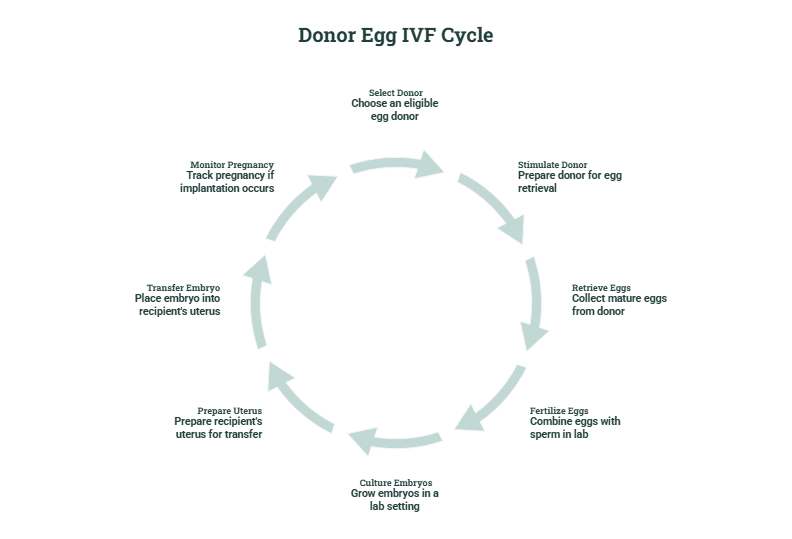
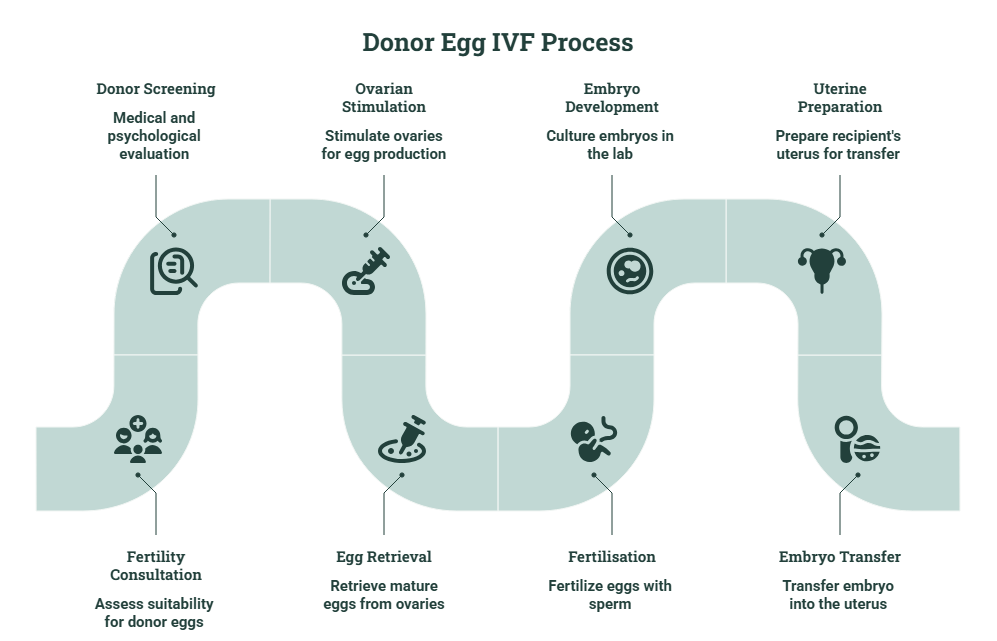
Donor egg IVF involves nine main stages. The sequence and timing depend on the individual treatment plan.
Step 1: Fertility Consultation
The specialist reviews ovarian reserve, previous IVF outcomes, medical history, sperm quality, uterine health and genetic concerns.
The clinic also assesses whether the proposed donor arrangement meets Thai requirements.
The objective is to establish whether donor eggs are appropriate rather than automatically proceeding after unsuccessful IVF.
Book Your Consultation at GFC.
Step 2: Donor Screening
An eligible donor undergoes medical and psychological assessment.
Screening may cover general health, ovarian function, infectious diseases, genetic history, suitability for stimulation and required legal consent.
Step 3: Ovarian Stimulation
The donor receives fertility medication to encourage multiple follicles to develop.
Ultrasound and, when appropriate, blood tests monitor the ovarian response.
Step 4: Egg Retrieval
Eggs are retrieved through an ultrasound-guided procedure under medical supervision.
Not every retrieved egg will be mature or suitable for fertilisation.
Step 5: Fertilisation
Suitable donated eggs are fertilised in the laboratory using conventional IVF or ICSI, depending on clinical circumstances.
Learn more about IVF and ICSI treatment, including fertilisation and embryo culture.
Step 6: Embryo Development
Embryologists monitor fertilised eggs as embryos develop.
Suitable embryos may be selected for transfer or freezing. Not every fertilised egg becomes a transferable embryo.
Read about GFC’s advanced lab technology and AI embryo assessment. Laboratory systems support embryo assessment but cannot guarantee successful development.
Step 7: Preparing the Recipient’s Uterus
The recipient’s endometrium is prepared using an appropriate hormonal or monitored natural-cycle protocol.
The doctor assesses the uterine lining before scheduling transfer.
Step 8: Embryo Transfer
An appropriate embryo is transferred into the uterus.
Additional suitable embryos may be cryopreserved.
Learn more about FET procedures and success factors, including endometrial preparation and transfer timing.
Step 9: Pregnancy Testing
A pregnancy test is performed at the recommended time.
If pregnancy occurs, early monitoring is arranged. Otherwise, the specialist reviews the treatment findings before recommending next steps.
Does Donor Egg IVF Have a Higher Success Rate?
Donor egg IVF may improve outcomes for selected patients when egg quality is a major limiting factor.
However, results depend on donor age, egg maturity, sperm quality, embryo development, uterine health and other clinical factors.
Donor eggs do not guarantee pregnancy or live birth.
How Should You Compare Success Rates?
| Measure | Meaning |
|---|---|
| Pregnancy rate | Positive pregnancy result |
| Clinical pregnancy rate | Pregnancy confirmed by specified clinical criteria |
| Implantation rate | Evidence of implantation using the reported definition |
| Live birth rate | Live births relative to a stated denominator |
| Cumulative live birth rate | Live births across a defined series of attempts |
These measures are not interchangeable.
Ask whether a clinic’s results relate to fresh or frozen embryos, donor age, pregnancy or live birth, and outcomes per transfer or treatment cycle.
The SART patient guide to assisted reproductive technology explains how treatment statistics are reported.
For additional context, read GFC’s guide to understanding IVF success rates in Thailand.
Can PGT-A Be Used With Donor Egg Embryos?
Yes. PGT-A may be considered in selected donor egg IVF cycles, but it is not automatically necessary.
PGT-A screens embryos for chromosome-number abnormalities. Its potential value depends on donor age, available embryos, treatment history and clinical circumstances.
PGT-A does not guarantee implantation or live birth.
GFC NGS Plus Pricing
GFC offers NGS Plus, combining PGT-A with polyploidy screening.
| Screening | Price |
|---|---|
| First embryo | ฿39,900 |
| Each additional embryo | ฿15,900 |
These promotional prices apply through 31 December 2026, subject to GFC’s terms.
Screening costs are separate unless specifically included in the treatment quotation.
How Much Does Donor Egg IVF Cost in Thailand?
The total cost varies according to the donor-related procedures, laboratory services, medication and treatment plan.
GFC does not publish a separate fixed donor egg IVF package price in its standard English pricing information.
Its published ICSI prices provide context but should not be mistaken for complete donor egg treatment costs.
Current GFC ICSI Package Prices
| Package | Published price |
|---|---|
| ICSI LiTE | ฿150,000 |
| ICSI Gold | ฿170,000 |
| ICSI Platinum | ฿230,000 |
| ICSI Diamond | ฿350,000 |
These are standard ICSI package prices, not guaranteed donor egg IVF totals.
Additional charges may apply for donor screening, stimulation, retrieval, medication, embryo freezing, storage, frozen embryo transfer and optional genetic testing.
Other laboratory services, including Sperm Advance, Sperm Premium and GM-CSF with Embryo Glue, may be available when clinically appropriate.
For more information, see the guide to ICSI costs and packages in Thailand.
What Should Your Quotation Include?
Ask the clinic to confirm:
- Donor screening and medical procedures
- Medication and ovarian stimulation
- Egg retrieval and fertilisation
- Embryo culture and freezing
- Storage and embryo transfer
- Optional PGT-A
- Additional laboratory charges
- Cancellation or repeat-treatment costs
A written estimate should clearly identify inclusions and exclusions.
What Should You Ask Before Choosing a Donor Egg IVF Clinic?
Before committing to treatment, ask:
- Is donor egg treatment legally available for our circumstances?
- Does the proposed donor meet Thai requirements?
- What medical and genetic screening is performed?
- Which consent documents are necessary?
- Why are donor eggs recommended instead of another IVF cycle?
- Will IVF or ICSI be used?
- Is embryo freezing or frozen transfer included?
- Is PGT-A clinically appropriate?
- What is included in the total quotation?
- How many visits to Thailand may be required?
- Can preliminary tests be completed overseas?
- What happens if no suitable embryos develop?
Use the guide on choosing an IVF clinic in Bangkok based on laboratory quality and specialist expertise to compare clinics beyond their advertised package prices.
Frequently Asked Questions
Can I carry a pregnancy using a donor egg?
Yes. An eligible recipient may carry a pregnancy created using a donated egg.
Can donor eggs be fertilised using ICSI?
Yes, when clinically appropriate.
How old can an egg donor be in Thailand?
Generally 20–35 for unrelated donors and 20–40 for qualifying blood relatives, subject to other requirements.
Can I choose any donor?
No. Medical, nationality, relationship and consent restrictions apply.
Can unmarried patients receive donor egg IVF?
Thai donor egg treatment is subject to requirements involving legally recognised spouses. Eligibility must be confirmed individually.
Can foreigners receive donor egg IVF in Thailand?
Potentially, when the proposed treatment satisfies applicable nationality, marriage, donor and medical requirements.
How much does donor egg IVF cost?
An individual quotation is required. GFC’s standard ICSI packages range from ฿150,000 to ฿350,000 but do not establish the total donor egg treatment price.
Does donor egg IVF guarantee pregnancy?
No. Outcomes depend on embryo development, uterine health, sperm factors and other circumstances.
Is PGT-A necessary with donor eggs?
Not automatically. The decision should be individualised.
Book a Consultation with GFC
Chat on LINE
Why Choose Genesis Fertility Center (GFC)?

Every fertility journey is unique, and choosing the right fertility clinic is an important step toward building your family. At Genesis Fertility Center (GFC), our experienced team of reproductive specialists provides personalized treatment plans using advanced Assisted Reproductive Technology (ART), including IVF, ICSI, Egg Freezing, Embryo Freezing, and PGT-A. We combine advanced laboratory technology with treatment protocols to deliver care tailored to your individual fertility needs.
Our fertility team of obstetricians, gynecologists, fertility specialists, and embryologists is committed to providing compassionate care, clear communication, and transparent pricing throughout every stage of your fertility journey.
To learn more or schedule a consultation, please contact Genesis Fertility Center (GFC).
Call Center: 097-484-5335
Medical Disclaimer
This article is for educational purposes only and should not replace personalised medical advice. Treatment recommendations vary depending on each individual’s medical history, fertility assessment, and reproductive goals.