Choosing a clinic for Frozen Embryo Transfer (FET) in Bangkok is different from choosing a clinic for a complete IVF cycle.
With FET, the embryo has already been created and frozen. The focus now shifts to preparing the uterus, managing the hormonal cycle, thawing the embryo correctly, and transferring it at the right time.
That means the clinic’s FET protocol, fertility specialists, embryology laboratory, and approach to endometrial preparation matter. For an overview of how frozen embryo transfer works, read the frozen embryo transfer at GFC, which explains uterine preparation, embryo thawing, and transfer timing.
FET in Bangkok, in short.
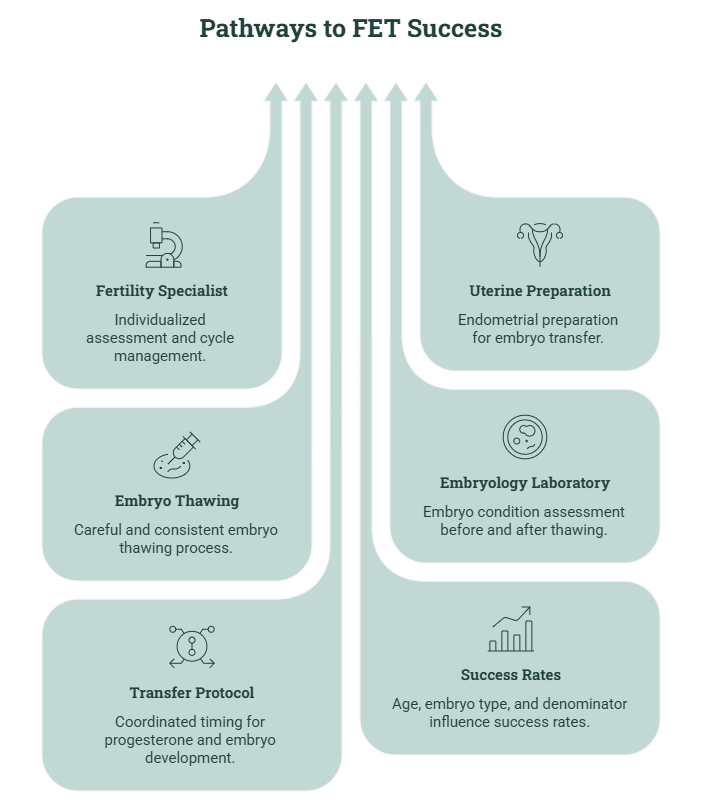
| What to Check | Why It Matters |
|---|---|
| Fertility specialist | FET requires individualized assessment and cycle management |
| Uterine preparation | The endometrium needs to be appropriately prepared before transfer |
| Embryo thawing | The laboratory must handle the frozen embryo carefully and consistently |
| Embryology laboratory | The embryo's condition before and after thawing matters |
| Transfer protocol | Timing between progesterone exposure and embryo development must be coordinated |
| Success rates | Rates should be explained by age, embryo type and denominator |
| Package inclusions | Medication, monitoring and other fees may be separate |
| Previous treatment history | Failed transfers may require a different assessment |
| International coordination | Patients travelling to Bangkok need a clear treatment timeline |
The best FET clinic is not necessarily the one advertising the highest pregnancy rate.
It is the clinic that can explain how it prepares your cycle, how it handles your embryo, and what outcome you can realistically expect.
Questions to Ask Your Fertility Clinic
1. Does the Clinic Have Fertility Specialists Who Regularly Manage FET Cycles?
Start with the doctor.
FET may involve fewer procedures than a complete IVF cycle, but that does not make the medical decisions less important.
The specialist may need to assess:
- Your previous IVF history – If your embryos were created during an earlier IVF or ICSI treatment cycle in Bangkok, the FET specialist will review the original stimulation protocol, fertilization method, and embryo quality.
- The age of the embryo
- Embryo quality
- Whether the embryo has undergone PGT-A – Learn more about PGT-A genetic testing by NGS and ask your specialist whether testing is appropriate for your circumstances.
- Uterine anatomy
- Endometrial thickness
- Previous implantation or pregnancy history
- Hormonal and medical factors
At Genesis Fertility Center (GFC), FET is managed by a team of seven fertility specialists led by Assoc. Prof. Dr. Pitak Laokirkkiat, who has more than two decades of clinical experience. GFC reports caring for more than 2,000 patients each year across its fertility services.
Experience matters.
But the more useful question is how that experience is applied to your specific FET cycle.
2. How Does the Clinic Prepare the Uterine Lining?
The uterine lining, or endometrium, needs to be prepared before a frozen embryo is transferred. The clinic may use a programmed, natural, or modified natural cycle, depending on your menstrual cycle, ovulation, medical history, and previous fertility treatment. There is no single FET protocol that is automatically best for every patient.
During preparation, the clinic monitors the uterine lining with ultrasound and may use blood tests when appropriate. In a programmed cycle, estrogen is used to develop the lining before progesterone is started. The transfer is then scheduled according to the timing of progesterone exposure and the developmental stage of the embryo.
GFC describes FET as a separate treatment cycle in which the uterine lining is prepared and monitored before the frozen embryo is transferred. Read more about why uterine-lining preparation is important for IVF success, including how lining thickness, adhesions, fibroids, and hormonal factors may affect implantation planning.
3. Does the Clinic Explain the Timing of the Embryo Transfer?
A good FET clinic will clearly explain how and when your transfer is timed, because success depends on synchronizing the embryo’s developmental stage with the endometrium’s “window of implantation.
How transfer timing is usually determined:
- Natural cycle FET – The clinic tracks your natural ovulation (by LH surge and/or ultrasound). For a day‑5/6 blastocyst, transfer is typically scheduled 5–6 days after ovulation/LH surge (some protocols use ovulation + 5 days). The data extracted in pmc.ncbi.nlm.nih
- Modified natural cycle – An hCG “trigger” shot is used to pin down ovulation timing. Transfer is then set a fixed number of days after the trigger (commonly hCG + 6–7 days for blastocysts). Data is base on academic.oup
- Programmed (medicated/HRT) cycle – There is no natural ovulation; instead, the clinic starts progesterone on a chosen “P‑day 0” once the lining is ready. Transfer is scheduled by embryo stage: day‑3 embryo → P+3, day‑5/6 blastocyst → P+5 (sometimes P+6 depending on protocol). This data extracted in pmc.ncbi.nlm.nih.gov article.
GFC’s FET process includes preparation of the uterine lining, embryo thawing and transfer, followed by a pregnancy blood test approximately 10–14 days after transfer. For additional information about the transfer procedure itself, see the guide to embryo transfer in IVF and ICSI.
4. How Does the Laboratory Handle Frozen Embryos?
The doctor’s role is only part of the process.
The embryo must first be thawed by the embryology laboratory.
Ask:
- What vitrification method was used?
- How are embryos stored?
- Who performs the thawing?
- How is embryo survival assessed after thawing?
- What happens if an embryo does not survive the thaw?
- Are embryos individually identified and tracked?
GFC uses vitrification for embryo freezing and describes its embryology laboratory as supporting embryo thawing using established laboratory protocols.
This is particularly important if your embryos were created and frozen at another clinic.
In that situation, ask whether the Bangkok clinic can accept embryos from the original laboratory and what documentation or transport arrangements are required.
Do not assume every clinic will accept every embryo shipment.
Confirm it first.
5. Does the Clinic Have an In-House Embryology Laboratory?
For FET, laboratory quality deserves serious attention.
The embryo has already gone through fertilization and development. By the time it reaches the FET stage, there is already significant value in that frozen embryo.
The laboratory needs to manage:
- Frozen embryo storage
- Identification and tracking
- Thawing
- Embryo assessment
- Transfer preparation
- Communication between the embryologist and fertility specialist
At Genesis Fertility Center, the on-site embryology laboratory supports FET alongside other assisted reproductive technologies, including AI-assisted embryo assessment through iDAScore, MACS sperm selection, PGT-A and vitrification.
6. How Does the Clinic Report Its FET Success Rates?
Be careful with headline numbers.
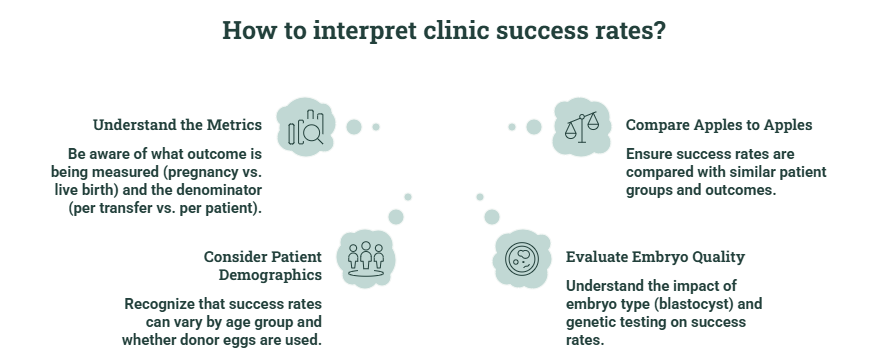
A clinic might advertise a “70% success rate,” but that number is difficult to interpret without knowing:
- What outcome is being measured?
- Is it pregnancy or live birth?
- Is it per transfer?
- Which age group does it represent?
- Are the embryos genetically tested?
- Are the embryos blastocysts?
- Are donor eggs involved?
- How many patients were included?
These factors can significantly change the number. Before choosing a provider, use this guide on how to choose an IVF clinic in Bangkok to evaluate specialist experience, laboratory standards, success-rate definitions, package inclusions, and international-patient support.
Genesis Fertility Center reports an ICSI success rate of 60–65% per embryo transfer, increasing to 70–75% when PGT-A is used in appropriate cases. These figures should not be treated as a guaranteed FET outcome for an individual patient. For context on how GFC presents and explains its reported outcomes, read the clinic’s guide to IVF success rates in Thailand. Success figures should be compared only when the patient group, embryo type, outcome definition, and denominator are similar.
That distinction matters.
An ICSI or IVF success figure is not automatically the same thing as a patient’s expected live birth rate following FET.
Related Services at GFC
- Fertility Consultation for Both Partners: assess fertility in both partners and plan treatment
- Egg Freezing: preserve healthy eggs for future pregnancy through vitrification and secure storage
- IVF/ICSI: an overview of the steps, timeline and costs
Available at 3 branches: GFC Rama 9 · GFC Rama 3 · GFC Ubon Ratchathani, or book online.
7. Does the Clinic Explain What Can Affect FET Success?
The quality of the embryo is important.
But it is not the only factor.
FET outcomes can also be affected by:
- Age at the time the eggs were retrieved
- Embryo quality
- Whether the embryo is euploid after PGT-A
- Endometrial preparation
- Uterine abnormalities
- Timing of progesterone exposure
- Previous implantation history
- Sperm factors involved in embryo creation
- Underlying medical conditions
This is why a clinic should not promise a particular outcome based only on the fact that you have a frozen embryo.
A good embryo still needs an appropriate environment for implantation.
And a well-prepared uterus cannot compensate for every embryo-related factor.
The clinic should consider both.
8. What Does the FET Package Actually Include?
Do not compare clinics using the advertised FET price alone.
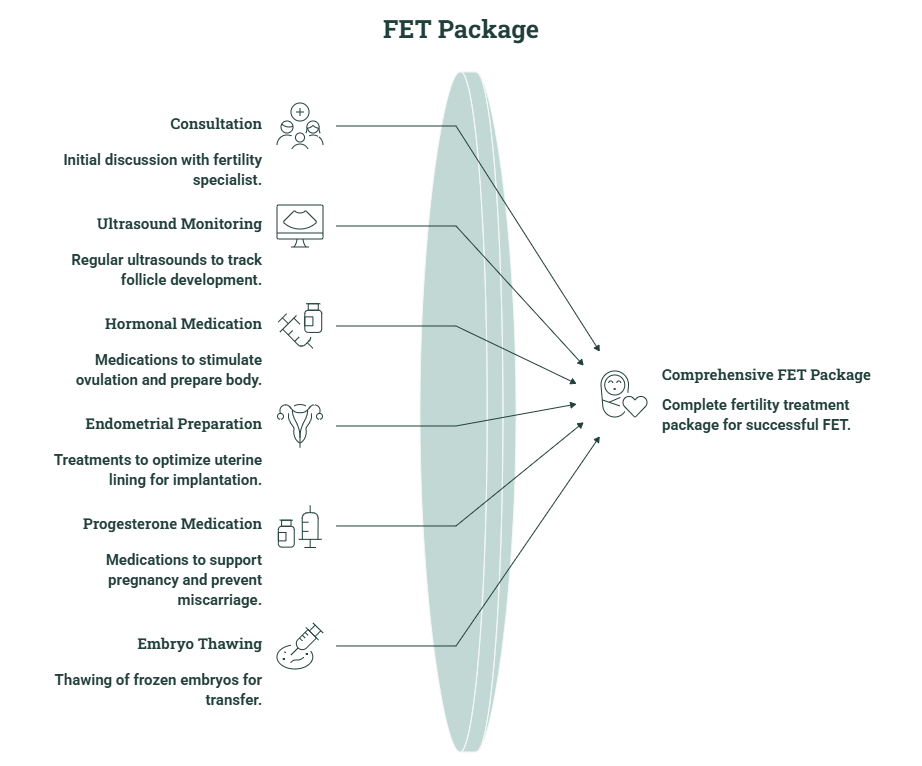
Ask whether the package includes:
- Consultation
- Ultrasound monitoring
- Hormonal medication
- Endometrial preparation
- Progesterone medication
- Embryo thawing
- Embryo transfer
- Laboratory fees
- Pregnancy testing
- Follow-up consultation
- Additional medication if the cycle needs adjustment
Some clinics may separate medication and monitoring from the transfer fee.
Others may offer a package.
The important thing is to compare like with like.
A cheaper FET package is not necessarily cheaper if several essential services are excluded. Review GFC’s current ICSI packages and pricing for package tiers, eligibility criteria, medication limits, and additional services.
9. Can the Clinic Handle Previous Failed Transfers?
This question matters if you have already undergone FET or embryo transfer without achieving pregnancy.
Do not assume that repeating the same protocol is automatically the best option.
Ask the specialist to review:
- Previous transfer records
- Embryo quality
- Endometrial preparation
- Hormonal timing
- Uterine assessment
- Previous pregnancy history
- Any relevant medical factors
The goal is not to order every available test. Patients who are unsure which treatment or testing is appropriate can begin with fertility counseling and treatment planning. A consultation can help review age, ovarian reserve, treatment history, and personal fertility goals.
It is to identify whether there is a reasonable explanation for the previous outcome and whether another approach is justified.
Be cautious of clinics that immediately recommend a long list of expensive add-ons without explaining why each one is relevant.
More testing does not automatically mean better treatment.
10. Can the Clinic Coordinate FET for International Patients?
Bangkok attracts international fertility patients, but travelling for FET requires planning. PlacidWay notes that FET generally requires a shorter stay than a complete IVF cycle and that some patients may complete part of their uterine preparation in their home country before travelling to Bangkok.
The treatment may involve appointments before the transfer, ultrasound monitoring, medication and a specific transfer date.
Ask:
- Can some monitoring be completed in your home country?
- Which records should be sent before travelling?
- When should you arrive in Bangkok?
- How long should you expect to stay?
- Can medication be started before arrival?
- What happens if your lining is not ready?
- Can the clinic communicate with your local fertility doctor?
FET generally requires a shorter stay than a complete IVF cycle and that some patients may complete part of their uterine preparation in their home country before travelling to Bangkok.
The exact timeline should still be determined by your fertility specialist.
For international patients, coordination is part of the treatment experience. International patients can review the guide to IVF in Thailand for foreigners before arranging travel, testing, and follow-up.
11. What Happens If the Embryo Does Not Survive Thawing?
This is an uncomfortable question.
It is also worth asking before treatment.
Embryo vitrification has made frozen embryo storage highly reliable, but no laboratory process should be described as a guarantee.
A transparent clinic should be able to explain its process without avoiding the question.
Frequently Asked Questions
Which FET protocol is appropriate for me?
This helps explain how your cycle will be prepared (natural, modified natural, or hormone‑replacement), and which approach best fits your menstrual pattern and medical history.
How will my uterine lining be monitored?
Endometrial preparation is central to FET; clinics typically use serial ultrasounds and blood tests to time transfer when the lining is optimal.
When will the embryo be transferred?
Timing must match embryo development stage (day‑5 vs day‑6) and the duration of hormonal exposure (progesterone days) to maximize implantation chances.
Who will manage my cycle?
This confirms which doctor is responsible for your treatment decisions, monitoring schedule, and any protocol changes during the cycle.
How are embryos thawed?
Thawing is a critical laboratory step; clinics should explain their vitrification/warming methods and share thaw‑survival rates.
What is your FET success rate and how is it measured?
Asking for age‑specific live‑birth or clinical‑pregnancy rates per transfer prevents misleading comparisons based on “overall” averages.
What does the FET package include?
A clear breakdown (medications, monitoring scans, thawing, transfer, anesthesia, storage) helps you identify the true treatment cost and avoid surprise fees.
What happens if my lining is not ready?
This is important for treatment planning; clinics may adjust medications, delay transfer, or recommend additional tests before proceeding.
What happens if an embryo does not survive thawing?
This clarifies the clinic’s laboratory protocol, including whether another embryo will be used, how costs are handled, and what options you have next.
Can I complete monitoring in my home country?
Many international patients do part of their monitoring locally; clinics should explain which tests can be done remotely and how results are shared.
Why Choose Genesis Fertility Center (GFC)?

Every fertility journey is unique, and choosing the right fertility clinic is an important step toward building your family. At Genesis Fertility Center (GFC), our experienced team of reproductive specialists provides personalized treatment plans using advanced Assisted Reproductive Technology (ART), including IVF, ICSI, Egg Freezing, Embryo Freezing, and PGT-A genetic testing by NGS. We combine advanced laboratory technology with treatment protocols to deliver care tailored to your individual fertility needs.
Our fertility team of obstetricians, gynecologists, fertility specialists, and embryologists is committed to providing compassionate care, clear communication, and transparent pricing throughout every stage of your fertility journey.
To learn more or schedule a consultation, please contact Genesis Fertility Center (GFC).
Call Center: 097-484-5335
Medical Disclaimer
This article is for general information and does not replace a personal medical consultation. Individual results vary; your fertility specialist will advise on what is appropriate for your situation.